

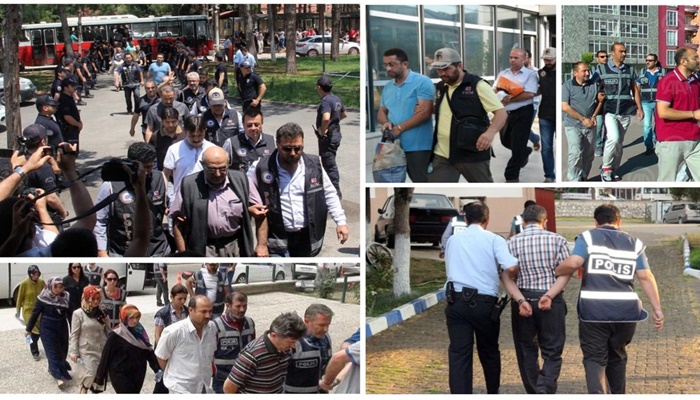

Nearly 99 percent of civil servants dismissed by emergency decrees after a coup attempt in Turkey in 2016 say they were denied the right to a fair trial, according to a survey reported by the TR724 news website and conducted by MAK Consulting, a polling company widely viewed as being close to the government.
The survey, carried out November 15–20, 2025, on 6,500 people who identified themselves as purge victims or immediate relatives, found that 98.8 percent said they had no access to a defense or fair-trial rights.
Ninety-nine percent said the State of Emergency Inquiry Commission, created to review appeals, failed to carry out its mandate. The findings reflect only the views of those who consider themselves directly affected by the decrees, not the broader public.
The purge mostly targeted alleged followers of Fethullah Gülen, an Islamic scholar who lived in exile in the United States until his death in October 2024. The Turkish government accuses the Gülen movement of orchestrating the failed coup on July 15, 2016, a charge the movement strongly denies.
The Gülen movement is renowned worldwide for its contributions to education, social welfare and interfaith dialogue.
The Turkish government, however, labeled the group as a “terrorist organization” in May 2016, before the coup attempt took place, a designation not recognized by other governments and major international bodies, including the United States and the European Union.
The movement’s followers, also known as Hizmet (Service) supporters, say they have been unfairly targeted in a campaign of political persecution aimed at silencing dissent and consolidating power. The post-coup purge has seen hundreds of thousands investigated and tens of thousands imprisoned on terrorism-related charges widely viewed as politically motivated.
Citing national security concerns, the government declared a state of emergency and removed more than 130,000 civil servants, including 4,156 judges and prosecutors, from their jobs by decrees after the coup, as well as 24,000 members of the armed forces. The decisions were made without judicial review and often relied on criteria such as using a messaging app, having an account at a Gülen-linked bank or membership in certain trade unions. The state of emergency lasted until July 2018 after seven extensions.
Rights groups, including Amnesty International and Human Rights Watch, have long argued that the decrees lacked individualized evidence and violated basic standards of due process.
A study titled “Perspectives of Those Who Declare Themselves Victims of Emergency Decrees” used a hybrid method combining the survey data with face-to-face interviews conducted with about 1 percent of participants. Researchers said the findings reflect personal perceptions rather than legal assessments.
A large majority expressed mistrust in the process. A total of 91.4 percent said the decrees were unnecessary, while 88.7 percent believed innocent people were dismissed along with those accused of ties to the coup. Nearly 67 percent said their dismissals were based on false accusations or personal vendettas rather than evidence. The survey also found that many participants believed the decrees violated the legal principle of individual criminal responsibility, a concern echoed in reports by international observers.
MAK Consulting Chairman Mehmet Ali Kulat said the plight of purge victims is among Turkey’s most urgent national issues. “This is a problem we must solve. It has grown so large that it is now beyond politics,” he wrote on X, calling for broad legal reforms.
Respondents reported extensive social and economic harm. Fully 91.8 percent said their children faced discrimination at school or work, while 81.7 percent said they were ostracized by friends or neighbors. Two-thirds said they needed psychological support.
Dismissed public servants were not only removed from their jobs but also banned from returning to the public sector and faced strict passport restrictions. A total of 87.2 percent said they experienced discrimination in the private sector, while 98.2 percent said employment bans amounted to a violation of basic rights. Many described these measures as a form of “civil death,” a term used by legal scholars to describe long-term social exclusion.
Nearly all respondents — 99.1 percent — rejected the government’s national security justification for the purges, saying their return to work would pose no threat. The same share said the decrees damaged Turkey’s global credibility on democracy and the rule of law. Turkish officials have repeatedly defended the decrees as necessary to protect state institutions from infiltration.
When asked about solutions, 92.9 percent supported a new law or amnesty and said reinstatement should include both returning to work and full legal exoneration. A total of 79.3 percent said reinstatement should come through court rulings rather than political decisions.
Only 21.2 percent believed the issue could be resolved within three years, and just 38.2 percent expected a future government to prioritize purge victims after the next election.