

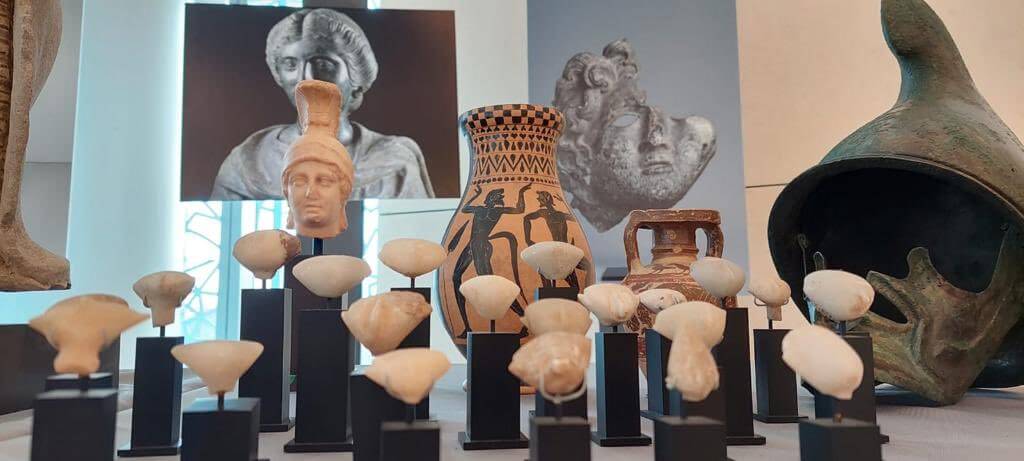

Turkey has recovered 110 cultural artifacts so far this year, raising the number of antiquities repatriated since 1980 to 26,761, according to data published by the Turkish Ministry of Culture and Tourism.
Turkey has facilitated 169 recoveries in 19 countries over the past 45 years to track objects removed illegally from the country. Germany has returned the largest number with 8,670 artifacts, followed by Croatia with 4,147, Britain with 3,748, Bulgaria with 3,061, the United States with 2,701 and Serbia with 1,865.
The anti-smuggling department, which operates under the General Directorate of Cultural Assets and Museums, coordinates the repatriation work through cooperation with foreign authorities, provenance research and monitoring of international auction houses where smuggled items often appear.
According to the ministry figures, 13,412 artifacts were returned between 2002 and 2025, underscoring the scale of recent efforts. The latest returns follow a strong year in 2024, when 1,149 objects were brought back to Turkey.
Among the 2025 recoveries is a 16th century hexagonal İznik tile stolen from Adana’s Ulu Mosque in 2003. It was located at an auction house in Britain and transferred to the Ankara Ethnography Museum.
The United States returned a bronze statue of Roman Emperor Marcus Aurelius, identified at the Cleveland Museum of Art and traced to the ancient city of Boubon in Burdur province. Washington also handed over 83 Roman coins minted during the reigns of Maximianus, Constantine I, Constantine II and Arcadius.
A 757-year-old manuscript titled “Kitab Sharh al-Asma,” stolen from the Yusuf Ağa Manuscript Library in Konya in 2000, was donated to Turkey by Nizam Muhammad Salih Yaqubi, head of the Sharia Supervisory Board at Bahrain’s International Investment Bank.
A Canadian citizen returned Anatolian pottery inherited from a family member, including a jug, two oil lamps, two terracotta vessels and an armlet. The items were sent to the Museum of Anatolian Civilizations in Ankara.
Bronze Age votive figurines with gilded faces and belts, gold earrings and early medieval glass oil vessels recovered from Switzerland are now on display at the Bodrum Museum of Underwater Archaeology.