

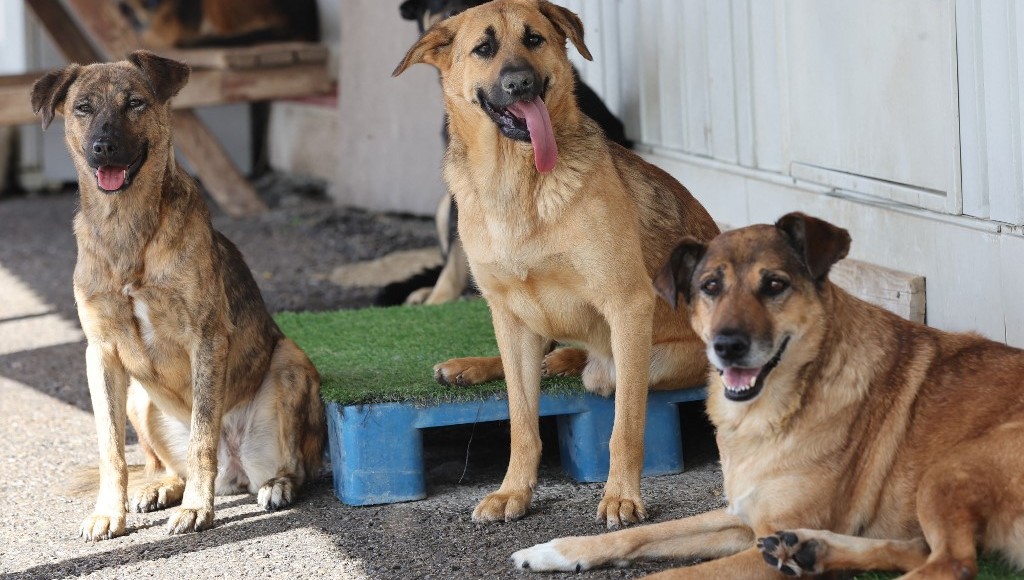

The İstanbul Governor’s Office has issued a new circular prohibiting what it describes as “uncontrolled feeding” of stray dogs in public spaces, citing public health risks amid an ongoing controversy over Turkey’s treatment of street animals, Deutsche Welle Turkish service reported on Monday.
The directive, published Monday, refers to decisions of the Provincial Animal Protection Board taken on July 2 and instructs local administrations to enforce restrictions aimed at reducing public health risks and environmental damage.
The circular says unregulated feeding has contributed to rising insect and rodent populations as well as disturbances to the “ecological balance,” requiring tighter controls across the city where stray animals are a part of daily life.
Municipalities were told to block feeding points in locations such as health and education institutions, airports, places of worship, parks, gardens, roadside areas and children’s playgrounds.
District officials were warned to monitor compliance closely and ensure “no disruption” in implementation. The circular also notes that any loss of life or property caused by stray animals will be evaluated as municipal negligence under relevant legislation.
The governor’s office additionally reminded municipalities of their responsibility to accelerate the collection, sterilization and transfer of stray dogs to shelters or designated “natural living areas,” reiterating obligations already outlined under national law.
İstanbul Governor Davut Gül had signalled a harder line earlier this month, saying, “Cats in İstanbul are not catching mice. Mice are eating food together with cats. This is not healthy. People should not feed [animals] in the first place they see.”
Animal rights advocates sharply criticized the new feeding restrictions. The Animal, Life, Freedom Initiative called for “civil disobedience,” pledging to continue feeding stray animals despite the ban.
“We call on all of society: Do not recognize these bans. Strengthen solidarity with animals living on the streets by placing a bowl of food and water in front of your home every day,” DW quoted the group as saying in a statement.
Another organization, Four-Legged City, called the decision “extremely problematic in terms of the principles of animal welfare,” arguing that restricting access to food and water violates stray animals’ fundamental “right to life.”
“Regardless of the bans, we stand with our companions under all conditions,” the group said on X.
İstanbul Valiliği’nin sokak köpeklerine ilişkin yayımladığı genelgede yer alan “kontrolsüz beslemenin engellenmesi” kararı, hayvan refahı ilkeleri açısından son derece sakıncalıdır. Tüm yasaklara karşı, her koşulda can yoldaşlarımızın yanındayız.
Sokakta yaşayan hayvanların… pic.twitter.com/wMek2XTo6y
— dört ayaklı şehir (@dortayaklisehir) November 24, 2025
The latest circular comes as municipalities continue grappling with the implementation of a sweeping amendment to Turkey’s Animal Protection Law that passed in August 2024 with support from the ruling Justice and Development Party (AKP) and its far-right ally, the Nationalist Movement Party (MHP).
The legislation, known as Law No. 7527, requires municipalities to capture stray dogs and put them in shelters. Dogs deemed dangerous, terminally ill or unfit for adoption may be euthanized under provisions of the Veterinary Services Law.
Although lawmakers removed explicit references to euthanasia in the final version following a public outcry, critics argued the legislation still enabled mass killings. Animal rights groups and the main opposition Republican People’s Party (CHP) condemned the bill as a “massacre law,” warning that it violated international norms on animal welfare and failed to address long-standing issues such as inadequate sterilization programs and poor shelter conditions.
Protests broke out in major cities as activists and opposition lawmakers staged demonstrations outside the Constitutional Court and parliament. CHP-led municipalities, including İstanbul, pledged resistance to what they viewed as an unconstitutional mandate. The party filed an application with the Constitutional Court in August 2024 seeking the annulment of key provisions, but the court rejected the appeal in May, allowing the law to stand.
President Recep Tayyip Erdoğan has defended the law, citing public safety and claiming that Turkey faces a unique stray animal crisis. “People want safe streets,” he said. The government has warned that local officials who refuse to implement the law could face legal action, even jail time.
Despite revisions to soften its language, critics say the law fails to address the root causes of the stray dog population, such as inadequate sterilization programs and poor shelter conditions. Many warn that adoption alone cannot handle the scale of the problem, given that Turkey is estimated to have nearly 4 million stray dogs.