

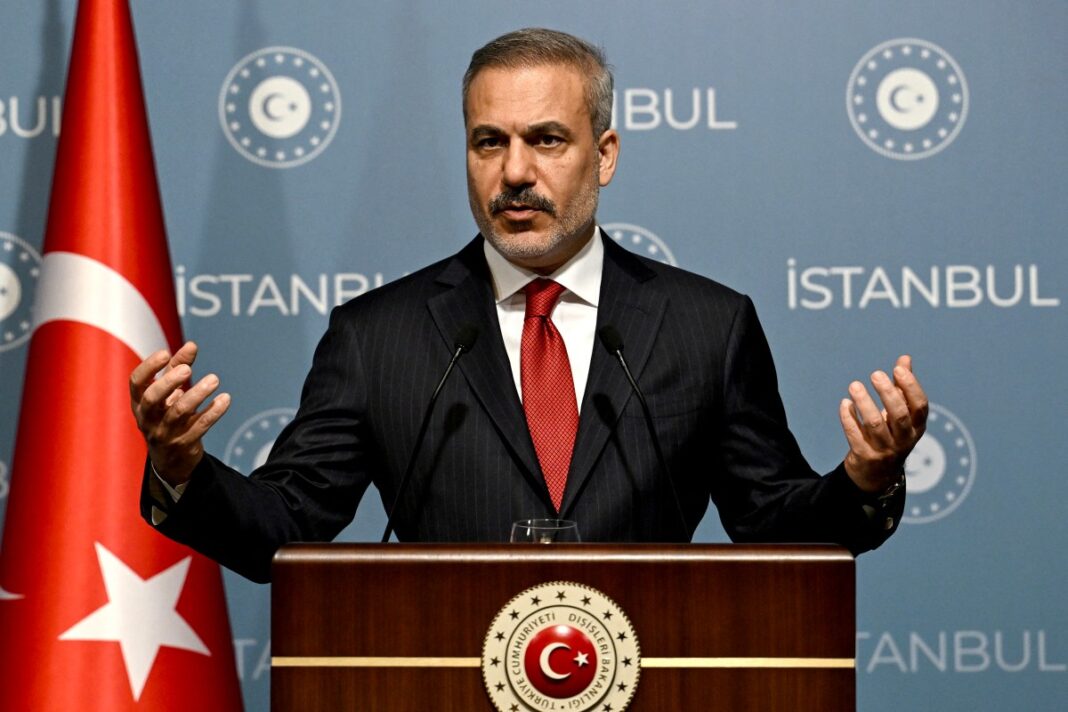

Countries are still working on a United Nations Security Council mandate for an international stabilization force in the Gaza Strip and will only decide whether to send troops after they see the final terms of the mission, Turkish Foreign Minister Hakan Fidan said at a conference in İstanbul on Monday.
Fidan was speaking after hosting foreign ministers and senior officials from Qatar, Saudi Arabia, the United Arab Emirates, Jordan, Pakistan and Indonesia to discuss the future of Gaza and the three-week-old ceasefire between Israel and Hamas, according to the Turkish Foreign Ministry.
Gaza is a densely populated Palestinian territory on the Mediterranean coast that has been the target of a two-year Israeli military assault which began after a major Hamas attack, and the United Nations Security Council is the UN’s main decision-making body that can authorize international forces and legally binding measures.
Fidan said the countries involved are trying to give a clear definition and international legitimacy to a proposed stabilization force through a Security Council resolution and that each government will decide on troop deployment “depending on the wording” of that text.
He said their guiding principle is that “Palestinians should govern the Palestinians and ensure their own security” while the international community provides support “diplomatically, institutionally and economically.”
The idea of an international force is part of a United States-backed plan for Gaza under President Donald Trump that underpins the current ceasefire and calls for a phased Israeli withdrawal and steps toward demilitarizing Hamas.
Fidan said there were problems in fully implementing the ceasefire because Israel was regularly violating it and because humanitarian aid entering Gaza was not sufficient.
Under Trump’s plan the stabilization force would help secure Gaza during a transition period and work with vetted Palestinian police units, but the United States wants most troops to come from Muslim-majority countries that can work with both Israel and Palestinian authorities.
Turkey has said it would like to join any force that monitors the ceasefire or helps stabilize Gaza, but Israel has said it will not accept Turkish soldiers in the territory, with Israeli Foreign Minister Gideon Sa’ar saying at a news conference in Budapest that “it is not reasonable for us to let their armed forces enter the Gaza Strip, and we will not agree to that.”
Seven Arab and Muslim countries, including those in İstanbul on Monday, had also met with Trump in New York around the time of the United Nations General Assembly in September to discuss his Gaza plan.
The İstanbul talks focused not only on the proposed force and political future of Gaza but also on humanitarian aid, as UN agencies say almost the entire population of the enclave has been displaced and that water, food, shelter and medical care remain at emergency levels after the two-year assault.
Diplomats told The Guardian and other outlets that a draft Security Council resolution setting out the mandate of the stabilization force could be ready in about two weeks but that key questions remain over which countries will contribute troops, how the force will coordinate with Palestinian civil police and when Israeli forces will leave Gaza.