


Adem Yavuz Arslan*
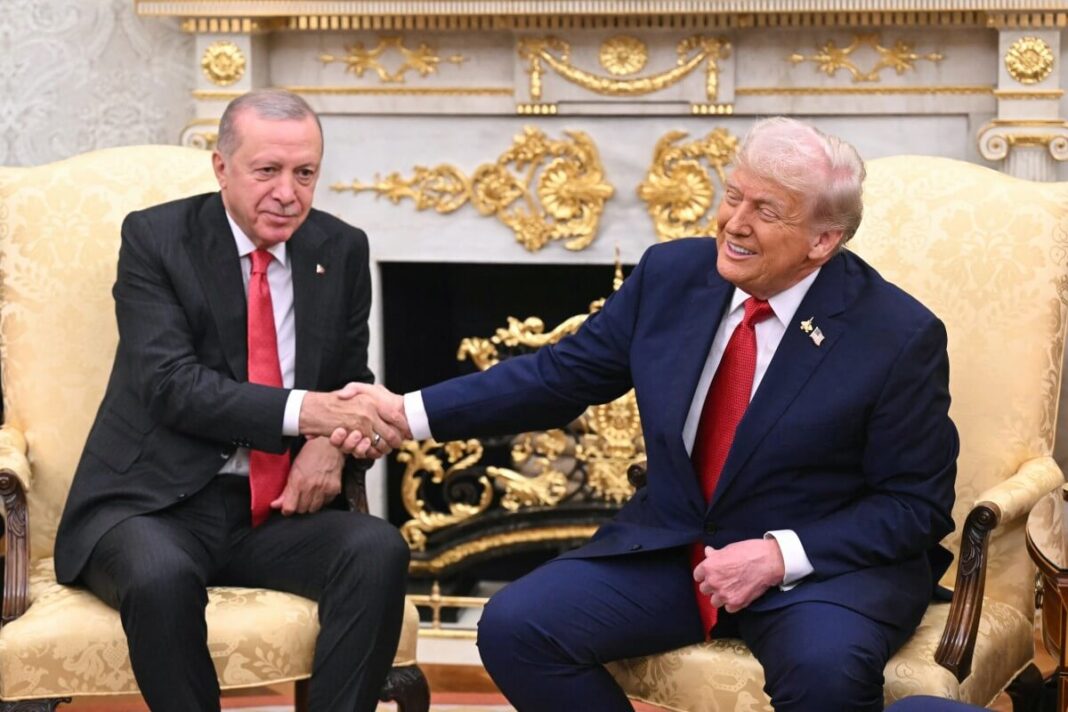
President Recep Tayyip Erdoğan’s long-awaited White House meeting finally took place this week. In Turkey the pro-government media, which dominates the media landscape in Turkey, quickly declared the trip a “historic success,” portraying it as proof of Ankara’s renewed global influence. Yet the reality looked far less triumphant. The visit exposed Turkey’s deepening isolation, Washington’s enduring distrust and the high diplomatic and economic costs of Erdoğan’s foreign policy.
Trump’s barbed remarks
Even the optics of the Oval Office were uneasy. President Donald Trump quipped to Erdoğa that he knows about “rigged elections better than anybody.” The remark, half in jest, revealed skepticism about Turkey’s democratic record and election security. Trump also recalled the 2018 imprisonment of Pastor Andrew Brunson, a crisis that prompted US sanctions and sent the Turkish lira into free fall and thanked Erdoğan for freeing him. The reminder was clear: As long as Ankara continues to erode the rule of law, its leverage in Washington will remain fragile.
Fighter jets and the S-400 shadow
Defense issues dominated the talks. Turkey’s bid to secure F-16 fighter jets remains stalled in Congress, where both parties distrust Ankara. The deeper rupture, Turkey’s expulsion from the F-35 Joint Strike Fighter program after its purchase of Russian S-400 air defense systems remains unresolved. Washington again signaled that readmission to the program is impossible unless Ankara shifts course. The standoff illustrates Turkey’s weakened standing inside NATO and the enduring consequences of a policy that put Moscow above alliance unity.
Boeing deal: a heavy lift
Among the most-striking announcements was Turkey’s pledge to buy a large number of Boeing passenger aircraft. The pro-government media outlets in Ankara cast it as a leap forward, but aviation experts called it financially unrealistic. With Turkish airlines already drowning in debt, financing such a massive order will be extraordinarily difficult. The deal provided Boeing with a badly needed boost after recent setbacks yet offered Ankara little beyond the optics of loyalty to Washington.
A costly 20-year gas pact
Energy was another focal point. Erdoğan’s government signed a 20-year liquefied natural gas (LNG) supply agreement with Mercuria Energy Group Ltd. to buy US LNG, presented as diversification from Russian energy. In reality, the deal risks locking Turkey into expensive obligations. Rather than reducing dependence, Ankara has now tied itself simultaneously to Moscow and Washington, narrowing its room to maneuver in future crises.
Gaza: silence in Washington
Perhaps most striking was what was not discussed. At home, Erdoğan presents himself as a fierce defender of the Palestinian cause, often denouncing US policy in Gaza. Yet in Washington, the topic was absent. The silence confirmed what many observers suspect: that Erdoğan’s fiery rhetoric is meant for domestic audiences, while in international settings he avoids clashes with Washington. The gap between populist posturing and cautious diplomacy was stark.
The economic memoranda announced after the meeting consisted largely of recycled promises and vague pledges. No new US investment was announced, no trade barriers lifted and no meaningful relief offered for Turkey’s faltering economy.
A photo opportunity with heavy costs
Erdoğan left Washington with little more than Oval Office images to display back home, powerful material for a controlled media environment where appearances matter as much as substance. But the costs were real: a massive Boeing order that strains the national carrier, a long-term gas deal that reduces flexibility, unresolved disputes over F-35s and F-16s and an entrenched perception of democratic backsliding.
Far from breaking Turkey’s isolation, the visit strengthened it. What Ankara sold domestically as a diplomatic triumph was, in truth, an expensive spectacle that deepened its vulnerabilities abroad.
*Adem Yavuz Arslan is a journalist with over two decades of experience in political reporting, investigative journalism and international conflict coverage. His work has focused on Turkey’s political landscape, including detailed reporting on the 2016 coup attempt and its aftermath, as well as broader issues related to media freedom and human rights. He has reported from conflict zones such as Bosnia, Kosovo and Iraq, and has conducted in-depth research on high-profile cases, including the assassination of Turkish-Armenian journalist Hrant Dink. Arslan is the author of four books and has received journalism awards for his investigative work. Currently living in exile in Washington, D.C., he continues his journalism through digital media platforms, including his YouTube channel, Turkish Minute, TR724 and X.
Disclaimer: The views expressed in this opinion piece are those of the author and do not necessarily reflect the editorial stance of Turkish Minute.