

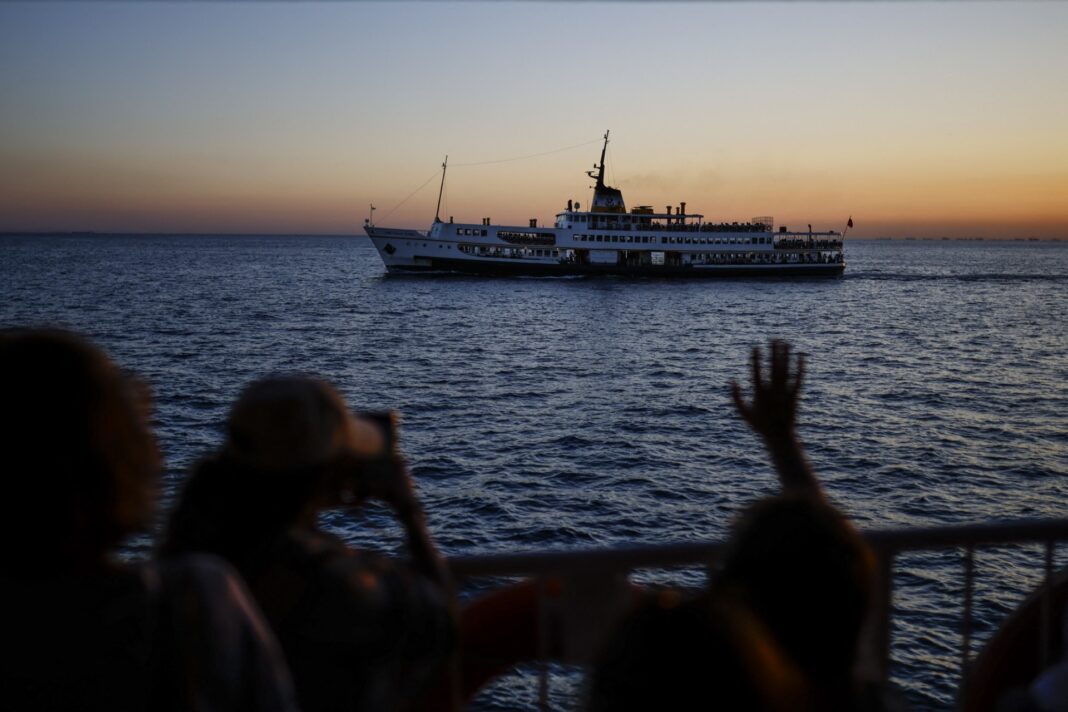

For nearly two centuries, the white ferries gliding across the Bosporus Strait have connected countless passengers traveling between İstanbul’s European and Asian shores.
Despite competition from bridges, tunnels and an undersea metro line, the ferries remain popular. The main operator, Şehir Hatları, carries at least 40 million passengers each year.
“Any view of İstanbul must include Maiden’s Tower, a ferry and a seagull,” said Adil Bali, a historian of İstanbul’s ferries. “It is one of the few cities in the world that can be crossed by sea, so the ferries are indispensable.”
Their arrival in 1843 transformed fishing villages along the Bosporus into holiday destinations, where Ottoman elites built wooden palaces overlooking the water. Until the first Bosporus Bridge opened in 1973, ferries were the only way to cross between Asia and Europe. Even today, many residents see the trip as part of the city’s charm.
‘A unique beauty’
At the helm of the Paşabahçe, the flagship of Şehir Hatları’s 30 vessels, Captain Ekrem Özçelik said the waters had become increasingly crowded.
“There’s a lot more traffic on the water,” he said of the tankers, container ships and cargo vessels that pass through the strait linking the Black Sea to the Aegean.
The Bosporus is one of the world’s busiest waterways, with 41,300 ships passing through in 2024 — an average of 113 per day.
“Navigating the waters of İstanbul requires experience,” Özçelik said of the strait’s powerful currents, which can whip up three-meter waves during strong southwesterly winds.
Born into a family of sailors and fishermen, Özçelik said his boyhood dream was to don the white cap of a captain. Now 52, he said he enjoys both the freedom of sailing and the prestige of his profession.
“Being a captain in the heart of İstanbul is a source of great pride.”
That pride is even greater aboard the Paşabahçe, which narrowly avoided decommissioning before a two-year restoration returned it to service in 2022 on its 70th birthday.
“It’s harder to maneuver than the others. It’s heavier, and turning corners is complicated,” said first officer Semih Aksoy, 36. But he added he wouldn’t trade the ferry, with its wooden tables and faded luxury. “This ship has a unique beauty, a special feel to it.”
Jet skis and nets
The Paşabahçe’s nine-man crew mainly sails the 20-minute route between Kadıköy on the Asian side and Beşiktaş on the European side. Even the short crossing has hazards.
“This summer, people were jumping into the water from Maiden’s Tower for hours. And then there are the fishing nets,” said sailor Burak Temiz, 24. He added that the ferry’s bow had even been grazed by jet skis.
Most ferries operate with a six-man crew, supported by dozens of dock staff across the city’s 53 ports, many of whom are known to regular passengers.
For İbrahim Bayus, a 62-year-old engineer born on Büyükada, the ferries carry a sense of familiarity. “As a boy, I often forgot to bring money but the captain knew me,” he said.
The service only stops for snow, fog or violent storms. Özçelik recalled a time when three students from Büyükada begged him for help after traffic was suspended.
“They told me if they couldn’t take their exams, they would fail the year. So I took them to Kadıköy. And they all passed,” he said with a smile. “They still come to visit me.”