


Adem Yavuz Arslan*
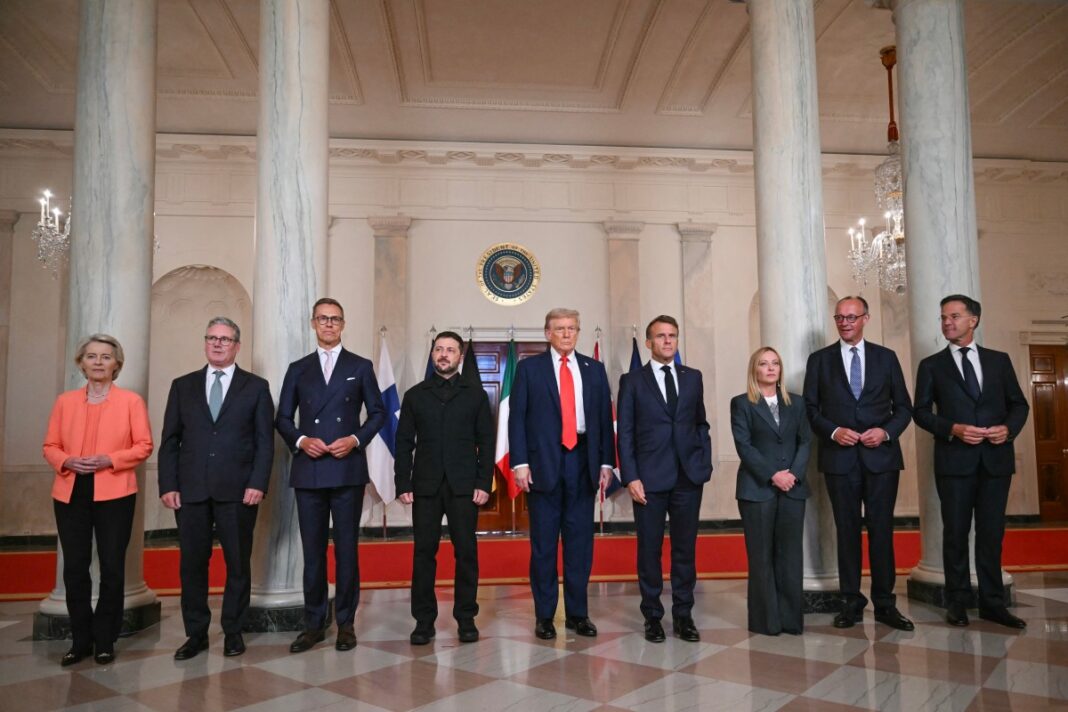
The Washington summit that included Donald Trump, Ukrainian President Volodymyr Zelensky and senior European Union leaders marked a significant moment in transatlantic diplomacy. While its central focus was the future of Ukraine and Europe’s security architecture, the implications extend well beyond Kyiv and Brussels. For Turkey, and President Recep Tayyip Erdoğan in particular, the meeting’s outcomes underscore a narrowing set of options and diminishing influence in the broader geopolitical arena.
For over a decade, Ankara has pursued a balancing strategy. It sought to maintain relations with both Moscow and the West. Turkey purchased Russian S-400 missile systems in 2017, with deliveries beginning in 2019. At the same time it also developed defense ties with Ukraine, supplying Bayraktar drones under a 2019 deal that later expanded as the war intensified. It obstructed NATO decision-making while demanding concessions from Brussels. It sustained transactional ties with Washington irrespective of the administration in power. This approach was predicated on two assumptions. One was persistent divisions within the West. The other was the notion that Turkey remains too strategically indispensable to be sidelined.
The Washington summit, however, suggested a shift. Trump, who had once cast doubt on NATO’s durability and signaled openness to accommodation with Vladimir Putin, appeared alongside Zelensky in support of a more unified Western posture. EU leaders, increasingly alarmed by Russian assertiveness and encouraged by American engagement, demonstrated uncommon cohesion. For Erdoğan, this represents a strategic setback. A more consolidated transatlantic position narrows the space for Turkey’s balancing maneuvers.
Ankara’s reduced role
For months Erdoğan has promoted the idea that Turkey could serve as a mediator in the Ukraine conflict. State-aligned media in Turkey has amplified this narrative. Yet the reality from Washington was clear. The international system does not view Ankara as a credible broker. A NATO member perceived as inconsistent, running parallel channels with Moscow and frequently obstructing alliance decisions is unlikely to be entrusted with critical negotiations. Instead, the locus of diplomacy remains Washington and Brussels, not Ankara.
Strategic risks for Turkey
Several risks now confront Turkey.
In the Black Sea enhanced Western security guarantees for Ukraine will tighten the pressure on Russia, leaving Ankara with less room to maneuver under the Montreux Convention.
Within NATO Trump’s ambivalence toward the alliance may trigger new debates about its role. Unless Ankara clarifies its strategic alignment, it risks being further marginalized as an unreliable partner.
At the same time Erdoğan’s domestic narrative of global leadership through mediation, useful for political consumption at home, was effectively undermined by the summit’s outcomes.
What Turkey could do
To avoid deeper isolation Ankara has a number of options. It could reaffirm its commitments to NATO by easing obstructionist behavior and cooperating more transparently on security issues, a move that would help restore trust among allies.
Reducing exposure to Russian energy, finance and defense would also strengthen its credibility in Western capitals, even though diversification would come at a cost.
Another path would be to reinvest in relations with the European Union. Even modest steps on the rule of law, democratic governance and migration cooperation could reopen channels with Brussels at a moment of heightened geopolitical cohesion.
Finally, easing authoritarian practices at home and addressing human rights concerns would improve Turkey’s standing abroad while also giving Erdoğan greater legitimacy domestically.
Empty rhetoric for empty stands
American media described the summit as a “hopeful but chaotic step.” Trump set the agenda with his trademark “diplomacy.” Zelensky sought to strengthen his hand. Europe, despite Trump, tried to act with unity.
Turkey, however, was left watching from the stands. Erdoğan continues to proclaim at home that “the world is bigger than five.” Yet abroad he is increasingly seen as a marginal figure. As Washington convenes the peace table, Ankara’s name is not even mentioned.
In the end Erdoğan’s so-called “world leadership” is nothing more than political theater for a domestic audience. On the real stage Turkey is absent, its government left waiting for applause in empty stands.
The Washington summit highlighted an uncomfortable reality for Ankara. Erdoğan’s balancing strategy depends on disunity within the West. It falters when the transatlantic community presents a united front. A closer US-EU alignment on Ukraine, sanctions enforcement and NATO cohesion would leave Turkey facing stark choices. Either recalibrate its ties with Moscow at considerable cost, or risk renewed tensions with Western partners.
For Erdoğan, who is already grappling with economic headwinds and growing domestic discontent, the narrowing of strategic space abroad compounds pressures at home. Turkey is not absent from the geopolitical chessboard. But its ability to shape outcomes is increasingly constrained, and the window for maneuver is closing.
*Adem Yavuz Arslan is a journalist with over two decades of experience in political reporting, investigative journalism and international conflict coverage. His work has focused on Turkey’s political landscape, including detailed reporting on the 2016 coup attempt and its aftermath, as well as broader issues related to media freedom and human rights. He has reported from conflict zones such as Bosnia, Kosovo and Iraq, and has conducted in-depth research on high-profile cases, including the assassination of Turkish-Armenian journalist Hrant Dink. Arslan is the author of four books and has received journalism awards for his investigative work. Currently living in exile in Washington, D.C., he continues his journalism through digital media platforms, including his YouTube channel, Turkish Minute, TR724 and X.