

.)
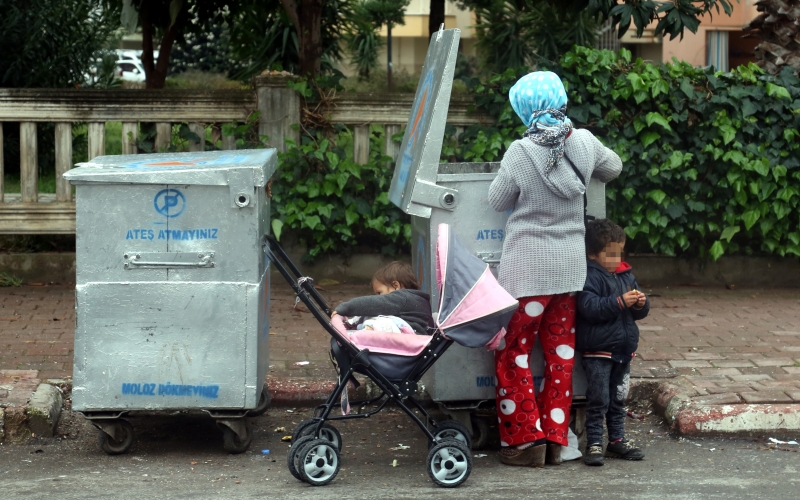
More than half of Turkey’s households fall into the lower end of the country’s socioeconomic scale, according to new data released by the Turkish Statistical Institute (TurkStat).
TurkStat on Monday for the first time published a comprehensive socioeconomic status (SES) index for all 26 million households. The index combines administrative data on income, occupation and years of schooling, assigning each household a composite score between 0 and 300. Scores are grouped into seven categories ranging from “A+” (highest) to “E” (lowest).
The results show that only 1.1 percent of households are in the top “A+” category, while 16.7 percent fall into the very bottom “E” group. When combined with the adjacent “D” and “C2” categories, the share of households in the lower half of the index reaches 51.8 percent. In contrast, just 12.1 percent of households are in the top two categories, “A+” and “A.”
What makes these findings especially striking is the role of education in the calculations. Education accounts for half of the SES score, while income contributes 30 percent and occupation 20 percent. Over the past two decades Turkey has significantly expanded access to schooling, raising enrollment rates and increasing university attendance. Yet even with education carrying the most weight, only a tiny share of households qualified for the top category, indicating the depth of economic inequality.
While education is more widely available, real wages have been eroded by years of high inflation, and wealth remains concentrated among a narrow elite. For most families, higher education has not delivered upward mobility.
The data also reveal sharp geographic divides. More than 28 percent of households in the top two categories are concentrated in İstanbul, followed by 11.5 percent in Ankara and 6.7 percent in İzmir. At the district level, the affluent Ankara district of Çankaya alone accounts for 4.1 percent of the nation’s top-tier households. In contrast, rural districts in central and northern Anatolia dominate the bottom of the scale, including Çamoluk in Giresun, Derebucak in Konya, Doğanşar in Sivas and Felahiye in Kayseri.
Even in major cities, inequality is pronounced. In İstanbul 2.4 percent of households are in the top “A+” group while 12.6 percent are in the bottom. In Ankara, 2.5 percent are at the top compared with 12.2 percent at the bottom. In İzmir, often seen as one of Turkey’s more prosperous provinces, 15 percent of households fall into the lowest group.
The SES index is not identical to official poverty measures, but it is intended to capture a household’s overall position in society by combining income, education and occupation. By design, it reflects structural inequality rather than short-term fluctuations.
Opposition parties and independent researchers have long argued that the government’s economic policies have widened the gap between wealthy elites and the poorer majority, while eroding the value of wages and savings.
TurkStat said the results are based on data from 2022 to 2024, with 2023 taken as the reference year. The next update of the SES report is scheduled for August 2028.