

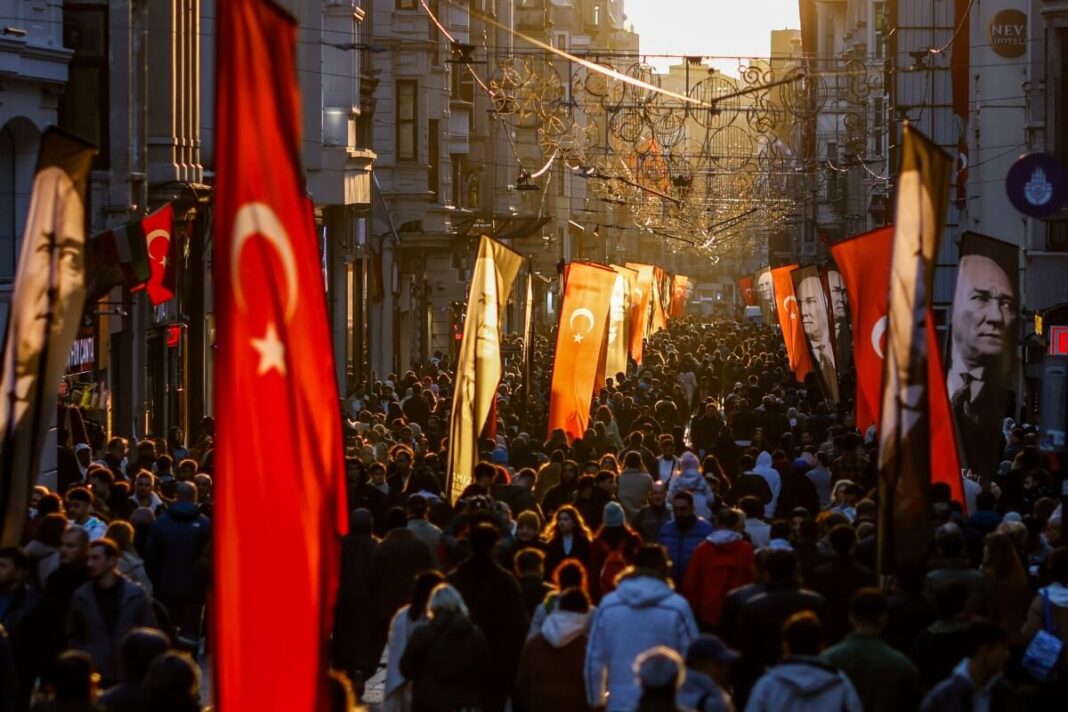
 and faces mounting pressure to address overcrowding in Turkey’s prisons amid concerns about widespread rights violations.)
A majority of Turks support a general amnesty, according to a public opinion survey released as the Turkish government pursues a renewed peace process with the outlawed Kurdistan Workers’ Party (PKK) and faces mounting pressure to address overcrowding in Turkey’s prisons amid concerns about widespread rights violations.
The survey, conducted by the ORC Research Company between August 1 and 3, polled 2,400 respondents across 18 provinces. Participants were asked whether they support the idea of a general amnesty, a legal measure that could reduce or eliminate sentences for certain offenses.
According to the results, 54.1 percent of respondents said they support a general amnesty, while 36.9 percent opposed it. Another 9 percent said they had no opinion.
The poll comes amid rising inmate numbers, debate over sentencing reform and efforts to advance reconciliation with Turkey’s Kurdish population.
"TOPLUMUN GENEL AF KONUSUNA BAKIŞI"
▪︎Genel Affı Destekliyorum %54,1
▪︎Genel Af Konusunda Partilerin Politikalarından Haberdarım %55,2
▪︎Genel Af Konusunda Görüş Belirten,En Beğenilen 5 Genel Başkan@RTErdogan@dbdevletbahceli@tuncerbakirhan@TeomanMutlu@erbakanfatih pic.twitter.com/WvwgHVRvWB
— ORC ARAŞTIRMA (@orc_arastirma) August 5, 2025
In Turkish law, a general amnesty is a legislative measure enacted by the parliament that nullifies convictions for certain crimes. When granted, it drops public prosecutions, annuls imposed sentences and clears criminal records, typically serving purposes like promoting social peace and reintegration
Prison system under strain
The overcrowding in Turkey’s prisons has been a growing issue since 2005, with prison populations swelling annually. The situation became even more dire during the COVID-19 pandemic. The Turkish Parliament passed an early parole law in April 2020 aimed at reducing the inmate population of the country’s overcrowded prisons. Yet the legislation excluded political prisoners, including opposition politicians, journalists, lawyers, academics and human rights defenders convicted under the country’s controversial counterterrorism laws.
Human rights groups and legal experts have long criticized the country’s heavy reliance on pretrial detention, vague anti-terror laws and politically motivated prosecutions.
Under the government of President Recep Tayyip Erdoğan, the prison population has steadily increased in Turkey. As of July 1, 2024, Turkey’s prisons held 342,526 inmates, despite a total prison capacity of 295,328. By February 3, 2025, the number had climbed to 392,456, exceeding a slightly increased capacity of 299,940 by 30 percent.
Political awareness and party positions
The poll also found that just over half of respondents, 55.2 percent, said they were aware of their preferred political party’s stance on a general amnesty. Another 44.8 percent said they were not informed.
Although no legislation is currently before parliament, the possibility of a potential amnesty has come back to the nation’s agenda with the recent PKK decision to lay down its arms and disband as part of ongoing peace talks with the group’s jailed leader, Abdullah Öcalan.
The renewed peace process was initiated in October 2024 by Nationalist Movement Party (MHP) leader Devlet Bahçeli, a key government ally. Bahçeli publicly called on jailed PKK leader Öcalan to urge the militant group to lay down its arms. Öcalan responded in February with a message calling on the PKK to disarm and disband. The militant group complied, and a group of 30 PKK militants burned their weapons in a symbolic ceremony in northern Iraq last month.
A parliamentary commission tasked with advancing reconciliation with the Kurds held its inaugural meeting earlier this week. It is not yet known whether the commission, which does not have formal legislative authority, will recommend a general amnesty that will also include former PKK militants.
Leaders most favored on the issue
Participants were also asked which political leader they most supported in relation to the amnesty issue. President Erdoğan, who leads the ruling Justice and Development Party (AKP), received the highest approval, with 44.7 percent of respondents naming him.
He was followed by MHP leader Bahçeli with 28.7 percent and pro-Kurdish Peoples’ Equality and Democracy Party (DEM Party) Co-chair Tuncer Bakırhan with 20.6 percent.
The DEM Party, which facilitated the talks between Öcalan and Ankara during the peace process by regularly visiting Öcalan in prison, is the successor to the pro-Kurdish Peoples’ Democratic Party (HDP), many of whose leaders and members remain imprisoned on charges linked to alleged PKK ties, a point of contention in ongoing reconciliation efforts.
Calls for a general amnesty in Turkey date back decades and have often followed periods of political or social unrest. Past amnesties have sparked both praise and backlash, depending on which offenses or groups were included.
Supporters of a new amnesty argue that it could ease the burden on the prison system and serve as a gesture of goodwill in the peace process. Critics worry it could undermine accountability or be used to absolve politically connected individuals.
The ruling AKP says a general amnesty is not on the party’s agenda, while MHP and Republican People’s Party (CHP) officials have suggested a revision of the country’s criminal enforcement law, primarily governed by the Turkish Penal Code (TCK) and the Turkish Code on Criminal Procedure (CMK).