

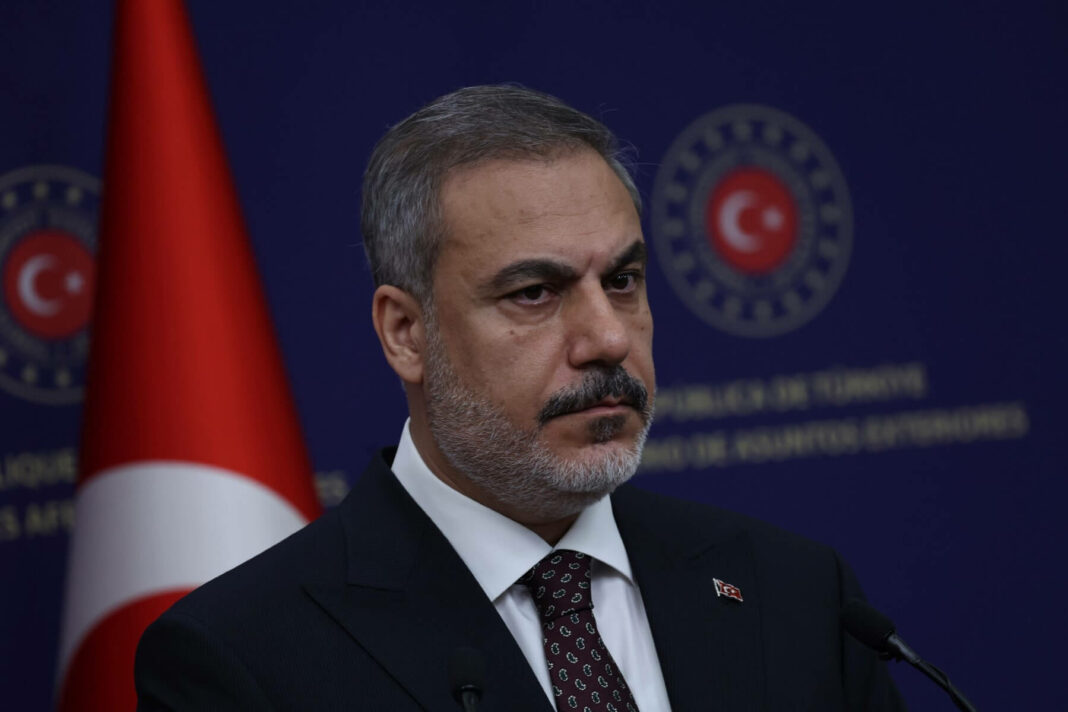

The Turkish foreign minister said on Friday that Turkey declined to join 12 countries in endorsing a six-point action plan at a Colombia summit targeting Israel’s conduct in the occupied Palestinian territories due to concerns about legal implications under the UN Convention on the Law of the Sea (UNCLOS) that could affect its maritime disputes with Greece.
The July 15–16 conference in Bogotá, co-hosted by Colombia and South Africa under the framework of the Hague Group, brought together over 30 nations seeking coordinated legal and diplomatic measures against what they described as Israel’s genocidal campaign in Gaza. While Turkey signed the broader political declaration condemning Israeli actions, it withheld support for the concrete measures that included restrictions on weapons transfers, port access and public procurement tied to Israel’s occupation policies.
In remarks defending the decision, Turkish Foreign Minister Hakan Fidan emphasized that while Ankara strongly supports international legal efforts to hold Israel accountable, the action plan raised red flags related to UNCLOS — a treaty Turkey has not ratified due to ongoing maritime disputes in the Aegean Sea.
Fidan said that after consulting legal experts and relevant institutions, Ankara concluded it could accept the general content of the text so long as its reservation was noted.
Fidan criticized opposition leaders for attacking the decision, saying they either do not understand the legal complexities involved or are unintentionally aligning with Greek positions in the eastern Mediterranean. He said Turkey has led numerous international declarations on Palestine since October 7, particularly at the United Nations and the Organisation of Islamic Cooperation, and that its commitment to the Palestinian cause remains strong.
The six-point plan signed by Bolivia, Colombia, Cuba, Indonesia, Iraq, Libya, Malaysia, Namibia, Nicaragua, Oman, Saint Vincent and the Grenadines and South Africa commits signatories to block arms transfers to Israel, restrict port and flag access to ships carrying military supplies and initiate legal reviews of public contracts that could support the occupation. It also urges countries to exercise universal jurisdiction to prosecute serious crimes committed in the Palestinian territories.
A final deadline of September 20, 2025 — coinciding with the opening of the 80th UN General Assembly — was set for additional states to join the measures in line with General Assembly Resolution A/RES/ES-10/24, which calls for member states to take effective steps within 12 months to end Israeli violations of international law.
Despite its absence from the action plan, Turkey continues to project a pro-Palestinian image internationally. However, critics point to contradictions between Ankara’s rhetoric and its ongoing energy ties with Israel, particularly the flow of crude through the Baku-Tbilisi-Ceyhan (BTC) pipeline, which has served as a major source of Israeli oil imports. This, along with its refusal to close its ports to arms transfers to Israel, has drawn accusations of performative diplomacy.
UN special rapporteur Francesca Albanese, speaking at the summit’s close, described the action plan as a vital step to end impunity. “These aren’t just measures but are lifelines for a people who are under relentless assault and a world that has been paralyzed for too long,” she said.