


Turkey’s intelligence chief has unveiled a five-stage plan aimed at ending the armed campaign of the outlawed Kurdistan Workers’ Party (PKK), telling political parties in parliament that the peace efforts have entered the penultimate stage of fighters laying down their arms and that new legislation is needed to allow their return to civilian life.
As part of the government’s efforts to broaden support for the peace initiative, İbrahim Kalın, head of Turkey’s National Intelligence Organization (MİT), met with party representatives in recent days to present what he called the “Terrorism-Free Turkey” roadmap.
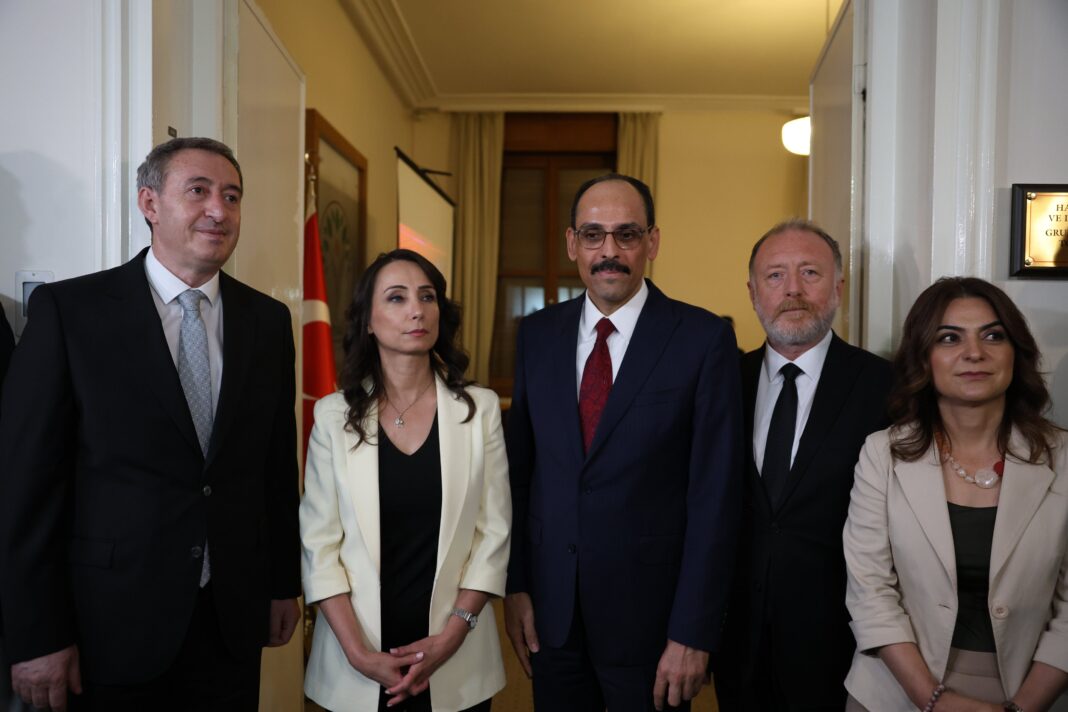
Kalın first visited Nationalist Movement Party (MHP) leader Devlet Bahçeli, then held closed-door talks with senior members of the ruling Justice and Development Party (AKP), including Deputy Chairman Efkan Ala and parliamentary group leader Abdullah Güler. He later met with Tuncer Bakırhan and Tülay Hatimoğulları, co-leaders of the pro-Kurdish Peoples’ Equality and Democracy Party (DEM Party).
The intelligence chief continued his consultations with other parties, including the nationalist İYİ (Good) Party, the New Path Party and a coalition of smaller opposition groups including the Future, DEVA and Felicity parties.
According to reporting by journalist İsmail Saymaz of pro-opposition Halk TV, Kalın said the government expects the complete the abandonment of armed conflict by PKK members by the end of the year. He called for the establishment of a parliamentary commission tasked with drafting a legal framework — commonly referred to as an “amnesty law” — to facilitate the reintegration of former PKK fighters.
Kalın’s remarks follow a high-profile ceremony in the northern Iraqi city of Sulaymaniyah on July 11, where 30 PKK members, including senior figures, destroyed their weapons in what was described as a gesture of farewell to the armed conflict. The move came after jailed PKK leader Abdullah Öcalan called for the group to transition to civilian politics earlier this year.
Kalın said the process has reached its fourth stage, marked by the public laying down of arms, and that the final step would be the complete dismantling of the organization. He emphasized that the fighters who took part in the July 11 ceremony were among the group’s most senior members and that some strategic bases and logistics centers had already been vacated and cleared by the Turkish state.
He told lawmakers that meaningful progress had been made on the security front but underscored that legal instruments must now follow.
The intelligence chief said MİT expects the Turkish Parliament to create a legal path to allow group members to return to Turkey without facing immediate arrest. Only after this step, he said, could the political and cultural dimensions of the Kurdish struggle for recognition be meaningfully addressed. He added that while the state may achieve its goals in ending armed hostilities, the deeper historical and political grievances remain and will require careful, inclusive political work over time.
During the meetings, Kalın also addressed concerns about northern Syria. He dismissed the possibility of federal autonomy for Kurdish-led regions, instead proposing a model of enhanced local governance. He argued that the Syrian Kurdish group controlling large parts of the country’s northeast should be integrated into the Syrian state and encouraged to reach an arrangement with the government in Damascus.
Several opposition lawmakers reportedly challenged Kalın on the ongoing imprisonment of Kurdish politician Selahattin Demirtaş and pretrial detention of İstanbul Mayor Ekrem İmamoğlu. They argued that continued imprisonment of prominent opposition figures undermines public trust in peace efforts and contradicts the government’s stated desire for national reconciliation. Kalın declined to offer comment on those cases, responding only that they were “political matters.”
Kalın is expected to meet with Özgür Özel, leader of the main opposition Republican People’s Party (CHP), on Thursday.
The renewed peace efforts were made public in October 2024, when far-right MHP leader Bahçeli called on Öcalan to urge the PKK to lay down its arms. Öcalan responded in February with a message calling for an end to the insurgency.