

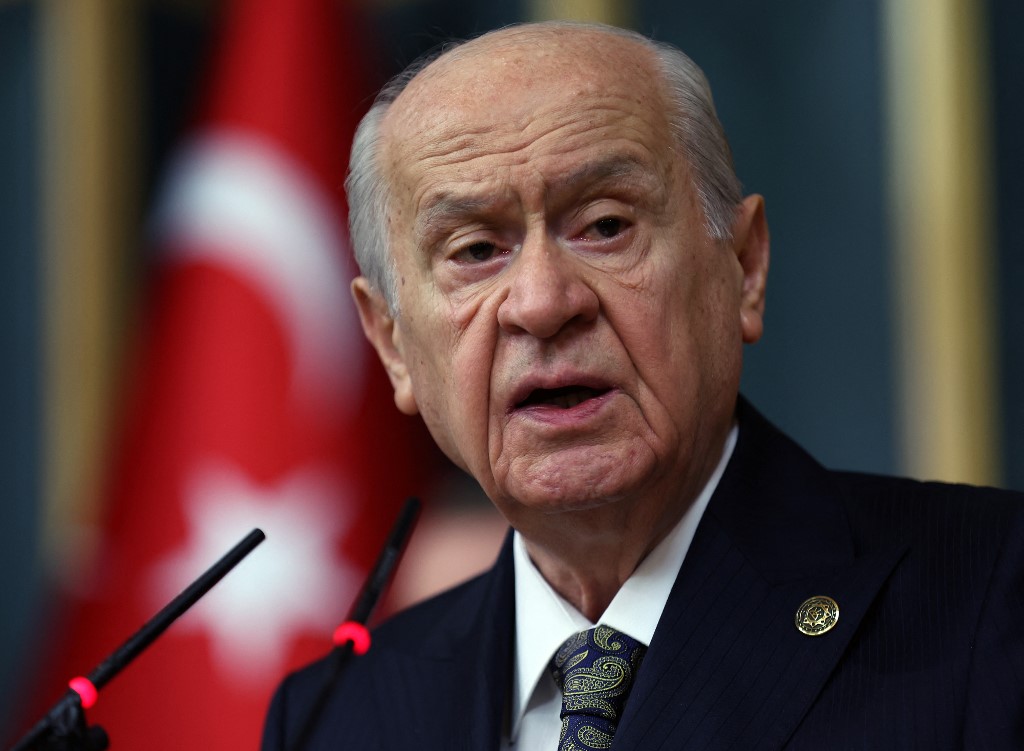
 and a key ally of President Erdoğan, sparked a political controversy after proposing that #Turkey appoint one #Kurdish and one #Alevi figure as vice presidents.)
Devlet Bahçeli, the leader of Turkey’s far-right Nationalist Movement Party (MHP) and a key ally of President Recep Tayyip Erdoğan, sparked a political controversy after proposing that Turkey appoint one Kurdish and one Alevi figure as vice presidents, a move he said would help heal long-standing ethnic and sectarian divisions.
The proposal, first made during a closed-door meeting of the MHP’s central executive board on July 18, was confirmed in a written statement released by Bahçeli on Monday. The remarks come amid renewed efforts by the Turkish government to end the country’s decades-long conflict with the outlawed Kurdistan Workers’ Party (PKK).
Bahçeli said that amid Turkey’s progress toward becoming a terrorism-free country and in light of the deep social and economic costs caused by long-standing ethnic and sectarian tensions, one of the country’s two vice presidents could be an Alevi and the other a Kurd.
He said he would not retreat “even one step” from this position.
“Alevis are our people, Kurds are our people. We are all together the Turkish nation,” he added.
Bahçeli’s suggestion surprised many observers due to his party’s traditionally hardline nationalist stance. The MHP has long opposed concessions to Kurdish and Alevi communities, both of which have historically faced marginalization in Turkish political and social life although each is estimated to make up a significant part of Turkey’s population, between 15 and 25 percent.
A shift in tone amid peace talks with PKK
The MHP leader’s statement comes amid the Turkish government’s ongoing peace efforts with the outlawed Kurdistan Workers’ Party (PKK), which were rekindled in October 2024, when Bahçeli publicly called on the PKK’s jailed leader, Abdullah Öcalan, to urge the militant group to lay down its arms. Öcalan responded in February with a message calling on the PKK to lay down its arms and disband.
Following months of indirect negotiations between Öcalan and the Turkish government, a group of 30 PKK fighters held a high-profile ceremony on July 11, publicly destroying their weapons in what was billed as the first step toward ending the group’s four-decade armed conflict against the Turkish state. The move was followed on Monday by a signal from Erdoğan that his government is preparing new legislation to support the peace efforts.
Reaction from Kurdish party
Tuncer Bakırhan, co-chair of the pro-Kurdish Peoples’ Equality and Democracy Party (DEM Party), responded to Bahçeli’s remarks during a press appearance on Tuesday.
“Why shouldn’t the president be Kurdish as well?” Bakırhan asked. “We are candidates for governance. All identities in this country deserve representation in leadership.”
British economist Timothy Ash also reacted on social media with sarcasm, writing on X, “Was he abducted by aliens over the past year and returned to earth with a brain implant of multiculturalism and liberalism? What a transformation.”
Pushback over Lebanon comparisons
Bahçeli also rejected criticism likening his proposal to Lebanon’s sectarian-based political system, where top government positions are allocated by religious identity. “Linking this proposal to Lebanon is a misrepresentation and a deliberate attempt to twist a sincere idea,” he said. “No one will have the strength or the ability to turn Turkey into the unstable and chaotic system of Lebanon or any similar country.”
Similar criticism was directed at President Erdoğan earlier this month, when he praised the PKK’s gesture of destruction of its arms as a “national victory” and emphasized the unity of Turkey’s diverse ethnic groups.
“Turks, Kurds, Arabs, all 86 million citizens, emerged as winners,” Erdoğan said at the time, while warning of the destructive consequences of ethnic and sectarian divisions.
Erdoğan’s reference to Turks, Kurds, and Arabs as equal stakeholders in the country’s future was also interpreted by some observers as signaling a potential paradigm shift in Turkey’s governance model, with many speculating that the framing could hint at a power-sharing formula loosely resembling Lebanon’s sectarian political system.