

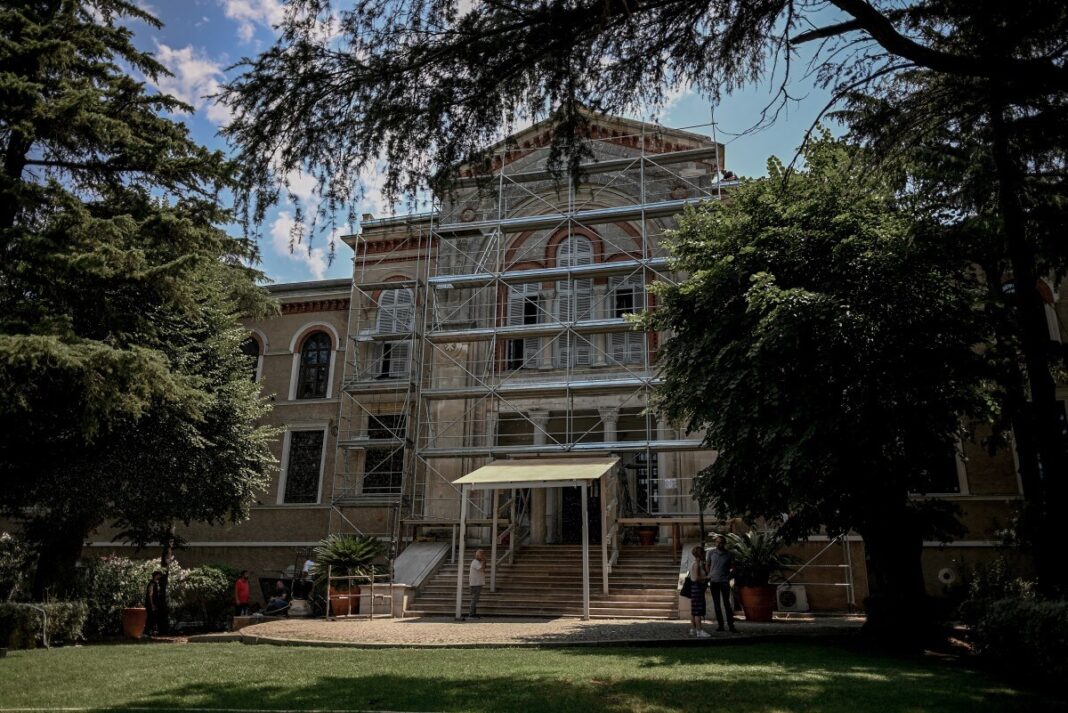

Hopes are rising that a long-closed Greek Orthodox seminary on an island off İstanbul could reopen soon, with talks underway on its future legal status, Bishop Aravissu Kassianos Nikolar told Agence France-Presse.
The Halki seminary, located on Heybeliada, one of the Princes’ Islands, opened in the mid-19th century and served as the main theological school for the Eastern Orthodox Church until it was closed in 1971 under a Turkish law affecting private higher education.
Despite decades of calls on Ankara to allow it to reopen, including from Ecumenical Patriarch Bartholomew, the İstanbul-based spiritual leader of the world’s Orthodox Christians and a graduate of the seminary, the school has remained closed.
“At this stage, we are making quite good progress overall. Things are positive at the moment, 100 percent positive,” Nikolar told AFP in a rare interview ahead of US President Donald Trump’s visit to Ankara for the July 7-8 NATO summit.
The seminary issue gained renewed attention after Trump raised it with President Recep Tayyip Erdoğan during talks at the White House in September, increasing hopes that the decades-long impasse could be resolved.
The Halki seminary has symbolic importance for the Orthodox world and has long been cited by the United States, the European Union and rights groups as a test of Turkey’s record on religious freedom.
The site, perched on a hill on Heybeliada, is currently undergoing extensive renovation. AFP journalists who visited the complex saw work underway in classrooms and other parts of the building ahead of what Bartholomew has said is a September deadline for restoration to be completed.
The complex includes the seminary, a monastery and a high school, although the educational part has been closed for decades.
The school was shut after a 1971 court ruling required private institutions of higher education to come under state control. The Ecumenical Patriarchate rejected that arrangement at the time, saying it wanted to preserve the seminary’s independence.
After years of closure, however, the patriarchate has signaled that it is ready to accept a formula allowing the school to operate under Turkish oversight.
Renewed talks began after Turkish Education Minister Yusuf Tekin visited the seminary in 2024 and conveyed a message from Erdoğan that a solution should be found for its reopening.
“That kicked off negotiations with Ankara,” Nikolar said, adding that the process gained momentum after Trump and Erdoğan discussed the issue last September.
One early proposal was to reopen the seminary as a university operating under Turkey’s Higher Education Board (YÖK). A later option under discussion would establish an institute offering two years of postgraduate theological education, affiliated with a Turkish university and with a quota of 60 to 70 students.
Nikolar said there was “no set time” for the reopening but added that Erdoğan had urged the sides to finalize the matter quickly.
“Don’t lose too much time,” he quoted Erdoğan as saying.
He said Trump held Bartholomew “in high regard” and saw the seminary as important not only for Orthodox Christians but also for interfaith dialogue.
“We should not look at it solely from the perspective of Christianity,” Nikolar said. “The school’s mission was to educate broad-minded students, not people with a narrow outlook on the world.”
He said the continued closure of the seminary had caused a major loss for the Orthodox community.
“The fact that such a valuable institution has remained closed and been unable to train clergy is a major loss,” he said.
Even though the school is still closed, Nikolar said there was already strong demand from people who want to study there.
“It’s a valuable institution,” he said. “This school has never been forgotten.”
© Agence France-Presse