

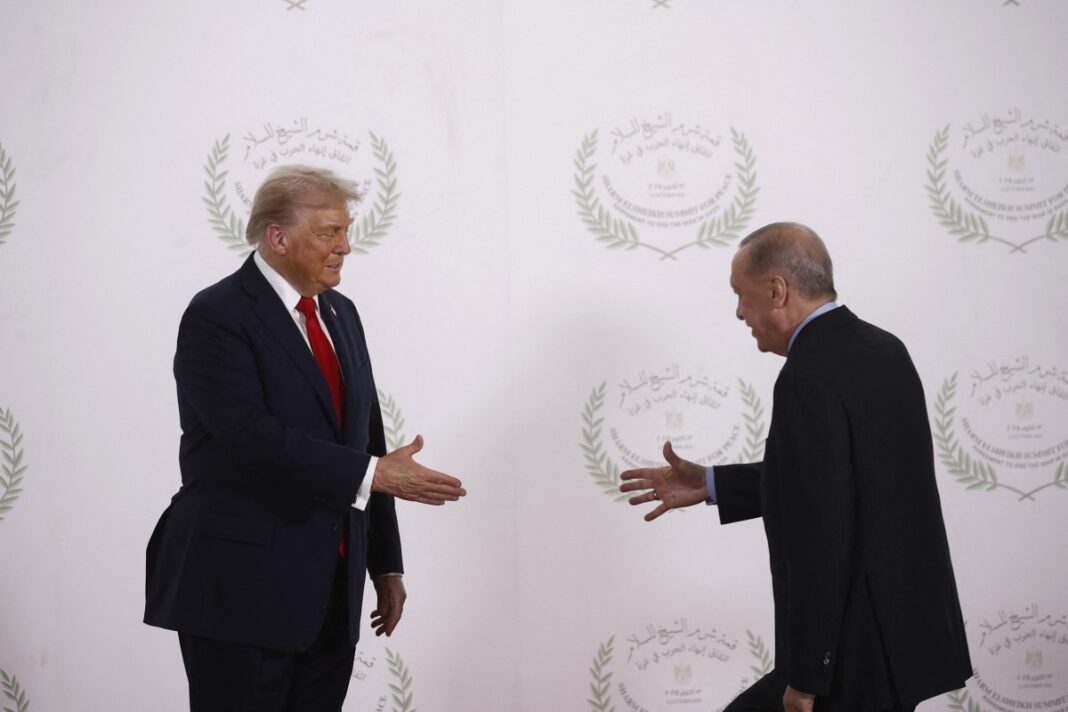

Turkish representatives joined Middle Eastern leaders and Pakistani officials in a call with US President Donald Trump as Washington and Tehran sought Sunday to finalize an agreement to formally end the Middle East war and reopen the Strait of Hormuz.
Trump said Saturday that a proposal involving the United States, Iran and other countries was “largely negotiated” but still “subject to finalization.”
“An Agreement has been largely negotiated, subject to finalization between the United States of America, the Islamic Republic of Iran, and the various other Countries,” Trump wrote on Truth Social.
“In addition to many other elements of the Agreement, the Strait of Hormuz will be opened.”
The reopening of the strait would ease pressure on global energy markets after a monthslong Iranian blockade of the route, one of the world’s most important passages for oil shipments.
Trump said leaders from Saudi Arabia, the United Arab Emirates, Qatar, Egypt, Jordan and Bahrain, along with representatives from Turkey and Pakistan, joined the call Saturday to discuss the deal.
Pakistan, which mediated face-to-face negotiations between US and Iranian delegations in April, hopes to host another round of talks “very soon,” Prime Minister Shehbaz Sharif said.
Sharif said Pakistan’s army chief, Asim Munir, who visited Tehran on Friday, also joined the call.
He said the call “provided a useful opportunity to exchange views on … how to move the ongoing peace efforts forward to bring lasting peace in the region.”
Trump said a separate call with Israeli Prime Minister Benjamin Netanyahu “went very well.”
US-Israeli strikes on Iran on February 28 triggered the war, with fighting continuing for weeks before a temporary ceasefire took effect in April.
“Final aspects and details of the Deal are currently being discussed, and will be announced shortly,” Trump said, without giving details.
The New York Times, citing unnamed American officials, reported that the details of an “apparent commitment” by Tehran to give up its stockpile of highly enriched uranium would be discussed after an initial agreement was reached.
The report said the current proposal does not define how Tehran would give up stocks of the fuel needed to build nuclear weapons, a scenario Washington has long said it would not accept in Iran.
Iranian officials have said gaps remain between the sides and that the dispute over the nuclear program would not be part of the first stage of talks.
Iran has not commented on Trump’s announcement.
Foreign Ministry spokesman Esmaeil Baqaei earlier noted “a trend towards rapprochement” with Washington but said “it does not necessarily mean that we and the United States will reach an agreement on the important issues.”
“Our intention was first to draft a memorandum of understanding, a kind of framework agreement,” he said on state television.
Baqaei said he hoped the details of a final agreement could be worked out “within a reasonable timeframe between 30 to 60 days” after the initial framework was completed.
Iran’s chief negotiator, Mohammad Bagher Ghalibaf, earlier warned that Washington would face a tough response if it resumed hostilities after US media reports raised the possibility of new strikes.
“Our armed forces have rebuilt themselves during the ceasefire period in such a way that if Trump commits another act of folly and restarts the war, it will certainly be more crushing and bitter for the United States than on the first day of the war,” Ghalibaf said.
On the war’s other main front in Lebanon, state media reported that Israel struck the country’s south Saturday, where fighting has continued despite an April 17 ceasefire.
Lebanon’s military said a strike targeted a Lebanese army barracks in the south and wounded a soldier.
Israel said one of its soldiers was killed Friday near the border.
Iran-backed Hezbollah drew Lebanon into the war on March 2 with rocket fire at Israel after US-Israeli strikes killed Iran’s supreme leader.
Hezbollah said Saturday that its chief, Naim Qassem, had received a message from Iran’s foreign minister saying Tehran “will not give up its support” for the Lebanese group.
© Agence France-Presse