

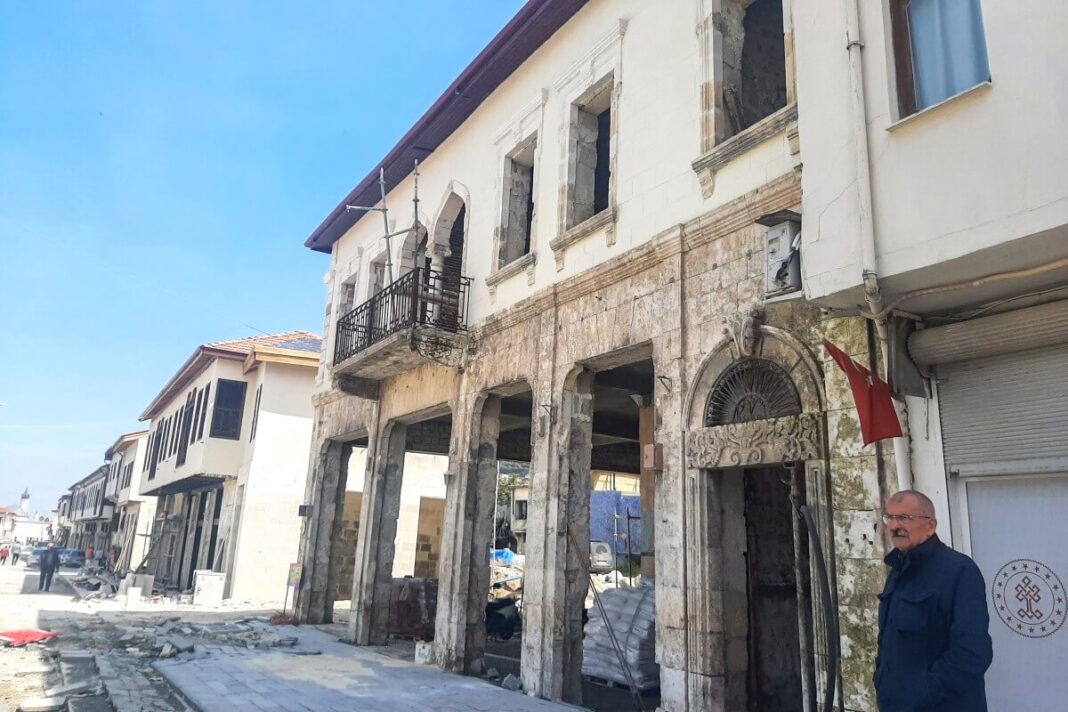

Selahattin Yoğurtçuoğlu pulls out his chair to chat with neighbors outside his home in Turkey’s Antakya, just as he used to but nothing is the same since the 2023 earthquakes that devastated the ancient city.
Three years after the disastrous tremors rippled across southern Turkey, killing at least 53,000 people, residents are up in arms against government-led reconstruction plans they say threaten the soul of Antakya, site of the millennia-old city of Antioch, and its multicultural identity.
“We hear they’re going to tear down the neighborhood to build villas for the rich,” the 68-year-old Yoğurtçuoğlu said.
“They’re going to drive us out of here and dump us at the foot of the mountain.”
Once bustling Kurtuluş Avenue, adjacent to working-class neighborhoods as well as Muslim, Christian and Jewish places of worship, is now a vast construction site where historic buildings are being hastily rebuilt with support from the European Union.
The old city was home to more than 13,000 residents before the earthquakes, but only a few homes will remain, according to the controversial urban development plan.
Most of them are expected to be relocated to the outskirts, at the foot of the mountains, which are considered more solid and safe, where the public housing agency TOKI is building apartments.
Several areas of the old town are marked as “at risk” or “reserve zones,” meaning that the state will have full power over the fate of properties, with no guarantee that residents will be able to return to their neighborhood.
‘Potemkin village’
Some buildings in the city center, however, have signs reading “No damage. Residents are there” in the hope of preventing their destruction.
This is an unacceptable prospect for Kemal Arıbaş, 65, who is deeply attached to his neighborhood and refuses to see it turned into what he describes as a “Potemkin village.”
“What’s the point of rebuilding Cafe Affan if the residents aren’t there anymore? Is it for the tourists?” he said, referring to a historic cafe in the neighborhood where his family has lived for generations.
He used to meet his friend Dimitri, a priest at the Orthodox church, to play backgammon every morning.
“Multicultural Antakya, where different communities lived side by side, wasn’t just a cliche, it was a reality,” he said.
“It is now under threat. My neighbors, including Dimitri, have been relocated about 10 kilometers from here.”
“Mosques are being built there, but will there also be a church? Will I be able to return to my place of worship?” asked this Alevi believer, a community whose rituals differ from those of Sunni Islam.
Political scientist Harun Aslan said residents were not being heard.
“The process is very confusing, highly centralized and opaque. It is difficult to challenge the decisions,” he said.
Residents have ‘no say’
The expert said the need for housing was “urgent” but that most residents cannot afford to rebuild on their own and instead “are forced to relocate” away from the city center.
More than 100,000 buildings were destroyed or severely damaged in the earthquakes in Hatay province near the Syrian border, according to the Turkish urbanization ministry.
More than 85,000 housing units were built by the end of 2025, the ministry said.
In Antakya, the destruction “is so extensive that the city’s cohesion has been shattered. Reconstruction means total ‘Tokification’: residents have no say in the design of their own homes,” Aslan said.
Local neighborhood official Şefik Fatihoğlu said uncertainties related to reconstruction prevented the return of his 4,000 constituents who moved to other cities after the quakes because his constituency was declared “at risk.”
“Under the law, at risk status allows for anything, even expropriation,” he said.
“I should be able to rebuild my property on my ancestors’ land, or the government could take care of it.”
“People fear they won’t be able to rebuild their community or return to live in the same places,” said Jurgis Vilcinskas, deputy chief of the EU Delegation to Turkey, during a visit to Antakya.
The EU has committed nearly 1 billion euros to fund hospitals, schools, temporary housing and the restoration of historic monuments in the 11 provinces affected by the earthquakes.
“We would have liked Europe to consider the fate of the residents when deciding on the projects it funds,” local resident Arıbaş said, sounding determined to keep on fighting.
© Agence France-Presse