

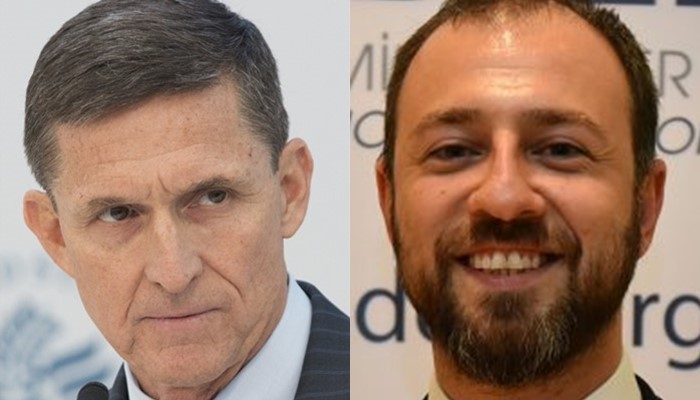

Turkish businessman Ekim Alptekin, a former head of a key Turkey-US business group who was indicted in the United States in a lobbying case linked to former US national security adviser Michael Flynn, said he is no longer a fugitive from US justice after prosecutors moved to dismiss the charges against him in October 2025.
“I was saved thanks to Trump,” Alptekin told journalist Cansu Çamlıbel in an interview published by the T24 news website, crediting the decision to President Donald Trump and a prosecutor appointed during Trump’s current term in office.
An order from the US District Court for the Eastern District of Virginia says the indictment was dismissed “with prejudice” as to Alptekin, meaning the case cannot be brought again on the same charges.
Alptekin said he plans to travel to the United States soon and described an invitation from Bryan Lanza, a former Trump spokesman. He said that after years of legal trouble, he “would like to smoke a cigar at the White House.”
Alptekin was charged in 2018 in a case centered on work performed by the Flynn Intel Group, a consulting and lobbying firm founded by Flynn, a retired US lieutenant general who briefly served as Trump’s national security adviser in 2017.
US prosecutors alleged that Alptekin and Flynn’s business partner Bijan Rafiekian arranged an effort that was directed by Turkey’s government but presented as work for Alptekin’s Netherlands-based company, Inovo BV. Prosecutors said the project sought to influence US officials and public opinion against Fethullah Gülen, a US-based Turkish Islamic scholar who passed away in 2024 and whom Turkey had long sought to have extradited.
The Gülen movement, inspired by the Islamic scholar, who lived in exile in the United States from 1999 until his death in October 2024, is renowned worldwide for its contributions to education, social welfare and interfaith dialogue.
The Turkish government, however, accuses the movement of orchestrating a failed coup on July 15, 2016, an allegation the movement strongly denies.
Flynn Intel Group later filed paperwork under the Foreign Agents Registration Act, acknowledging that the work for Inovo could be seen as benefiting Turkey. Documents on the US Justice Department’s Foreign Agents Registration Act website describe Inovo’s ownership and the firm’s understanding of Alptekin’s role.
In the T24 interview, Alptekin said he did not surrender to US authorities during the years the case was pending because he believed the prosecution had become politicized and carried a high personal risk. He said legal fees reached $1 million over about nine years, and he described limits on travel and business activity that he said followed the indictment.
Alptekin also repeated claims about US politics and the justice system and presented himself as someone who has worked close to Western institutions. He told Çamlıbel that he moved to the Netherlands as a child, later worked in the Dutch Parliament, spent time as a research fellow connected to the US House of Representatives and then worked at INTERPOL, headquartered in Lyon, France.
He said he began focusing on the Gülen movement years before Turkey’s failed coup and claimed he had warned Turkish authorities in 2004 about people he believed were linked to Gülen.
The 2016 coup attempt set off one of Turkey’s largest crackdowns in modern history.
However, Turkish President Recep Tayyip Erdoğan has been targeting followers of the Gülen movement since the corruption investigations of December 17-25, 2013, which implicated then-prime minister Erdoğan, his family members and his inner circle.
Dismissing the investigations as a Gülenist coup and conspiracy against his government, Erdoğan began to target the group.
Erdoğan’s government labeled the group as a “terrorist organization” in May 2016, before the failed coup took place, a designation not recognized by other governments or major international bodies, including the United States and the European Union.
Erdoğan intensified the crackdown on the movement following the coup attempt that he accused Gülen of masterminding. The movement strongly denies involvement in the abortive putsch or any terrorist activity.
The movement’s followers, also known as Hizmet (Service) supporters, say they have been unfairly targeted in a campaign of political persecution aimed at silencing dissent and consolidating power. The post-coup purge has seen hundreds of thousands investigated and tens of thousands imprisoned on terrorism-related charges widely viewed as politically motivated.
In the US case tied to Alptekin, prosecutors said money from Inovo supported work that included research products, messaging proposals and outreach to US officials during the 2016 presidential campaign. A Justice Department press release about the Rafiekian case described Alptekin as having ties to senior levels of Turkey’s government and said the project sought to sway US opinion against Gülen.
The Rafiekian prosecution moved through years of litigation. Court records show the case against Alptekin ended with the October 2025 dismissal order.
In the interview, Alptekin went beyond his own legal case, offering views about intelligence agencies and claims circulating around the Jeffrey Epstein scandal in the United States. Alptekin said he had no special information about Epstein but suggested intelligence services can exploit existing networks and individuals. He argued that Epstein’s network was not created by Israeli intelligence, while claiming foreign services can “plug in” to existing structures.
Asked about Trump’s involvement in the Epstein network, Alptekin called for respect for “presumption of innocence” and said it is not correct to label Trump an Israeli agent, much like labelling him as a Russian asset.
Alptekin also described a separate set of allegations involving the family of former President Joe Biden. He said he had known Biden for years and claimed Biden’s brother James Biden and his wife visited him in İstanbul in 2020 while he was under indictment. Alptekin alleged they urged him to sign a $3 million contract with a company linked to Eric Holder, a former US attorney general, and suggested it could help resolve his legal trouble. He presented the claim as an example of what he described as influence peddling in Washington.
Alptekin, who served as chairman of the Turkish-American Business Council, a business platform under the Foreign Economic Relations Board of Turkey (DEİK), said he took on what he called a lobbying mission after the coup attempt and described meetings and contacts with Turkish officials during that period.