

 no longer have the same central role they had when the US partnered with them to defeat the Islamic State group.)
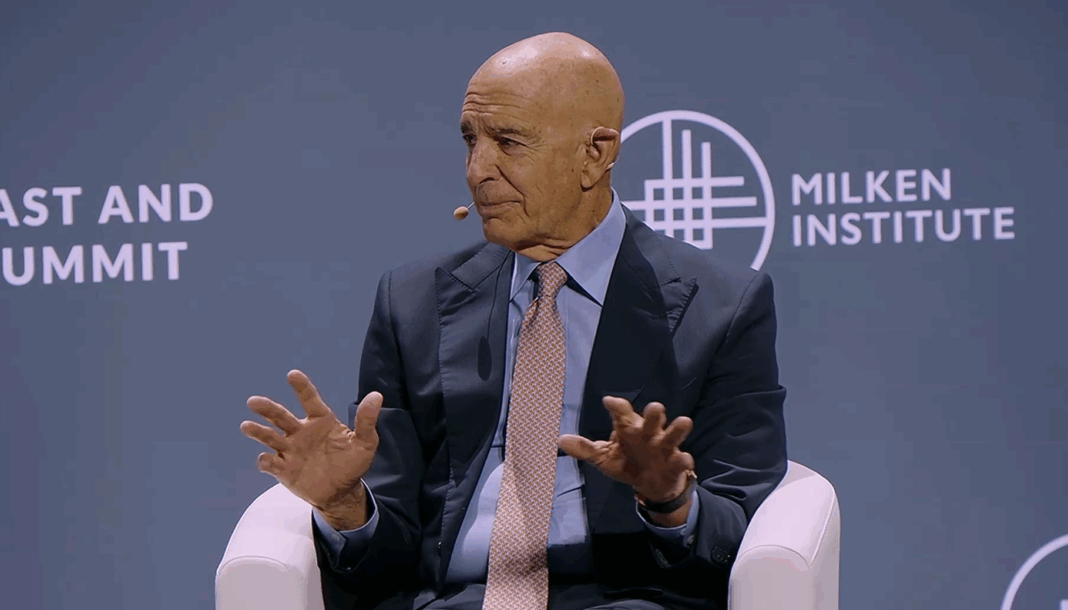
US Ambassador to Turkey Tom Barrack said Tuesday that Syrian Kurds’ “greatest opportunity” lies in integrating into Syria’s new political order under transitional President Ahmed al-Sharaa, arguing that the Kurdish-led Syrian Democratic Forces (SDF) no longer have the same central role they had when the US partnered with them to defeat the Islamic State group.
In a post on X, Barrack said the transition after the fall of Bashar al-Assad in December 2024 offers Syrian Kurds a path to full integration into a unified Syrian state with citizenship rights, cultural protections and political participation that he said were long denied during Assad’s rule, including cases of statelessness and restrictions on Kurdish language and identity.
The greatest opportunity for the Kurds in Syria right now lies in the post-Assad transition under the new government led by President Ahmed al-Sharaa. This moment offers a pathway to full integration into a unified Syrian state with citizenship rights, cultural protections, and…
— Ambassador Tom Barrack (@USAMBTurkiye) January 20, 2026
Barrack framed the US military presence in northeastern Syria as primarily built around the fight against the Islamic State group, saying the SDF, led by Kurdish commanders, served as Washington’s most effective ground partner in dismantling the militant group’s territorial rule by 2019 and in detaining thousands of Islamic State suspects and their relatives in prisons and camps.
But he said the situation has shifted because Syria now has an acknowledged central government willing to partner with the US and assume security responsibilities, including control of Islamic State detention sites.
Syria joined the US-led coalition to defeat the Islamic State group in November 2025, a move that US and Syrian officials cast as a sign of closer coordination on counterterrorism.
Barrack said Washington has worked with Damascus and SDF leadership to secure a ceasefire and integration agreement announced on Sunday and wants a “timely and peaceful” implementation, including the handover of key infrastructure such as oil sites, dams and border crossings, along with Islamic State prisons and camps.
Syrian state media published the 14-point agreement as a “ceasefire and full integration” plan signed by al-Sharaa and SDF commander Mazloum Abdi, a deal intended to bring the SDF and Kurdish-led governance structures under Damascus’s authority after weeks of clashes and rapid territorial shifts in northern and eastern Syria.
A major point of contention is how SDF forces would be absorbed. Damascus reportedly wants SDF fighters integrated as individuals rather than as intact units, a demand Kurdish officials have resisted because it would dissolve their command structure and political leverage.
Barrack’s comments came as fighting continued to flare in northeastern Syria despite the ceasefire announcement, including clashes around detention facilities holding Islamic State suspects. Syrian authorities and the SDF have traded accusations over whether government-aligned forces attacked prison sites or whether the SDF released detainees during the chaos.
Inside Turkey, the evolving battlefield has fueled street protests in Kurdish-majority areas and sharpened political tensions.
Turkey’s pro-Kurdish Peoples’ Equality and Democracy Party (DEM Party) has warned that violence against Kurds in Syria could derail peace efforts inside Turkey after decades of conflict with the Kurdistan Workers’ Party (PKK).
Turkey considers the SDF an extension of the PKK, which is designated as a terrorist organization by Turkey and its Western allies.
Barrack said US goals in Syria now center on securing detention sites holding Islamic State prisoners and facilitating talks that would integrate the SDF into state institutions while ensuring political inclusion for Syria’s Kurdish population.
He emphasized that Washington does not support separatism or federalism in Syria and has no interest in a long-term US military presence, describing US policy as focused on defeating Islamic State remnants and supporting national unity.
Those remarks align with Barrack’s earlier statements praising the January 18 ceasefire and integration plan and describing the SDF as a “historic partner” in the fight against the Islamic State group.
Turkey, which has repeatedly launched cross-border operations into northern Syria since 2016, welcomed the integration plan as advancing Ankara’s longstanding demand that Kurdish-led armed structures be removed from the border area and folded into Syria’s state apparatus.
Syrian state media reported late Tuesday that Damascus and the SDF had reached a new understanding focused on Syria’s northeastern Hasaka Governorate that would take effect at 8 p.m. local time, giving the SDF four days to submit a detailed administrative and military mechanism for the province and saying Syrian government forces would remain on the outskirts of predominantly Kurdish cities of Hasaka and Qamishli rather than entering the city centers if the arrangement holds.
Damascus said Syrian forces also would not enter Kurdish villages and that local security forces would be the only armed presence there, while SDF commander Abdi would propose candidates for senior posts including an assistant defense minister, Hasaka governor and representation in the People’s Council.