

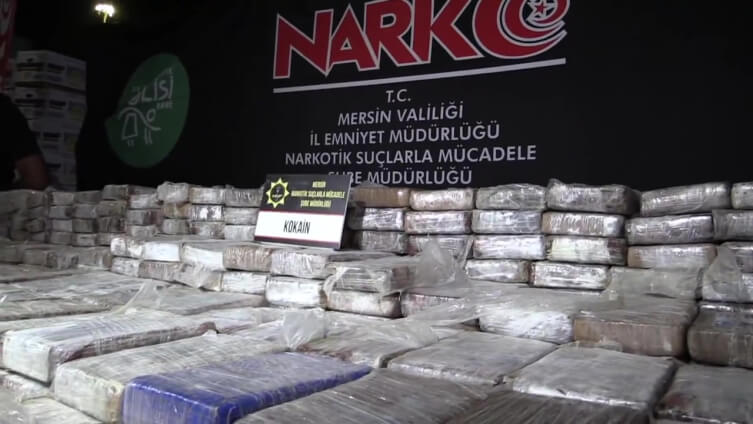

Turkey has moved beyond its traditional role as a corridor for illegal drugs and has become a destination market and a production hub, according to a 2025 report by the Turkish police.
Turkey lies on major land and sea routes linking Asia and the Middle East to Europe, and officials say traffickers are increasingly using the country not only to move drugs onward but also to process and manufacture them.
The report documented 49 methamphetamine conversion facilities discovered between 2022 and 2024, with 44 located in İstanbul alone.
Authorities also identified more than 10 illegal pharmaceutical tableting operations and two Captagon production sites in border provinces, the report said.
Drug-related deaths rose 42 percent to 427 in 2024, with synthetic cannabinoids and methamphetamine the most frequently detected substances in fatal cases, according to the report.
Six of the deaths involved children ages 15-18, it said.
Synthetic drugs show largest increase
The sharpest rise was recorded in synthetic pharmaceuticals, a category that includes counterfeit or illegal medicines used for narcotic purposes, the report said.
Authorities seized 94.7 million tablets in 2024, a 227 percent increase from the previous year, according to the report.
Products containing pregabalin, an active ingredient in prescription drugs such as Lyrica, accounted for a large share of the seizures, it said.
The report linked the shift in part to lower heroin availability after Afghanistan’s poppy cultivation ban, pushing some users toward synthetic substances.
Methamphetamine processing expands inside Turkey
Methamphetamine seizures rose 54 percent to 33.8 tons in 2024, the report said.
Officials said methamphetamine is often smuggled into Turkey in liquid form through the Iranian and Iraqi borders, then processed into crystal form at conversion centers.
The report also said some shipments originating in Mexico have used Turkey as a transit route to Japan, with İstanbul Airport often appearing in seizures.
Cocaine routes increasingly use Turkish ports
Cocaine seizures increased 23 percent to 3.08 tons in 2024, the report said, calling it the highest total recorded.
The report said Turkish ports are being used more often in transatlantic routes moving cocaine from Latin America toward Europe.
Mersin port recorded seizures totaling 4.1 tons between 2018 and 2024, while İstanbul’s Ambarlı port saw 1.8 tons seized during the same period, it said.
The report said traffickers are also using an “impregnation” method that embeds cocaine into soil, fertilizer and other cargo.
In two operations in Antalya and İstanbul, authorities seized nearly one ton of cocaine concealed in legal shipments, including 608 kilograms in Antalya alone, the report said.
Afghanistan remains main heroin source despite Taliban ban
Heroin seizures rose 31 percent to 4.3 tons in 2024, the report said.
Despite restrictions imposed by the Taliban on poppy cultivation, Afghanistan remains the world’s main source of heroin, it said.
The report said the Balkan route, which runs through Iran and Turkey before reaching Western and Central Europe, remains heavily used.
Captagon production shifts amid regional instability
Authorities seized 15.9 million Captagon tablets in 2024, a 15.6 percent increase, the report said.
Captagon is an amphetamine-type stimulant that has been produced and trafficked for years across the Middle East.
Most seizures occurred in provinces near the Syrian border, particularly Hatay and Gaziantep, it said.
The report said instability in Syria has pushed some Captagon production toward Iraq, while Turkey remains a key transit country.
Captagon tableting facilities were detected in Hatay and Kilis provinces, it said.
Synthetic cannabinoids drive fatalities
Synthetic cannabinoids, commonly known in Turkey as bonzai, were linked to 204 of the 427 drug-related deaths in 2024, the report said.
Seizures rose 25 percent to 2.49 tons, and related incidents increased by more than 95 percent, according to the report.
In May 2025 police uncovered a facility in İstanbul containing 100 kilograms of raw synthetic cannabinoid material along with chemicals used for processing, it said.
The report said the substance is often applied to legal products for distribution, which can make detection harder.
Government intensifies response
Turkish authorities conducted 309,028 drug-related operations in 2024, a 22.7 percent increase, detaining 374,948 suspects, the report said.
The government allocated 10.3 billion Turkish lira to anti-narcotics efforts, a 49 percent budget increase, it said.
Turkey exited the Financial Action Task Force grey list in June 2024, the report noted.
Authorities seized assets worth 32.4 billion lira, along with 251 vehicles and 640 properties, in proceeds-of-crime investigations, it said.
The report pointed to rising risks on both the supply and demand sides of the drug trade in Turkey, with synthetic substances expanding and drug-related deaths increasing.