

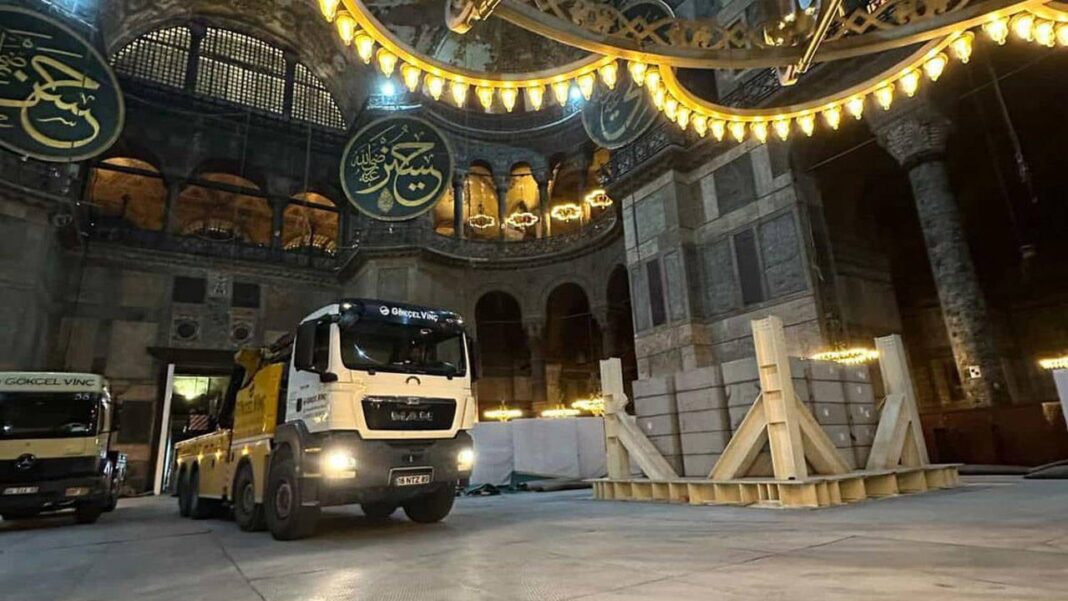

Construction work inside İstanbul’s historic Hagia Sophia triggered public backlash after images circulated on social media showing heavy trucks and machinery operating inside the 1,500-year-old monument, prompting concerns about potential damage to the UNESCO World Heritage Site, the BirGün daily reported.
Images of high-tonnage trucks, cranes and construction platforms operating inside and outside the building as part of the second phase of an ongoing restoration have fueled public concern, with experts warning that the work risks long-term structural harm, particularly because Hagia Sophia sits above numerous cisterns and underground voids.
The Turkish Culture and Tourism Ministry, responding to growing criticism, said in a statement on Monday that the vehicles were being used only after extensive technical assessments and with protective systems in place to prevent harm to the historic structure.
According to the ministry, the machinery inside the former basilica operated on a multilayered protective flooring system designed to distribute weight and shield the original marble surface. The statement said load-bearing tests, georadar scans and ground-class analyses were completed before determining safe routes for vehicle movement.
The second phase of restoration focuses on earthquake safety, including the renewal of lead coverings on the exterior of the main dome and the protection of mosaics and interior elements from weather exposure.
In April Turkish Culture and Tourism Minister Mehmet Nuri Ersoy announced the launch of the “largest and most comprehensive” restoration and reinforcement effort on the dome of Hagia Sophia, whose 2020 reconversion into a mosque sparked international criticism.
A temporary steel structure has been erected over the dome, supported by four interior columns measuring 43.5 meters in height as part of the restoration.
The ministry said installing the massive steel system made the use of heavy machinery “unavoidable,” adding that exhaust fumes were controlled with special filtration devices.
But specialists warn the precautions may not be enough.
Müge Kortanoğlu, an archaeological conservation expert, said in a post on X that using heavy equipment inside a World Heritage Site violates UNESCO principles.
“Excessive load and vibration can cause irreversible damage,” she wrote, adding that even minimal risk should not be accepted for a structure as valuable as Hagia Sophia.
UNESCO ilkeleri gereği Dünya Mirası Statüsündeki yapılarda ağır tonajlı ekipman kullanımı yasaktır.
Alınan tedbirler yeterli olmayabilir. Aşırı yük ve titreşim, geri dönüşü olmayan hasarlara neden olabilir..Ayasofya çok değerlidir. Hasar görebilecileği en ufak bir risk bile… https://t.co/XqCfViSgCr
— Müge Kortanoğlu (@MugeKortanoglu) November 24, 2025
The İstanbul-based Association of Historical Environment and Building Conservators said allowing 20 to 30-ton cranes inside the structure poses major risks by increasing vibration and concentrated loads.
The group said that UNESCO and International Council on Monuments and Sites (ICOMOS) guidelines classify the use of such vehicles in monumental structures as unsafe. It called for transparency, urging authorities to release technical evaluations, load analyses and engineering reports for public review.
The General Directorate of Foundations, which is overseeing the restoration, also defended the work, saying all steps are guided by scientific reports and conservation board decisions. It said the trucks did not enter casually but moved strictly along a specially prepared route following nearly a year of planning and testing.
Originally constructed in the sixth century as a cathedral under Byzantine Emperor Justinian I, Hagia Sophia was converted into a mosque after the Ottoman conquest of Constantinople in 1453. It served as a museum from 1935 until 2020, when a Turkish court annulled its museum status and President Recep Tayyip Erdoğan reinstated it as a mosque, a move that drew condemnation from UNESCO and several Western governments.
Following its conversion into a mosque, there were frequent claims about the damage being sustained by the historic building, with concerns about the preservation of the architectural and artistic treasures inside the structure.
Turkish government officials dismissed the comments as “biased and political.”