

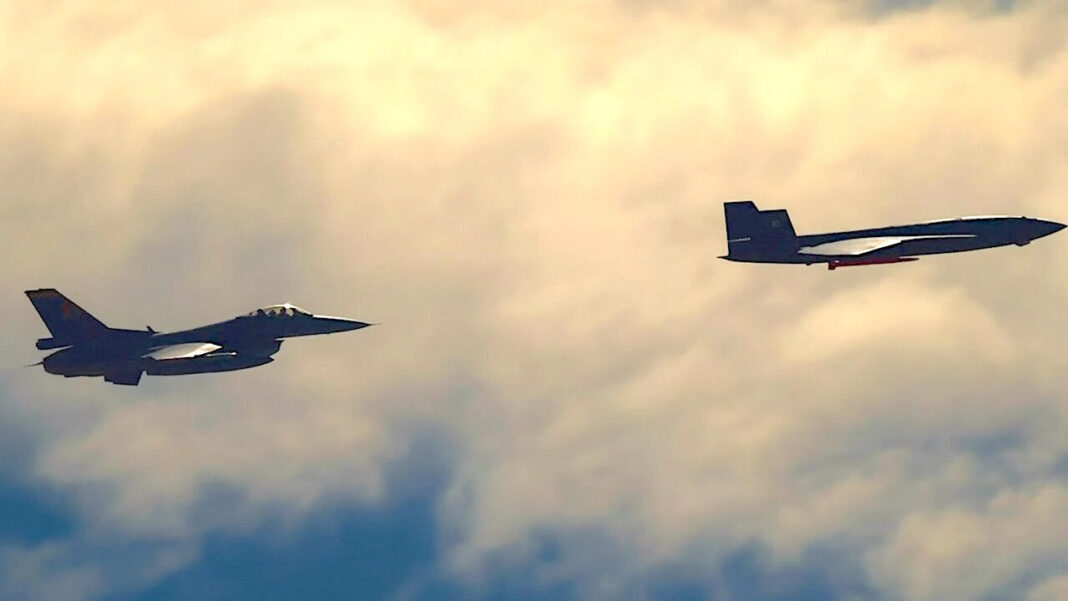
 detected and locked onto a Turkish Air Force F-16 fighter jet from about 30 miles (48 kilometers) during a test flight this week and carried out a simulated firing of a domestically developed beyond-visual-range air-to-air missile, according to Baykar, the UCAV's manufacturer)
Turkey’s jet-powered Bayraktar Kızılelma unmanned combat aerial vehicle (UCAV) detected and locked onto a Turkish Air Force F-16 fighter jet from about 30 miles (48 kilometers) during a test flight this week and carried out a simulated firing of a domestically developed beyond-visual-range air-to-air missile, according to Baykar, the UCAV’s manufacturer
The one-hour-45-minute test was conducted at the AKINCI Flight Training and Test Center in Çorlu, Tekirdağ, in northwestern Turkey. No live missile was fired. Instead, the UCAV transmitted real-time tracking and position data to an inert munition using ASELSAN’s MURAD active electronically scanned array (AESA) radar, allowing engineers to model the missile’s trajectory and predict a direct hit.
Bayraktar #KIZILELMA ✈️🚀🍎
✅ F-16 Formation Flight, GÖKDOĞAN Munition Linked Flight Test & Murad AESA Radar Performance Test#Baykar 🤝 @Aselsan 🤝 @SageTubitak#NationalTechnologyInitiative 🌍🇹🇷 pic.twitter.com/M6zzDK1CoS
— BAYKAR (@BaykarTech) November 20, 2025
Baykar said the test validated data links between the UCAV, the radar and the munition, describing it as a key step toward future live-fire trials and a sign of the progress made in integrating Turkey’s radar and missile systems.
Baykar’s central role in Turkey’s drone industry
Baykar, Turkey’s leading drone manufacturer and developer of the TB2 combat drone widely used in Ukraine and other conflict zones, is led by Selçuk Bayraktar, President Recep Tayyip Erdoğan’s son-in-law. The company developed Kızılelma using its own resources and Bayraktar once said a jet-powered UCAV was a “12-year-long dream.”
Kızılelma is being designed to operate alongside manned fighters, including Turkey’s KAAN fighter jet, which is currently undergoing development and flight testing.
Radar lock, data transfer and formation flight tested
During the trial, Kızılelma flew at an average altitude of 15,000 feet and carried the Gökdoğan, a beyond-visual-range air-to-air missile developed by TÜBİTAK SAGE, the Defense Industries Research and Development Institute of the Scientific and Technological Research Council of Turkey. It was the first time the UCAV carried the missile during a flight test.
Two Turkish Air Force F-16s took part in the evaluation: One flew in formation with Kızılelma to test manned-unmanned teaming, while the second served as the target aircraft. Baykar said the UCAV successfully detected, tracked and locked onto the target using the MURAD radar before sending continuous guidance data to the missile.
The test also included close formation maneuvers, demonstrating the potential for future joint operations between unmanned and piloted platforms.
A key step in Turkey’s unmanned fighter program
The flight brings Kızılelma’s cumulative test time to more than 55 hours across several prototypes. The UCAV features a low-observable design and is intended to operate alongside manned jets in future air-combat concepts. Turkey also plans for the UCAV to conduct missions from the TCG Anadolu, an amphibious assault ship that serves as a light aircraft carrier.
The program places Turkey among a small number of countries developing “loyal wingman”-style UCAV designed to support and extend the reach of piloted fighter fleets.
A comparable system is Boeing’s MQ-28 Ghost Bat, developed with the Royal Australian Air Force. Boeing says the MQ-28 is scheduled to conduct its first live firing of a Raytheon AIM-120 AMRAAM air-to-air missile in December 2025, marking a key step in its own beyond-visual-range integration effort.
Baykar has not announced a timeline for Kızılelma’s first live Gökdoğan launch.