

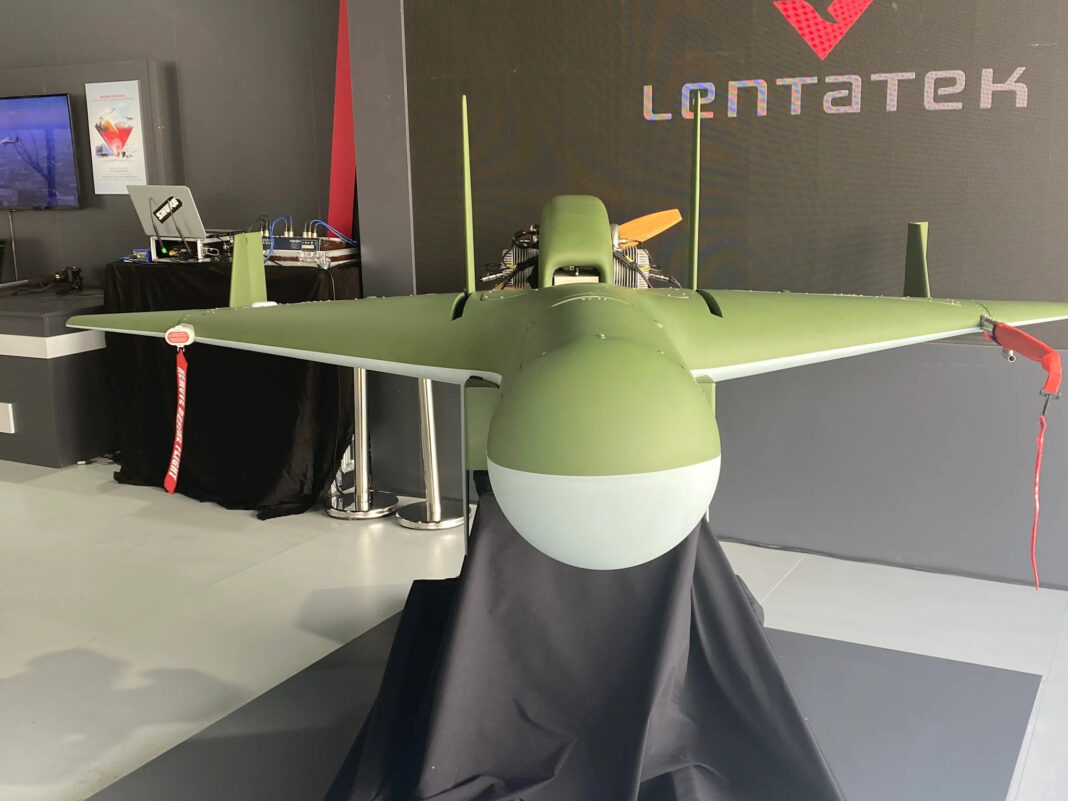

Turkish defense contractor Lentatek has signed its first export deal for the Kargı loitering munition, according to an announcement the company made on its official LinkedIn account.
The buyer was not disclosed.
Lentatek is a subsidiary of Vestel, a company more widely known for producing consumer electronics such as televisions and household appliances. The firm has in recent years expanded into the defense sector as part of Turkey’s broader push to develop indigenous weapons systems.
Loitering munitions, sometimes called “kamikaze drones,” are unmanned aerial vehicles equipped with an explosive warhead. Unlike conventional missiles, they can remain airborne for hours while searching for targets, then dive into them to detonate on impact. Militaries use them against radar sites, missile launchers and other high-value ground targets, and they can also provide reconnaissance.
The Kargı system was developed with support from TÜBİTAK, Turkey’s state-run Scientific and Technological Research Council, beginning in 2015. A prototype was first displayed in İzmir during the Efes-2022 exercise, one of Turkey’s largest military drills. Lentatek is the lead contractor, working together with other state-linked defense companies including ASELSAN, TEI and TÜBİTAK’s Defense Industries Research and Development Institute (SAGE).
While the company has not published detailed specifications, defense analysts estimate that Kargı can fly for about six hours and carries a 30-kilogram explosive warhead. It is designed to detect and destroy enemy air defense radars using a passive radio frequency seeker. Other reported features include satellite communication control, resistance to electronic jamming and the ability to navigate without GPS.
Lentatek has also unveiled a version fitted with electro-optical and infrared cameras that can be used against targets that do not emit radar signals, such as armored vehicles or ammunition depots. That version can also carry out intelligence and surveillance missions.
Although Kargı has now been sold abroad, there has been no confirmation that Turkey’s own military has inducted the system.
Turkey has previously relied on imports for such technology. In 2002 the Turkish Air Force purchased 80 Harpy drones from Israel Aerospace Industries for $108 million. The Harpy, designed to suppress enemy air defenses, was reported to have limited effectiveness. A later $75 million deal for 48 upgraded Harop drones, which added cameras and a data link, was canceled after political relations between Turkey and Israel deteriorated in the late 2000s.
Whether Kargı will replace those systems in Turkey’s own arsenal remains uncertain.