

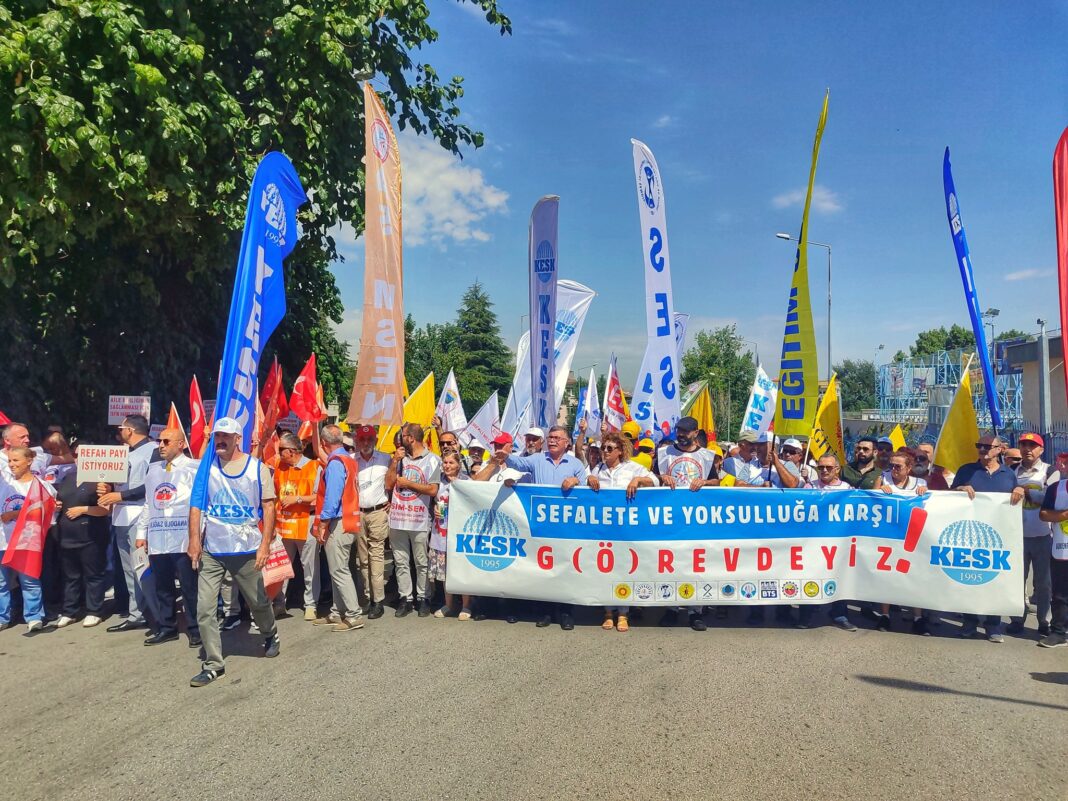

Civil servant unions across Turkey staged a nationwide work stoppage and held rallies on Monday to protest the government’s latest pay offer during ongoing collective bargaining talks, which union leaders slammed as insufficient amid the rising cost of living and high inflation.
The strike was organized by a coalition of public sector unions, most prominently the Confederation of Public Sector Trade Unions (KESK), which gathered with its affiliated unions in front of the National Library in Ankara before marching to the Labor and Social Security Ministry. KESK was later joined by the United Public Workers Confederation (Birleşik Kamu-İş) as well as several other unions, including BASK, DMK, HAK-SEN, YURT-SEN and ASİM-SEN. Coordinated demonstrations also took place in all 81 provinces.
Although the Civil Servants Trade Union (Memur-Sen) and the Turkish Public Workers Labor Union (Kamu-Sen) are known for their close ties to the government and did not take part in the joint demonstration, both held separate protests. Kamu-Sen convened in front of the Treasury and Finance Ministry at 10 a.m., while Memur-Sen’s march to the same ministry was scheduled for 2 p.m.
The strike comes after the government made its second offer in the 8th Term Collective Agreement negotiations, proposing a TL 1,000 ($24.40) raise in base salaries and wage hikes of 10 percent and 6 percent for the first and second halves of 2026, and 4 percent for both halves of 2027. Public employee confederations rejected the proposal, calling it unworthy of negotiation and announced a joint decision to stop work for a day.
Kamu-Sen Chairman Önder Kahveci defended public employees’ right to strike and dismissed warnings of administrative action against participants. “No one can take disciplinary action against any Kamu-Sen member who goes on strike. If anyone does, they will have to deal with me,” he said.
Speaking on behalf of Kamu-Sen members gathered outside the ministry, Kahveci said, “We are here not only for ourselves but for 4 million public workers and 2.5 million retirees and their families — 25 million people in total — who are fighting for a dignified life.”
He denounced the government’s offer, saying: “I ask you, do these rates … mean anything in the face of rapidly rising prices in the marketplace, the bazaar, the grocery store? In a country where rents exceed salaries, do they allow civil servants and retirees to breathe? Of course not. That’s why we say no to this offer.”
In late July the Confederation of Turkish Labor Unions (TÜRK-İŞ), Turkey’s largest labor confederation, announced a series of strikes after failing to reach a deal with government employers over wage increases. Together with HAK-İŞ, the country’s second-largest labor confederation, it is demanding that the daily minimum wage be raised to TL 1,800 ($44), followed by a 50 percent increase in the first half of 2025 and two 25 percent raises in subsequent terms. The unions are also seeking a 10 percent prosperity share to help offset rising living expenses.
A prosperity share is a type of payment made in addition to employees’ regular wages, typically intended to compensate for losses in purchasing power caused by inflation or economic crises. This payment is designed to improve workers’ living standards and ensure a higher level of well-being.
According to TÜRK-İŞ’s July figures, the hunger threshold in Turkey, the amount a family of four needs to spend on food for a healthy and balanced diet, stood at TL 26,413 ($665), exceeding the current monthly minimum wage of TL 22,104 ($574). The poverty line, which includes additional expenses such as housing, transportation, clothing, education and healthcare, was calculated at TL 86,036 ($2,167).
Turkey is known for its relatively high percentage of the workforce making the minimum wage. Labor unions estimated that roughly half of all workers earn a wage similar to the minimum wage.
The Turkish economy has been plagued by high inflation, currency depreciation and a widening wealth gap. The Turkish lira has ranked among the worst-performing emerging market currencies in recent years, largely due to economic and monetary policy under President Recep Tayyip Erdoğan’s government.
Earlier this month, the Turkish Statistical Institute (TurkStat) reported an annual inflation rate of 33.52 percent for July. However, the independent Inflation Research Group (ENAG) estimated annual inflation at 68.68 percent and a monthly rise of 3.05 percent, nearly double the official figures.