


Tarık Toros*
Modern states are often transformed by major crises.
The United States changed after the 9/11 attacks. France expanded its security apparatus in the wake of the Bataclan attacks. Turkey entered a new era after the failed coup of July 15, 2016.
What made Turkey different was that the extraordinary measures introduced in response to the coup did not remain temporary. Over time, the extraordinary became ordinary.
Ten years on, the central question is no longer limited to what happened on the night of the coup.
The real question is this: What kind of state emerged in Turkey after July 15? My argument is straightforward.
July 15 was not simply the date of a failed coup. It marked the birth of a new model of the Turkish state. May 21, 2026, marked the beginning of its second phase. The political, legal and diplomatic developments that have appeared unrelated over the past decade are, in fact, different stages of the same transformation.
A new state
For readers unfamiliar with Turkey, a brief recap is useful.
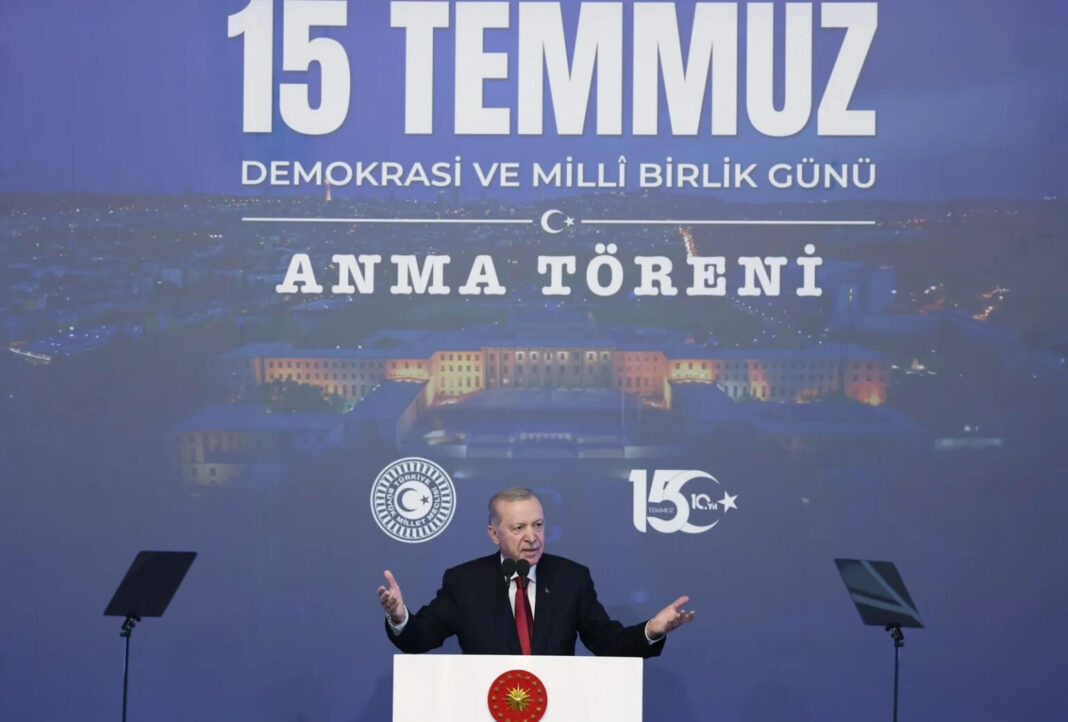
On the night of July 15, 2016, a faction within the military attempted to overthrow the government. Tanks rolled onto the streets, fighter jets flew low over İstanbul and Ankara and more than 250 people were killed. The coup failed.
Yet 10 years later, many of the most important questions about that night remain unanswered. The coup trials gradually faded from public attention. The political and legal order established in their aftermath did not.
In the days that followed, Turkey declared a state of emergency. The state was restructured through emergency decrees, known by their Turkish acronym, KHKs. Parliament was largely sidelined, thousands of institutions were shut down and the state bureaucracy was reshaped from top to bottom.
The post-coup purge also led to the dismissal of more than 120,000 public servants, including judges, prosecutors, teachers, academics and police officers, many without effective judicial review. The armed forces separately expelled 26,206 members through emergency decrees and administrative decisions. The purge reshaped the military, judiciary and other state institutions.
At the time, these measures were presented as temporary. The government said the aim was to remove those believed to have been linked to the coup, rebuild state institutions and eventually return to the normal constitutional order.
Instead, what emerged went far beyond a temporary state of emergency.
Since the coup, Turkish prosecutors have opened terrorism-related investigations involving more than 3 million people, according to Justice Ministry statistics compiled by lawyer Levent Mazılıgüney. Justice Minister Akın Gürlek said recently that 720,338 people had faced legal proceedings over alleged links to the Gülen movement alone.
The prison population also rose dramatically. As of July 1, 2026, Turkey held 427,525 prisoners and pretrial detainees in facilities with an official capacity of 304,956 — more than 122,000 above capacity.
Taken together, the purges, mass investigations and expansion of the prison system reflected a transformation that extended far beyond changes in state personnel.
The change was not limited to personnel.
The scale of the state changed. The way it functioned changed. So did its relationship with citizens.
The biggest lesson of the past decade is this: Once the rule of law yields to exception, the exception has a way of becoming permanent.
The state of emergency formally ended in 2018. Emergency rule came to an end, but the governing logic behind it did not.
If anything, many of the practices introduced during that period became even more deeply embedded.
Today, the state’s decision-making culture still operates largely according to habits formed during the years of emergency rule. There is little sign that this will change any time soon.
A permanent state of emergency
The NATO summit held in Ankara on July 7-8 offered a revealing glimpse into this transformation.
Extraordinary security measures are normal during international summits. What stood out in Turkey, however, was not simply the measures themselves but the degree to which they reflected an established style of government. Public space, daily life, politics and even the judiciary have increasingly come to be shaped by administrative decisions, security justifications and directives issued from the center.
In the run-up to the summit, demonstrations were banned, major roads were closed and nonessential public employees were placed on administrative leave. Some 56,000 police officers and gendarmes were deployed in the capital, while residents faced checkpoints and extensive security screening.
During the summit, Ankara resembled a ghost city.
Officially, Turkey is no longer under a state of emergency.
In practice, however, the mindset of emergency rule has become the normal way of governing in many areas: a system that relies heavily on administrative discretion, operates within poorly defined boundaries and normalizes the use of extraordinary powers.
This transformation has not only reshaped security policy. It has also reshaped the state’s relationship with the law.
Institutions, in my view, increasingly serve those who hold political power. Rules are bent to accommodate political timetables, while the law is often applied according to political necessity.
The state’s decision-making culture has changed. Its bureaucracy has changed. Its judicial architecture has changed. And so has its relationship with citizens.
That is why the political and social developments of recent years should not be seen as isolated events but as different stages of the same transformation.
A permanent economic crisis
The changing relationship between the state and the rule of law did not affect politics alone. It also reshaped Turkey’s economy.
As property rights became less predictable and court decisions increasingly difficult to anticipate, foreign investors grew more cautious about committing long-term capital to the country.
The impact was felt beyond financial markets. Senior executives of the Turkish Industry and Business Association (TÜSİAD), Turkey’s leading business group, were detained and prosecuted after publicly criticizing the government and the state of the country’s legal system.
The seizure of companies during criminal investigations, followed in some cases by their sale under state-appointed management, also became a recurring feature of the economic landscape.
Inflation, which began accelerating sharply in 2021, eroded purchasing power and lowered living standards. Growing income inequality cannot be attributed to the erosion of institutional trust alone, but the weakening of legal predictability has compounded Turkey’s economic problems.
Turkey ranked 118th out of 143 countries in the World Justice Project’s 2025 Rule of Law Index and 163rd out of 180 in Reporters Without Borders’ 2026 World Press Freedom Index. Freedom House continues to classify the country as “Not Free” in the Freedom in the World 2026 index.
These rankings are not merely abstract measurements. They reflect a system in which legal uncertainty increasingly affects political participation, freedom of expression and economic decision-making.
A second phase
The Republican People’s Party (CHP), established by Mustafa Kemal Atatürk, is the party that established the Republic of Turkey and remains the country’s main opposition force. For that reason, every major crisis within the CHP is more than an internal party dispute; it also offers important clues about how Turkey’s political system functions.
Following the military coup of 1980, the CHP was dissolved by the junta before eventually being re-established. In 2026, however, the party faced an unprecedented challenge of a different kind.
In my view, the second phase of the state model that emerged after July 15 began on May 21, 2026.
On that day the Ankara Regional Court of Appeals annulled the CHP’s 2023 congress, ruling that it had been legally invalid from the outset. The decision removed Chairman Özgür Özel and his administration and reinstated former chairman Kemal Kılıçdaroğlu and his team.
Kılıçdaroğlu’s return was fiercely opposed by much of the party and prompted claims from his critics that he had reached an accommodation with the government.
This marked a new stage not only for the CHP but also for the way political competition itself was being shaped in Turkey.
During the first decade after the coup, the state was fundamentally restructured.
In this second phase, that reconfigured state began redefining the rules of politics itself.
For that reason the ruling is about more than the future of the CHP. It forms part of a much broader debate about how Turkey will be governed in the years ahead.
The legal cases against the İstanbul Metropolitan Municipality should be understood in the same context.
The strongest challenger
İstanbul is Turkey’s largest city and its economic powerhouse. For that reason, the office of mayor of İstanbul is widely seen as the country’s most important stepping stone to national leadership. President Recep Tayyip Erdoğan himself began his rise in national politics after serving as mayor of the city in the 1990s.
That is why Ekrem İmamoğlu’s victory in the 2019 local elections was so significant. He defeated the ruling party in İstanbul, ending roughly a quarter-century of Islamist and ruling-party control over the city.
When election officials annulled the initial result in 2019 and ordered a rerun, İmamoğlu won again, this time by an even larger margin. He repeated that success in the 2024 local elections.
Even before formally taking office in 2019, İmamoğlu was being discussed as a future presidential candidate. Having followed a political path that invited comparisons with Erdoğan’s own, he was widely seen as the opposition figure with the greatest potential to challenge the president. The CHP’s sweeping victory in the 2024 local elections reinforced that perception.
From the government’s perspective, İmamoğlu had become its strongest political rival. From the opposition’s perspective, he had become the primary target of the state.
İmamoğlu faced a succession of judicial investigations and was sentenced in 2022 to more than two-and-a-half years in prison and barred from politics for allegedly insulting election officials. That judgment has yet to become final.
The pressure escalated after the 2024 local elections. İmamoğlu was detained on March 19, 2025, and jailed pending trial on March 23 as part of a corruption investigation into the İstanbul Metropolitan Municipality.
The government insists that the investigations are based entirely on legal evidence and that the judiciary operates independently. The opposition argues that they are politically motivated prosecutions designed to remove Erdoğan’s strongest potential challenger from the presidential race before voters have a chance to decide.
A new definition
The transformation taking place inside Turkey has also reshaped its foreign policy.
Turkey remains a NATO member and retains enormous strategic importance to the Western alliance because of its position at the crossroads of Europe, the Middle East, the Caucasus and the Black Sea.
At the same time it is increasingly governed through a model that is more centralized, personalized and security-driven.
The Trump factor has become an important part of this new equation. The relationship between Donald Trump and Recep Tayyip Erdoğan has relied less on traditional state-to-state diplomacy than on personal negotiations between the two leaders.
As decision-making has become increasingly centralized at home, foreign policy has also become more personalized.
It is in this context that the language used by US Ambassador to Turkey and special envoy for Syria Tom Barrack becomes particularly revealing.
Barrack has praised the Ottoman millet system for enabling different communities to coexist under a central authority. In separate remarks about governance in the Middle East, he said that the systems that had proved effective were “powerful leadership regimes,” including “benevolent monarchies” and what he called “a monarchical republic.”
Whether intended as prescriptions for Turkey or merely as historical and regional observations, the remarks appeared to describe a system in which elections and formal institutions remain in place while political power becomes increasingly concentrated at the center.
What makes this even more striking is that around the same time, Kılıçdaroğlu, who had returned to the leadership of the CHP, also invoked Ottoman geography when discussing Turkey’s future, saying the country should develop its own identity within that broader historical space.
The statements were made in different contexts and should not be treated as evidence of a coordinated political project. Taken together, however, they illustrate the growing use of Ottoman concepts to explain Turkey’s place in the region and the governing system emerging at home.
Turkey was entering a new phase of statehood.
Perhaps for the first time, its evolving system of government was being described with new concepts — not only by observers outside the country but also from within Turkey itself.
Conclusion
Describing this transformation simply as authoritarianism is no longer enough.
What has changed in Turkey is not only the concentration of political power. It is the way the state itself functions.
Instead of surrendering the extraordinary powers it acquired during a period of crisis, the state has absorbed them into the new normal.
It has done so without abolishing elections, shutting down parliament or closing the courts, while bringing much of the media under direct or indirect political control.
For that reason understanding today’s Turkey requires more than analyzing election results.
It requires asking how political competition is shaped before people vote, under what circumstances the judiciary intervenes, how much room the opposition is allowed to operate in and how the state continually reproduces its own power.
Above all, it requires asking under what conditions the exception comes to replace the rule of law.
July 15 marked the birth of a new model of the Turkish state.
May 21, 2026, marked the beginning of its second phase.
During the first decade, the state itself was restructured. In the second, that reconfigured state began reshaping the political arena.
Even so, it is too early to conclude that the future is set.
Turkish society is changing. Official narratives face greater scrutiny, particularly from younger people who increasingly expect the state to be accountable rather than unquestionable.
No society can live under a permanent state of exception forever.
States may claim extraordinary powers during times of crisis. The real test comes afterward: whether those powers are ever truly surrendered.
That is one of the defining challenges facing democracies around the world today.
Democracies rarely collapse overnight. More often, they change as exceptions gradually become normal.
That is why, 10 years after July 15, it is no longer enough to debate the coup itself. The more important question concerns the state that emerged in its aftermath.
The fate of nations is often shaped not by coups themselves but by the exceptional measures that survive long after the crisis has passed.
That leaves Turkey with one fundamental question:
Will the rule of law once again become the foundation of the state, or will the exception become its permanent form of government?
*Tarık Toros is a well-known journalist and political commentator currently living in exile in the UK. He was previously the editor-in-chief of Bugün TV, which was seized by the Turkish government in 2015 and subsequently closed down. Toros co-founded MoonStar TV, a YouTube platform dedicated to providing independent journalism for Turkish-speaking audiences. Through his personal channel and other platforms, he analyzes political developments, governance and social issues in Turkey.