

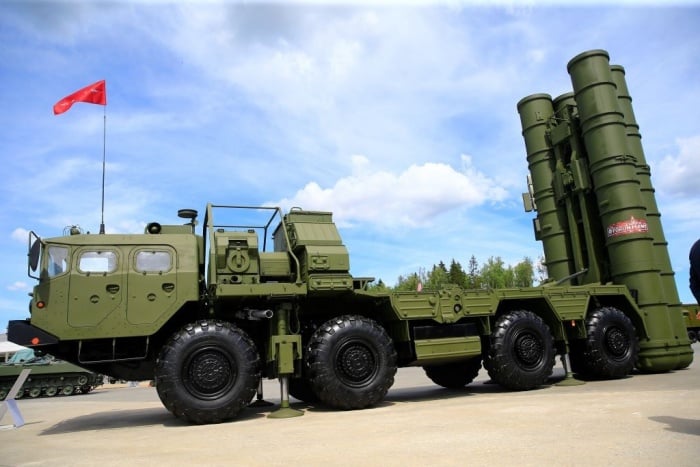

Turkey’s defense ministry said on Thursday that work on the country’s Russian-made S-400 missile defense system was continuing, stopping short of confirming reports that Ankara is seeking to sell or transfer the system to clear the way for its return to the US F-35 Joint Strike fighter program.
“Multi-track work on the S-400 Long-Range Regional Air and Missile Defense Systems is underway,” the ministry said in response to questions after its weekly press briefing. “Concrete developments will be shared with the public when they occur.”
The remarks came after several days of Turkish media reports claiming that Ankara was preparing to sell the S-400 system to a third country, possibly in the Gulf, as part of efforts to resolve a dispute that led to US sanctions and Turkey’s removal from the F-35 program.
Hürriyet daily columnist Abdulkadir Selvi claimed last week that Russia had been persuaded to accept such a proposal and that the system had been sold to either the United Arab Emirates or Qatar.
No Turkish, Russian, Qatari or Emirati official has confirmed a sale.
The Kremlin said on July 10 that Russia was in contact with Turkey over the fate of the S-400s after reports that Ankara could transfer the system to an unnamed Gulf country, Reuters reported.
“This is an extremely sensitive issue,” Kremlin spokesman Dmitry Peskov said, adding that Moscow would continue contacts with Ankara on the matter.
The S-400 issue returned to the agenda after US President Donald Trump said during a meeting with Turkish President Recep Tayyip Erdoğan at a NATO summit in Ankara on July 7 that Washington would lift sanctions on Turkey and decide on a possible F-35 sale.
“We’re going to be taking the sanctions off,” Trump told reporters when asked about measures imposed under the Countering America’s Adversaries Through Sanctions Act (CAATSA).
Foreign Minister Hakan Fidan said on July 10 that Turkey hoped to reach a result soon on both the sanctions and the F-35 issue, adding that there was political will in Ankara and Washington to resolve the dispute.
Fidan said the CAATSA sanctions and the F-35 issue were both subject to US legislation and that the relevant ministers were working on them.
Turkey bought the S-400 system from Russia despite US objections and took delivery of the first components in 2019.
Washington said the Russian system could expose sensitive data about the F-35 stealth fighter and removed Turkey from the aircraft’s procurement and manufacturing program.
The United States imposed CAATSA sanctions in 2020 on Turkey’s defense procurement agency over the purchase.
US law bars the transfer of F-35 aircraft, related support equipment, parts, technical data and maintenance support to Turkey unless the US secretaries of defense and state certify to Congress that Turkey no longer possesses the S-400 system or any associated equipment, materials or personnel.
The law also requires assurances that Turkey will not accept delivery of the system in the future and has not received other Russian defense equipment since July 31, 2019, that could compromise the F-35.
That requirement has made the physical removal, sale or transfer of the S-400 system central to any possible formula for Turkey’s return to the program.
Turkey had planned to buy 100 F-35 fighter jets and was a production partner before its removal from the program.
The Pentagon said at the time that Turkey produced more than 900 parts for the F-35 and stood to lose more than $9 billion in projected work over the life of the program.
The S-400 system has been a source of tension between Ankara and Washington for years, even as both sides have continued defense talks on other issues, including Turkey’s purchase of upgraded F-16 jets and its interest in rejoining the F-35 program.