

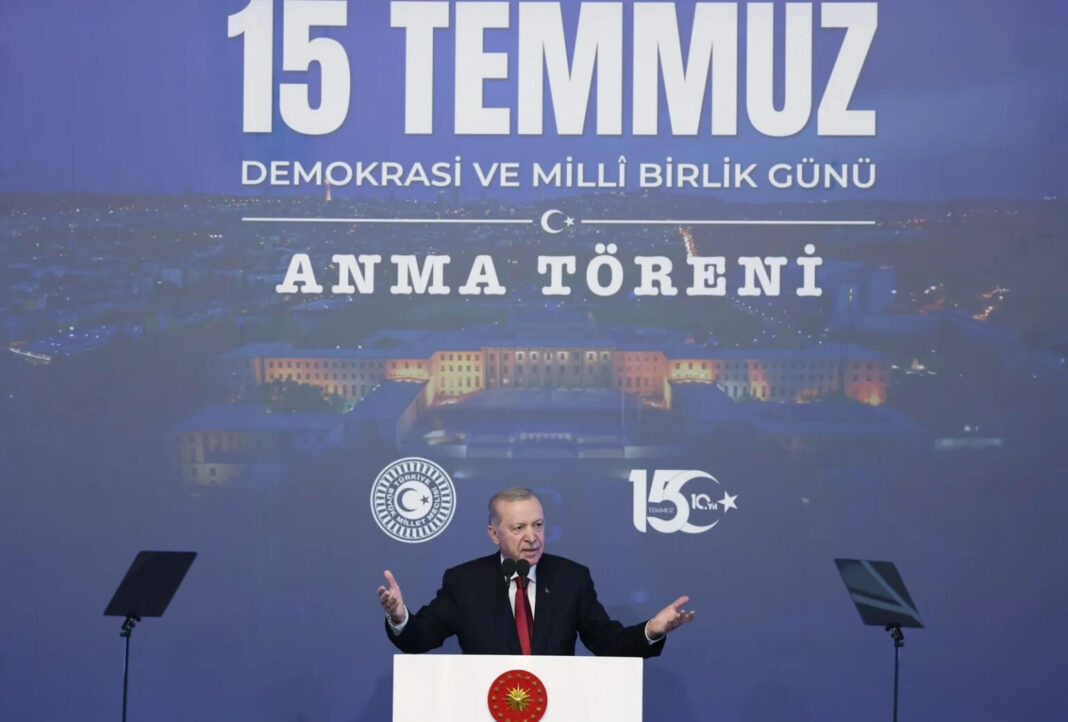

President Recep Tayyip Erdoğan said Wednesday that the faith-based Gülen movement continues to pose a threat to Turkey, as nationwide detention operations continue a decade after a failed coup and more than 720,000 people have been investigated over alleged links to the group, the state-run Anadolu news agency reported.
Speaking at a ceremony in parliament marking the 10th anniversary of the July 15, 2016, coup attempt, Erdoğan vowed to continue the campaign against the movement, which Turkey designates as the Fethullahist Terrorist Organization (FETÖ).
The movement was inspired by Turkish-Islamic scholar Fethullah Gülen, who died in the United States in October 2024, and developed a worldwide network of schools, charities, businesses and media organizations.
The Turkish government began targeting the movement after corruption investigations in December 2013 implicated Erdoğan’s government, family members and inner circle.
Erdoğan dismissed the investigations as a judicial coup by Gülen followers and later accused the movement of infiltrating state institutions and orchestrating the 2016 coup attempt.
Turkey designated the movement as a terrorist organization in May 2016. The movement denies involvement in the coup or any terrorist activity and is not designated as a terrorist organization by the United States or the European Union.
“The threat posed by FETÖ has been quarantined, but despite all this, the danger still persists,” Erdoğan said.
“If we forget, we will experience the same hardships again. That is why we will not lower our guard for even a moment in the fight against the organization.”
Erdoğan described July 15 as not only a coup attempt but also an attempted invasion, calling it “an imperialist project” carried out by domestic actors in cooperation with foreign powers. He did not elaborate.
On that night, a faction of the Turkish military used warplanes and tanks to attack government buildings in İstanbul and Ankara in an attempt to overthrow Erdoğan. More than 250 people were killed and nearly 2,200 injured.
Erdoğan immediately blamed the Gülen movement. Gülen repeatedly denied involvement and called for an independent international investigation, saying he would accept its findings. Ankara did not take up the proposal.
The government subsequently declared a state of emergency and launched a sweeping purge in which hundreds of thousands of people were investigated, more than 120,000 convicted and some 130,000 civil servants dismissed by emergency decree, often without effective judicial review.
The postcoup purge also led to the dismissal of more than 120,000 public servants, including judges, prosecutors, teachers, academics and police officers, many without effective judicial review. The armed forces separately expelled 26,206 members through emergency decrees and administrative decisions. The purge reshaped the military, judiciary and other state institutions.
Erdoğan also described the executive presidency introduced after the coup attempt as one of Turkey’s most important reforms, claiming that the country’s achievements over the past decade in the defense industry, economy, national security and foreign policy had been made possible by removing alleged Gülen followers from state institutions.
Turkey adopted the executive presidency in a 2017 referendum, replacing its parliamentary system. Critics say the system eliminated important checks and balances, granted Erdoğan extensive powers and enabled one-man rule.
Erdoğan’s remarks came after Justice Minister Akın Gürlek announced last Sunday that 720,338 people had been investigated over alleged links to the movement since the coup attempt. According to Gürlek, 127,102 have been convicted, while proceedings involving another 83,404 are continuing.
Gürlek also said security forces carried out 1,065 operations targeting alleged movement members in the first half of 2026, detaining 2,451 people.
The government also announced on Monday another nationwide operation targeting 968 suspects in all 81 provinces ahead of the anniversary. Media reports and rights advocates said those targeted included elderly, sick and disabled people as well as teachers, doctors, lawyers, academics and other civilians.
Rights organizations and legal experts say terrorism prosecutions in Gülen-linked cases have frequently relied on activities that were legal at the time or alleged association with the movement rather than individualized evidence of criminal conduct.
Those concerns were reinforced by a landmark September 2023 ruling in which the Grand Chamber of the European Court of Human Rights found that Turkey had violated the rights of former teacher Yüksel Yalçınkaya under Articles 7, 6 and 11 of the convention.
The court ruled that the Turkish courts’ categorical reliance on his use of ByLock, an encrypted messaging app, had created an effectively automatic presumption of guilt without individualized evidence, violating his rights to a fair trial and to no punishment without law.