

 said Wednesday that continued inaction over Turkey’s refusal to implement European Court of Human Rights (ECtHR) judgments sends the wrong message about the credibility of Europe’s rights system, while a Cypriot lawmaker said proposed Magnitsky-style sanctions could target judges, prosecutors, trustees and ministers involved in violations.)
Bünyamin Tekin, Strasbourg
A British member of the Parliamentary Assembly of the Council of Europe (PACE) said Wednesday that continued inaction over Turkey’s refusal to implement European Court of Human Rights (ECtHR) judgments sends the wrong message about the credibility of Europe’s rights system, while a Cypriot lawmaker said proposed Magnitsky-style sanctions could target judges, prosecutors, trustees and ministers involved in violations.
The comments came at a side event held at PACE in Strasbourg on Turkey’s failure to comply with judgments of the ECtHR, the court that interprets the European Convention on Human Rights.
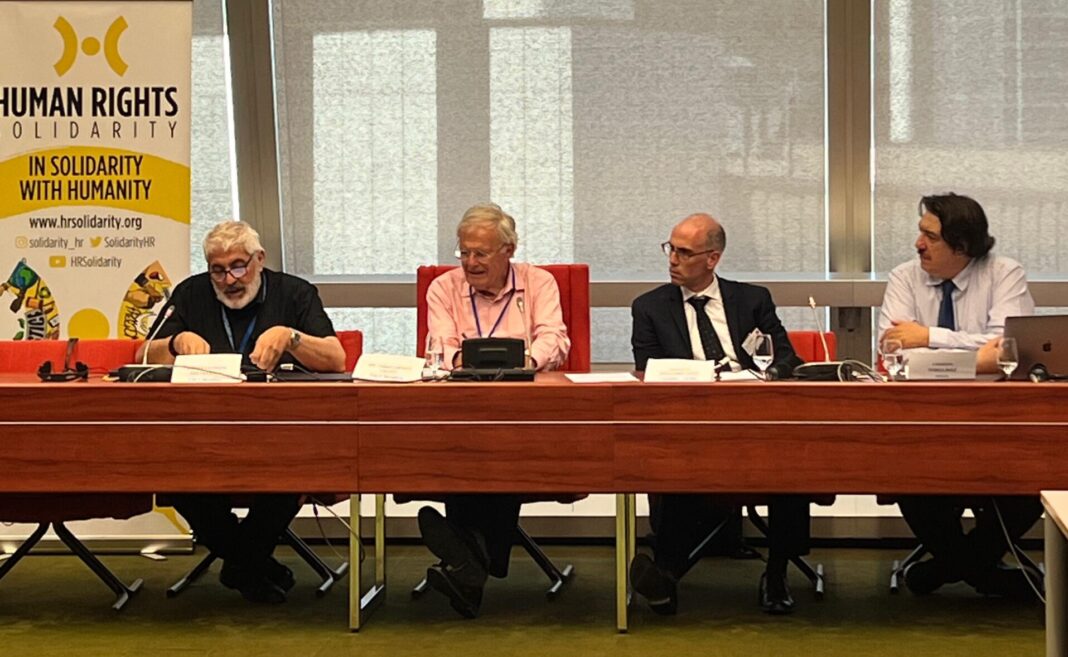
The event, titled “Turkey and the European Court of Human Rights: The role of the Parliamentary Assembly and civil society in ensuring compliance with court judgments,” was organized by The Arrested Lawyers Initiative and Human Rights Solidarity and hosted by Sir Christopher Chope, a British PACE member.
The panel discussion was moderated by lawyer Coşkun Yorulmaz. Speakers included Chope, Constantinos Efstathiou, a Cypriot PACE member and rapporteur on the implementation of ECtHR judgments, and Alexis Anagnostakis, human rights officer of the European Criminal Bar Association.
The discussion focused on Turkey’s refusal or failure to enforce European court rulings in cases involving civil society leader Osman Kavala, Kurdish politician Selahattin Demirtaş, former lawmaker Figen Yüksekdağ Şenoğlu and thousands of people convicted of terrorism over alleged links to the faith-based Gülen movement.
Turkish President Recep Tayyip Erdoğan has targeted followers of the Gülen movement, inspired by the late Muslim cleric Fethullah Gülen, since corruption investigations in December 2013 implicated him as well as some members of his family and inner circle.
Dismissing the investigations as a Gülenist conspiracy and a coup attempt against his government, Erdoğan began to target the movement’s members. He designated the movement as a terrorist organization in May 2016 and intensified the crackdown following a failed coup in July of the same year that he accused Gülen of masterminding. The movement denies involvement in the coup attempt or any terrorist activity.
According to the latest figures from the Justice Ministry, more than 126,000 people have been convicted for alleged links to the movement since 2016, with 11,085 still in prison. Legal proceedings are ongoing for more than 24,000 people, while another 58,000 remain under active investigation nearly a decade later.
Turkey has been under increased scrutiny at the Council of Europe over its failure to implement European court judgments. The Council of Europe, founded after World War II to protect human rights, democracy and the rule of law, is separate from the European Union. Turkey is a founding member.
Chope said during the panel discussion that Turkey’s defiance of Strasbourg judgments was not only a Turkish problem but a threat to the Council of Europe system itself.
He said the Council of Europe, the European court and the Committee of Ministers, the council’s executive body that supervises the implementation of court judgments, risk undermining their own authority if they fail to respond to Turkey’s conduct.
Chope said Turkey should either comply with its obligations or face consequences, adding that expulsion remained one of the ultimate tools available under the Council of Europe system, although member states have been reluctant to use it because of geopolitical concerns, including Turkey’s role in NATO.
Chope was asked by Turkish Minute after the panel discussion whether such a course could deprive Turkish citizens of access to the European court, as happened to the Russians after Russia was expelled from the Council of Europe following its invasion of Ukraine.
Chope said the point was not to call for Turkish citizens to lose access to the court but to make clear that noncompliance must have serious consequences. He said it would be up to Turkey whether to withdraw from the system, but what Europe should not do is remain inactive, because inaction sends the wrong message about the seriousness of the European human rights system.
Russia was expelled from the Council of Europe in March 2022 after its full-scale invasion of Ukraine. It ceased to be a party to the European Convention on Human Rights six months later, limiting Russians’ access to the court for violations that occurred after that date.
Efstathiou used the panel discussion to challenge Turkey’s claim that it has a strong record of implementing ECtHR judgments.
He said the real measure of compliance was not how many repetitive cases were closed through compensation but whether leading judgments pointing to structural problems had been implemented.
His 2025 PACE report said Turkey had 137 leading cases pending implementation at the end of 2024, the highest number among Council of Europe member states. Leading cases are cases that reveal problems in law or practice and often require legislative or administrative changes to prevent repeated violations.
Efstathiou said Turkey’s record showed that domestic courts systematically ignored the case law of the European court.
He pointed to Kavala, who has been imprisoned since 2017 despite European court judgments calling for his release, and Demirtaş, the former co-chair of the pro-Kurdish Peoples’ Democratic Party (HDP), who has been behind bars since November 2016.
Kavala, a businessman and civil society figure, was convicted over the 2013 Gezi Park protests and sentenced to aggravated life in prison. The European court found that his detention was politically motivated and that Turkey had failed to comply with its obligation to release him.
Demirtaş, one of Turkey’s best-known Kurdish politicians, was sentenced in May 2024 to 42 years in prison in a case stemming from speeches and social media posts. The ECtHR found in 2020 that his detention pursued an ulterior political purpose.
Efstathiou also referred to the Grand Chamber judgment in the case of Yüksel Yalçınkaya, a teacher convicted of terrorism over alleged use of the ByLock messaging application, an account at Bank Asya and membership in a trade union and association that were legal at the time.
The European court found violations of the right to a fair trial, the principle of no punishment without law and freedom of association in Yalçınkaya’s case. It said the Turkish courts’ approach to ByLock evidence reflected a systemic problem and noted that thousands of similar applications were pending before the Strasbourg court.
Efstathiou said the Yalçınkaya ruling was historic because it applied to more than 8,000 cases pending in Strasbourg and more than 100,000 cases that could reach the court from Turkey. He said violations of Articles 6 and 7 of the European convention in similar cases had exceeded 3,500.
Anagnostakis said the problem was not limited to one state’s violation of rights but also reflected a European failure of enforcement.
He said the European system had the legal tools to respond but lacked the political will, adding that engagement without consequences had a cost that was being paid by people in prison.
He also criticized the prosecution of lawyers in Turkey, saying lawyers were convicted while European institutions were monitoring and reporting on the situation.
The panel also discussed a proposal for Magnitsky-style targeted sanctions against Turkish officials involved in serious violations and the non-implementation of European court judgments.
In comments to Turkish Minute after the panel discussion, Efstathiou said the shortest path to such sanctions would depend on whether the relevant motion advances during the current PACE session and is then moved quickly through the Council of Europe process. If that happens, he said, the process could be completed in about nine months.
Asked whether the sanctions would be limited to token names or target a wider group of officials, Efstathiou said the proposal should cover anyone involved in the violations, from trustees appointed to replace elected mayors to cabinet ministers, judges and prosecutors.
The trustee system has been used by Turkish authorities to remove elected mayors, especially in Kurdish-majority provinces, and replace them with government-appointed officials. Critics say the practice nullifies election results and is part of a broader pattern of using the judiciary and administrative powers against opposition politicians.
The event took place during PACE’s summer session in Strasbourg and one day after the assembly’s new parliamentary network on the implementation of European court judgments held its first meeting.
PACE launched the network to bring parliamentarians together to push governments to enforce Strasbourg judgments and make legislative changes required by the court.
Civil society representatives at the panel discussion said victims of Turkey’s post-coup crackdown had been waiting years for justice and that European institutions had to move beyond monitoring, reports and technical consultations.
One speaker said people dismissed by emergency decrees after the coup attempt waited years before their cases reached the European court, only to face a new problem when Turkey refused to implement judgments in their favor.
The panel discussion ended with calls for more pressure from PACE, the Committee of Ministers and national parliaments, along with stronger coordination with civil society groups documenting violations in Turkey.
Chope said the Council of Europe cannot protect its authority unless it applies the rule of law within its own system. Efstathiou said Turkey’s record showed that the issue was not a technical problem but a question of political will.