

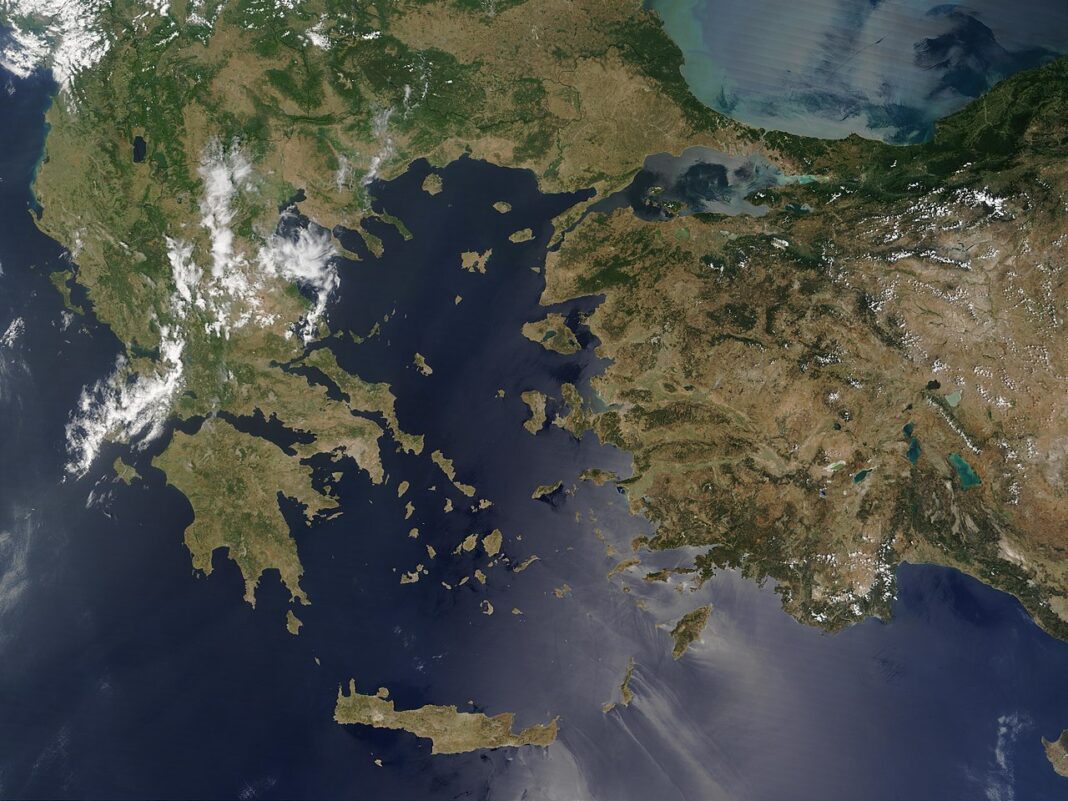

A Turkish maritime law center and officials linked to presidential advisory bodies on Tuesday detailed a bill that would write Ankara’s claims in the Aegean, the eastern Mediterranean and the Black Sea into domestic legislation while keeping territorial waters in the Aegean at six nautical miles and giving the president power to declare special-status maritime zones.
The draft was presented at a news conference organized by Ankara University’s National Center for Sea and Maritime Law (DEHUKAM), where DEHUKAM officials described it as a framework law covering Turkey’s internal waters, territorial waters, contiguous zone, continental shelf and exclusive economic zone.
The meeting marked the first public presentation of the legislation, following a Bloomberg report last week that Ankara was preparing a bill to put its maritime claims into domestic law, a move that would add a formal legal layer to long-running disputes with Greece and Cyprus over maritime boundaries and offshore energy resources.
DEHUKAM director Mustafa Başkara said the bill would set basic rules for determining the breadth and limits of Turkey’s maritime zones and would give the presidency powers related to those areas. It would also cover maritime crimes, narcotics cases, innocent passage through Turkish territorial waters and the legal framework for activities in Turkish-claimed zones.
Officials said the draft would not conflict with the 1936 Montreux Convention on the Straits, which governs passage through the Bosporus and the Dardanelles, and would strengthen Turkey’s position that the Dardanelles, the Sea of Marmara and the Bosporus are internal waters.
Citing senior officials from the ruling Justice and Development Party (AKP), DW Turkish reported that work on the bill is nearly complete and that it could be submitted to parliament after Eid al-Adha, which falls in late May this year. The Turkish Armed Forces, navy and coast guard have submitted technical opinions on the draft, the same report said.
The proposal would cover all seas bordering Turkey. Territorial waters would be recorded at 12 nautical miles in the Black Sea and Mediterranean and six nautical miles in the Aegean.
The Aegean limit
Yücel Acer, a member of the presidency’s Legal Policies Council, said the bill would keep Turkey’s territorial waters at six nautical miles in the Aegean and would not create a new situation for Greece. Ankara’s position that any extension beyond six nautical miles is unacceptable remains unchanged, he said.
That position has firm parliamentary backing. On June 8, 1995, Turkey’s parliament authorized the government to take all necessary measures if Greece extended its territorial waters in the Aegean beyond six nautical miles, a move widely described as a casus belli, or cause for war. The declaration has never been rescinded.
Acer said the bill would permit larger territorial waters in areas where Turkey deems this necessary to protect its rights, particularly in the Black Sea and eastern Mediterranean, while keeping the Aegean limit intact.
“Greece is not facing a new situation,” he said, adding that Turkey had told Athens since the 1960s that six nautical miles should remain the ceiling in the Aegean.
The underlying dispute concerns territorial waters, continental shelf rights and the maritime zones generated by Greek islands off Turkey’s western coast. Greece argues that islands carry full rights to continental shelves and exclusive economic zones under international law. Turkey rejects that view, at least in the Aegean, arguing that island entitlements should not automatically match those of mainland territory in all circumstances.
Turkey is not a party to the United Nations Convention on the Law of the Sea (UNCLOS), the main treaty governing maritime zones, arguing that some of its provisions, particularly those affecting the Aegean, do not reflect Turkey’s geographic circumstances.
Presidential powers
Another provision would allow the president to declare special-status maritime areas in zones where Turkey has not proclaimed an exclusive economic zone. Başkara said such areas could be designated for fishing, marine protection or other purposes.
The provision could allow Ankara to claim regulatory authority in areas where no bilateral maritime boundary has been negotiated, particularly in parts of the Aegean or eastern Mediterranean that Greece or Cyprus also claim.
Energy stakes
The bill comes amid competition over offshore energy in the eastern Mediterranean. The region has gained importance since gas reserves were discovered near Cyprus, Israel and Egypt, with Turkey objecting to energy agreements and exploration activity involving the Republic of Cyprus.
Ankara argues that Turkish Cypriots have rights to offshore resources around Cyprus, an island divided since Turkey’s 1974 military intervention following a coup backed by the then-ruling Greek military junta that sought to unite the island with Greece.
The Republic of Cyprus, a European Union member, is internationally recognized as sovereign over the entire island, while the Turkish Republic of Northern Cyprus (KKTC) is recognized only by Turkey.
Turkey also signed a maritime boundary agreement in 2019 with Libya’s Tripoli-based government. Greece, Cyprus and the European Union rejected the deal. Ankara views it as part of its maritime rights in the eastern Mediterranean; Athens and Nicosia say it violates their own claims.
Political signals
Devlet Bahçeli, leader of the far-right Nationalist Movement Party (MHP) and a key partner in President Recep Tayyip Erdoğan’s ruling coalition, warned parliament on Tuesday that Turkey could not stay silent in the face of moves ignoring its maritime claims or the rights of Turkish Cypriots.
His remarks came amid Turkish concern over security and energy cooperation between Greece, Cyprus, France and Israel, which Ankara views as creating a security imbalance in the region.
Greek government spokesperson Pavlos Marinakis said unilateral legislation by any one country “obviously carries absolutely no weight whatsoever under international law.” Cyprus has also objected to Turkish maritime claims that overlap with offshore energy blocks licensed by Nicosia.
Filling the gap
Supporters of the bill say Turkey has had no comprehensive maritime jurisdiction statute since the 1982 Territorial Waters Law, even as neighboring states built up maritime planning maps, fishing restrictions and energy agreements.
Çağrı Erhan, deputy chair of the presidency’s Security and Foreign Policies Council, said at the DEHUKAM meeting that the draft was not prepared with any one country in mind.
The bill has not been submitted to parliament, and its full text has not been released. If enacted, it would mark Turkey’s first attempt to consolidate its broader maritime jurisdiction claims into a single domestic legal framework, giving statutory force to positions that have been at the center of its disputes with Greece and Cyprus for decades.