

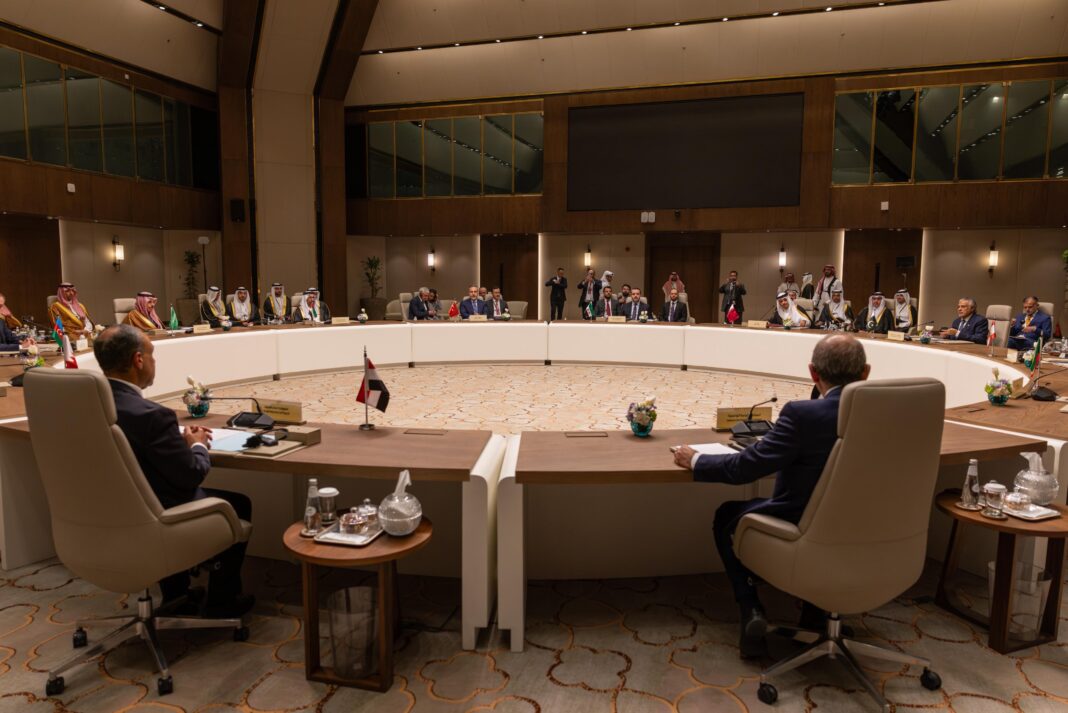

Turkey faced criticism after it joined 11 other Arab and Muslim countries in signing a statement in Riyadh on Wednesday that condemned Iran’s missile and drone attacks on regional states but made no mention of the US and Israeli strikes on Iran that critics say triggered the latest escalation.
The statement, issued after a consultative meeting of foreign ministers in the Saudi capital of Riyadh on Wednesday, was signed by Qatar, Azerbaijan, Bahrain, Egypt, Jordan, Kuwait, Lebanon, Pakistan, Saudi Arabia, Syria, Turkey and the United Arab Emirates. It denounced what it called deliberate Iranian attacks on Gulf Cooperation Council member states as well as Jordan, Azerbaijan and Turkey, and said the strikes targeted residential areas and civilian infrastructure including oil facilities, desalination plants, airports, residential compounds and diplomatic premises.
It appears Egypt, Saudi Arabia, Turkey, UAE, Azerbaijan, Pakistan, Qatar, Kuwait, Lebanon, Jordan, Syria convened in Riyadh to condemn Iran, and they only briefly mentioned about Israel to criticize its actions in Lebanon, not in Tehran. pic.twitter.com/giHhlq8v5z
— Ragıp Soylu (@ragipsoylu) March 19, 2026
The text said the attacks could not be justified “under any pretext or in any form” and reaffirmed the right of states to defend themselves under Article 51 of the United Nations Charter. It called on Iran to immediately halt its attacks, respect international law and stop supporting and arming affiliated militias in Arab states. It also urged Tehran not to threaten shipping in the Strait of Hormuz or maritime security in the Bab al Mandab.
The statement did mention Israel, but only in a separate passage on Lebanon. There, the ministers reaffirmed support for Lebanon’s sovereignty and condemned Israel’s attacks on Lebanon and what they called its expansionist policies in the region. The document did not mention Israeli strikes on Iran or the role of the United States in the war.
Missile alert interrupts Riyadh meeting
The meeting took place under direct threat. Reuters reported that ministers gathered in Riyadh as missile alerts were issued across the Saudi capital and Saudi air defenses intercepted incoming projectiles. Saudi Foreign Minister Prince Faisal bin Farhan later said the kingdom reserved the right to take military action against Iran if necessary.
Turkish media said the danger reached the ministers themselves. NTV political commentator Kemal Öztürk, who was in Riyadh following Foreign Minister Hakan Fidan’s Gulf tour, said phones at the venue received alerts warning that the area was under attack and telling people to go to shelters. According to Öztürk, Fidan received the same warning, with hotel staff directing those present to a shelter.
Backlash over omission of US, Israel
The omission of the US and Israel as the ones initiating strikes on Iran sparked a wave of criticism, particularly in Turkey, where commentators said Ankara had signed onto a text that treated Iran’s retaliation as if it had come out of nowhere while ignoring the broader military campaign that preceded it.
Journalist Gürkan Zengin said the statement was one that could only be signed if Iran had attacked those countries “for no reason,” arguing that the absence of any reference to Washington and the limited mention of Israel marked a serious retreat from Turkey’s earlier position.
Former culture minister Ertuğrul Günay also criticized the statement, saying it condemned Iran without a single sentence of context on Israel or the United States’ aggression toward Iran.
Naim Öztürk, a deputy chairman of the Islamist New Welfare Party, called the result shameful and said the ministers failed to show the courage to confront Washington and Israel over what he described as aggression.
Turkey had until now tried to strike a more balanced public line. Foreign Minister Fidan was expected to stress the need for a negotiated and peaceful solution and that Ankara had condemned both the US and Israeli strikes on Iran as violations of international law while also calling Iran’s attacks on Gulf states unacceptable.
That made Turkey’s signature stand out. By joining the Riyadh statement, Ankara aligned itself with a text that focused on Iranian attacks on neighboring countries and civilian sites while leaving out the US and Israeli actions that many critics see as the starting point of the crisis.
The joint text reflected the priorities of states that have come under direct Iranian fire in recent days, especially attacks on energy and civilian infrastructure in the Gulf.
Aslı Aydıntaşbaş, a Turkish journalist and analyst at the Brookings Institution, wrote that the statement’s silence on Israeli targeting of Iran, except for a reference to Israeli aggression on Lebanon, suggested Gulf and Muslim states were losing patience with Tehran and were divided over Israel. Others were less restrained, accusing Ankara of moving closer to the Saudi and Emirati line at the expense of the position it had voiced earlier.