

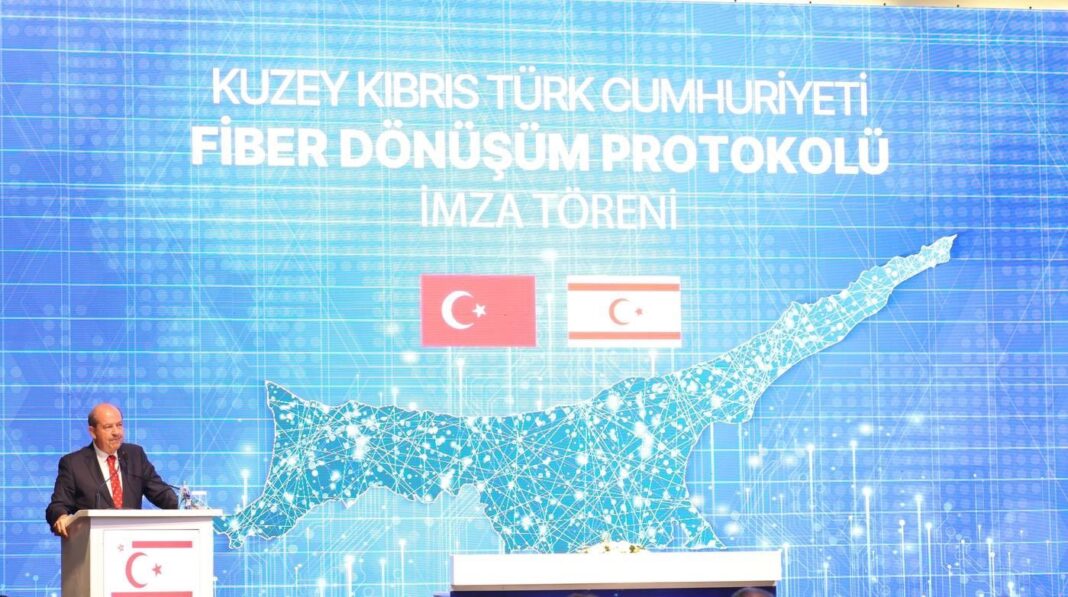
 has sent a law approving a fiber optic deal with Turkey to the KKTC's Constitutional Court to review its legality, opening a battle over an agreement critics say would hand control of a public communications network to Turkey’s Türk Telekom without a tender.)
The president of the Turkish Republic of Northern Cyprus (KKTC) has sent a law approving a fiber optic deal with Turkey to the KKTC’s Constitutional Court to review its legality, opening a battle over an agreement critics say would hand control of a public communications network to Turkey’s Türk Telekom without a tender.
President Tufan Erhürman said he had referred the law for constitutional review after it was passed by the KKTC assembly. The move puts fresh scrutiny on a protocol signed by Ankara and the Turkish Cypriot administration on July 11, 2025, to expand fiber infrastructure and connect homes and businesses through a long-term project led by Türk Telekom.
The agreement has become a political flashpoint in northern Cyprus, the breakaway state in the island’s north that is recognized only by Turkey. Supporters in the ruling coalition have described it as a strategic investment worth about $100 million that would bring fiber internet to 150,000 homes. Opposition lawmakers and trade groups, however, say the arrangement was approved without a competitive bidding process and would give Türk Telekom the right to operate the infrastructure for 25 years.
The bill passed the assembly with 27 votes in favor and 20 against after days of debate. The main opposition Republican Turkish Party objected to the lack of a tender and to the scale of control granted to Türk Telekom, while the coalition government at the time defended the deal as a needed upgrade to an outdated internet network.
Trade unions and internet service providers have also challenged the project. Tel-Sen, a union representing telecommunications workers, said it had gone to court over what it called an improper transfer of public assets. Industry representatives said the protocol could block other companies from providing service for years and shift revenue from the telecommunications department to a private company.
Critics say the case is not about whether northern Cyprus needs faster internet but about who will control a strategic network and under what terms. They argue that turning over infrastructure built with public resources to a company tied to Turkey’s sovereign wealth fund raises questions about transparency, state authority and the future role of local institutions.
Türk Telekom said when the protocol was signed that it would lead the fiber rollout and link the territory’s digital backbone more closely to Turkey.
If the Constitutional Court finds that parts of the law violate the KKTC constitution, those provisions could be struck down or returned to the assembly for revision. A broader ruling against the law could halt or reshape Ankara’s plan to put northern Cyprus’s fiber network under Türk Telekom’s management.
Cyprus has been divided since 1974, when Turkey intervened after a coup by Greek Cypriot hard-liners seeking union with Greece, leaving the island split between the internationally recognized Republic of Cyprus in the south and the KKTC in the north, separated by a United Nations buffer zone.
Erhürman, a center-left Turkish Cypriot leader, is generally seen as more supportive of renewed reunification talks and a UN-backed federal framework than Ankara’s recent push for a permanent two-state formula, putting him at odds with efforts by Turkish nationalists to treat northern Cyprus less as a self-governing entity and more as an extension of Turkey.