

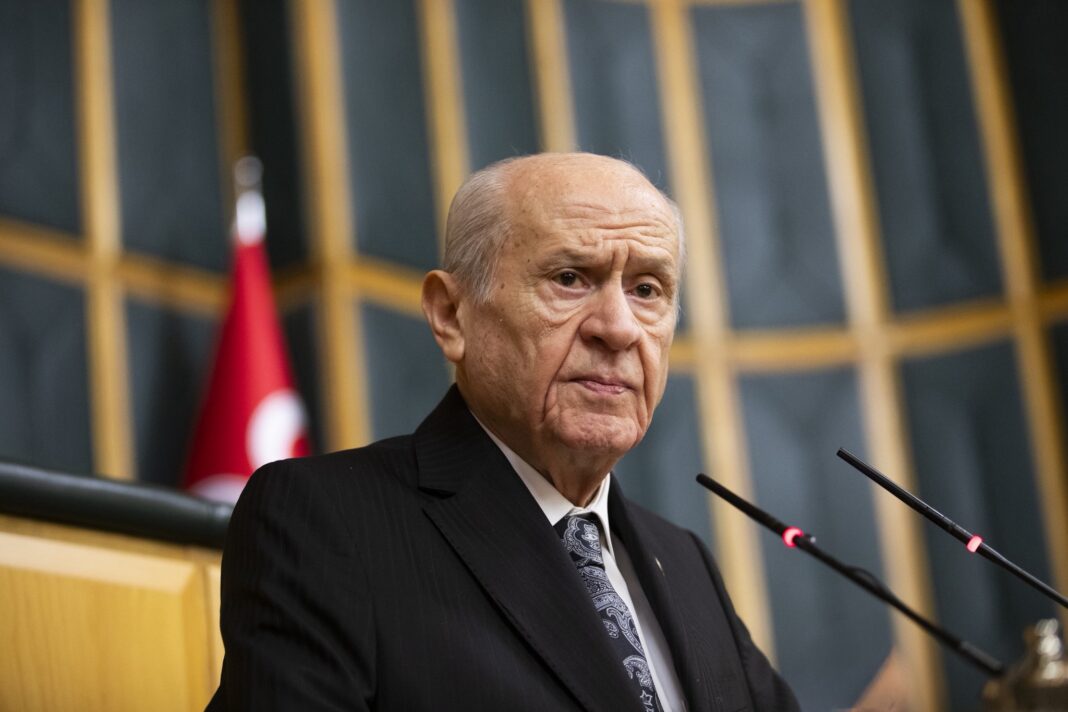
 and a key ally of President Recep Tayyip Erdoğan, on Tuesday accused the US and Israel of driving the region deeper into war, saying the “military and political will of the Zionist-imperialist alliance is steeped in blood, hatred and malice.”)
Devlet Bahçeli, leader of Turkey’s far-right Nationalist Movement Party (MHP) and a key ally of President Recep Tayyip Erdoğan, on Tuesday accused the US and Israel of driving the region deeper into war, saying the “military and political will of the Zionist-imperialist alliance is steeped in blood, hatred and malice.”
Bahçeli made the remarks during his party’s parliamentary group meeting in the legislature.
The far-right leader said calls for a ceasefire and diplomacy had failed and accused Washington of using coercive language after President Donald Trump said he and Israeli Prime Minister Benjamin Netanyahu would decide when the war ends.
Bahçeli also said civilians in Iran were bearing the cost of the campaign and pointed to the February 28 strike on a girls’ school in Minab, in southern Iran, which UN experts said reportedly killed at least 165 schoolgirls. Analyses by US media point to likely US responsibility for that strike. The US military is conducting an investigation.
Bahçeli’s remarks came as Washington signaled that Tuesday would bring the most intense day of strikes yet in the war. The US said it had hit more than 5,000 targets in the first 10 days of the campaign, including naval assets, while the disruption of traffic through Strait of Hormuz, through which about one-fifth of the world’s oil passes, is driving up energy and fertilizer costs and raising fears of greater economic fallout.
The Turkish politician’s speech also reflected Ankara’s growing concern that the war is moving closer to Turkey’s borders. Turkey said on Monday that NATO air defenses shot down a second ballistic missile fired from Iran after it entered Turkish airspace.
Turkey also said last week that it was also closely following the actions of the Iranian Kurdish militant group PJAK amid reports of discussions between Iranian Kurdish groups and Washington over whether and how to attack Iranian security forces.
Kurds and Iran
In his speech Bahçeli warned against any effort to use Kurds inside Iran as a proxy force against Tehran. He said Kurds were “not for sale” and “not for hire” and argued that attempts to push them into the conflict would amount to a plan to destabilize Iran from within. The remarks came days after Reuters reported that Iranian Kurdish groups had consulted with the US about possible action against Iranian forces in western Iran, a development that Turkish officials view with alarm as Ankara tries to manage a fragile peace initiative with the Kurdistan Workers’ Party (PKK).
Bahçeli also used the war to reinforce a long-running nationalist message at home, saying Turks and Kurds share a common fate and warning against attempts to drive a wedge between them or to open a new front between Turkey and Iran. His comments fit a broader line from Ankara, which has opposed moves that could turn Kurdish armed groups into a US-backed lever against neighboring states, whether in Syria, Iraq or now Iran.
Turkey has tried to present itself as a country seeking to contain the conflict rather than join it. Foreign Minister Hakan Fidan said over the weekend that any attempt to provoke civil war in Iran by exploiting ethnic or sectarian fault lines would be a historic mistake. But the missile incidents over Turkish territory, along with strikes elsewhere in the Gulf, have increased pressure on Ankara to tighten its air defense posture while staying out of direct confrontation.
The fighting has already moved beyond a direct Israel-Iran exchange into a wider regional crisis.
Iran appears to be betting on endurance, missile attacks and energy disruption to outlast Washington and Israel politically rather than defeat them outright on the battlefield. That strategy has included strikes across the Gulf, pressure on oil routes and an attempt to raise the economic cost of war for US allies and global markets.