


Leaders of Turkey’s business community have called on European Union institutions to take steps toward reinvigorating Turkey’s long-stalled EU membership bid, warning that the current stagnation undermines strategic cooperation at a time of growing geopolitical and economic challenges.
In an open letter addressed to top EU leaders, including European Parliament President Roberta Metsola, European Council President António Costa and European Commission President Ursula von der Leyen, representatives of 26 Turkey-EU business councils urged Brussels to adopt what they described as a “paradigm shift” in relations with Ankara.
The letter was published as an advertisement in the Financial Times on January 31.
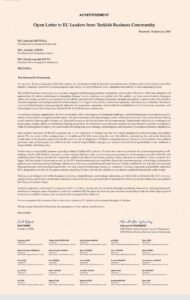
The business leaders said in the letter, signed by senior officials of the Foreign Economic Relations Board (DEİK), that Turkey’s integration into the EU’s strategic framework is increasingly urgent as Europe faces pressures ranging from artificial intelligence transformation to energy transition demands and regional security concerns.
They said Turkey has been an integral part of Europe’s industrial ecosystems and innovation networks for decades and stressed that renewed engagement would strengthen Europe’s economic competitiveness and strategic autonomy.
Turkey has been an official candidate for EU membership since 1999, and accession negotiations began in 2005. However, the process has effectively been frozen in recent years amid growing tensions over democratic backsliding, rule-of-law concerns and Ankara’s foreign policy disputes with EU member states.
The business leaders called on the EU to provide Turkey with a “clear and unambiguous perspective” on membership, saying that restoring trust and mutual confidence could help overcome what they described as an unproductive approach that has stalled accession talks.
“The time has come to reconsider the current unproductive methodology,” the letter said, claiming that stagnation has become disproportionate compared with the scale of broader challenges confronting Europe.
The letter also called for updating the EU-Turkey customs union, saying that modernizing trade arrangements would benefit both sides in an increasingly fragmented global economy.
The customs union agreement, in force since 1995, allows most industrial goods to circulate tariff-free between Turkey and the EU, making the bloc Turkey’s largest trading partner. However, it does not cover key areas such as services or public procurement, and most agricultural trade remains outside its scope.
The European Commission proposed launching talks to modernize the agreement in 2016, but the process has stalled amid political tensions and EU concerns over Turkey’s rule-of-law record.
The European Parliament and EU institutions have repeatedly criticized Turkey over restrictions on media freedom, the jailing of opposition figures and the weakening of judicial independence, while Turkish officials have accused the EU of applying double standards and failing to honor commitments.
Accession talks have been stalled since 2018, with the EU citing Turkey’s deteriorating human rights record and departure from democratic norms.
The businesspeople also said stronger cooperation would be essential for stability in Europe’s shared neighborhood and beyond, adding that Turkish and EU companies remained ready to contribute through investment, innovation and long-term partnership.
The letter was signed by DEİK President Nail Olpak and Mehmet Ali Yalçındağ, head of DEİK’s Turkey-Europe Business Councils, along with chairpersons representing multiple bilateral business councils of Turkey and EU member states.
The letter comes as Ankara and Turkish business groups are seeking to prevent Turkey from being sidelined by a new European Commission proposal that could restrict access for non-EU suppliers to parts of the bloc’s public procurement market.
The draft plan, often described as a “Made in Europe” or “Buy European” push, would set local content thresholds that could reach 70 percent for some products purchased through public tenders, potentially affecting sectors closely tied to Europe-focused supply chains such as automotive manufacturing and green technologies.
Turkish officials have reportedly urged Brussels to ensure that Turkey is not excluded from the framework, arguing that the EU-Turkey customs union should provide a basis for continued access.
EU officials have not publicly responded to the letter.