

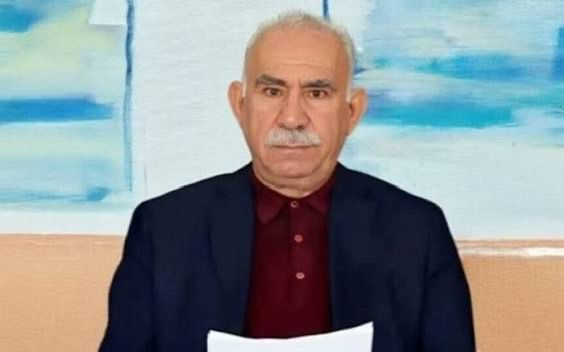
 leader Abdullah Öcalan, offering a detailed look at how Ankara’s peace effort was seen as tied to developments across the border in Syria.)
Turkey’s parliament has released the full minutes of a rare meeting between lawmakers and jailed Kurdistan Workers’ Party (PKK) leader Abdullah Öcalan, offering a detailed look at how Ankara’s peace effort was seen as tied to developments across the border in Syria.
The 16-page record shows Turkish lawmakers pressing Öcalan on whether PKK-linked fighters are shifting from northern Iraq into Syria instead of laying down arms and disbanding, and whether Öcalan still has enough influence to bring the process under control.
Öcalan is serving a life sentence on İmralı, a high-security prison island south of İstanbul. He founded the PKK, an armed group that has fought the Turkish state since 1984. Turkey and its Western allies designate the PKK as a terrorist organization.
The meeting took place on November 24, 2025, as part of a parliamentary initiative meant to create a legal and political framework for ending the conflict. The delegation included lawmakers from Turkey’s ruling Justice and Development Party (AKP), its far-right ally the Nationalist Movement Party (MHP) and the pro-Kurdish Peoples’ Equality and Democracy Party (DEM Party).
The minutes were released after weeks of dispute over transparency. A shorter, four-page summary based on notes recorded by Turkey’s National Intelligence Organization (MİT) had been read to a parliamentary commission earlier tasked with developing a peace framework, prompting criticism from a DEM Party delegate who said it did not reflect the spirit and full depth of Öcalan’s remarks.
Syria emerges as the central test
Much of the newly released text focuses on Syria and the future of the Syrian Democratic Forces (SDF), the Kurdish-led group that partnered with the US military to fight the Islamic State group, which controlled much of northeastern Syria back in November but lost most of that area to the Syrian government earlier this week.
Turkey views the SDF as tied to the PKK through its leading faction, the People’s Protection Units (YPG), and has carried out repeated cross-border military operations in Syria over what it describes as threats to Turkish security.
In the minutes lawmakers tell Öcalan that it is essential for the SDF in Syria to comply with a March 10 integration agreement and urge him to make a new statement on Syria. They also warn that giving up arms should apply to all branches and components linked to the PKK.
The delegation also confronts Öcalan with what it describes as observations that militants who withdrew from Iraq were being sent to Syria, calling this a contradiction with earlier statements about ending armed activity.
Öcalan responds by saying the PKK must lay down not only weapons in its possession but also what he calls “mental weapons.”
The minutes also include one of the clearest references yet to Öcalan’s claimed influence over the armed and political landscape in Syria.
When asked whether he knows Ferhat Abdi Şahin, the SDF commander known internationally as Mazloum Abdi, and whether he would listen to Öcalan’s orders, Öcalan says he is a close associate and “loyal.”
No autonomy formula and a unitary Syria
The record shows Öcalan agreeing with parameters that Turkish officials often cite as red lines in any political settlement.
He is reminded that his February 27 call to the PKK to lay down its arms stated that Kurds won’t push for a separate state, federal structure or administrative autonomy.
On Syria, Öcalan says he supports a unitary state with local democracy and describes security in terms of public order forces, comparing them to police rather than a separate defense force.
He also urges caution against Israel’s moves in the region, with a particular focus on Syria.
The minutes show Öcalan praising MHP leader Devlet Bahçeli and President Recep Tayyip Erdoğan, crediting Bahçeli’s “handshake” with launching the peace effort and saying he stands behind the promises he has made.
He says that if conditions allow, he still has the theoretical and practical ability to help deliver peace with the PKK.
The transcript also includes his claim that earlier peace efforts failed because of sabotage by what he calls “coup mechanics,” including attempts dating back to the early 1990s.
The release of the full minutes comes as parliament works on legal steps for former PKK militants and wider counterterrorism rules, in a process that Ankara is also linking to Syria and the US-backed Kurdish-led force there.