

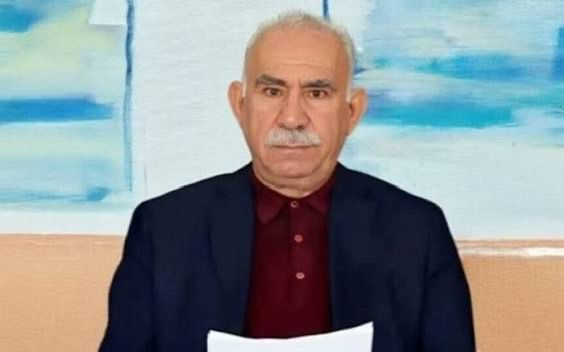
, said recent deadly clashes in Syria between government forces and Kurdish fighters appear aimed at derailing the ongoing peace talks between Turkey and the PKK, according to a delegation from Turkey’s pro-Kurdish Peoples’ Equality and Democracy Party (DEM Party).)
Abdullah Öcalan, the imprisoned leader of the Kurdistan Workers’ Party (PKK), said recent deadly clashes in Syria between government forces and Kurdish fighters appear aimed at derailing the ongoing peace talks between Turkey and the PKK, according to a delegation from Turkey’s pro-Kurdish Peoples’ Equality and Democracy Party (DEM Party).
The delegation said Öcalan made the remarks during a visit on Saturday to İmralı prison island near İstanbul, where he has been held in near-total isolation since 1999.
According to the delegation, Öcalan “sees this situation [in Syria] as an attempt to sabotage the peace process” in Turkey and reaffirmed his commitment to what he described as a process of “peace and democratic society,” calling for steps to move the talks forward.
Öcalan last year called on the PKK to lay down its weapons and disband, after a conflict with the Turkish state that has lasted more than four decades and has killed at least 40,000 people.
The PKK made a similar warning earlier this month, saying violence in Syria “calls into question the ceasefire between our movement and Turkey.”
The comments came as fighting in Syria continued to reshape control of territory in the north and east of the country, with Kurdish-led forces withdrawing from key areas and government troops expanding their presence.
Early Sunday the Kurdish-led Syrian Democratic Forces (SDF) withdrew from areas in the eastern Deir Ezzor countryside, including the al-Omar and Tanak oil fields, the Syrian Observatory for Human Rights said. The Britain-based monitor added that the move left the areas under effective government control.
Al-Omar is Syria’s largest oil field and previously hosted the US military’s largest base in Syria. Kurdish-led forces had controlled it since 2017, after the Islamic State group was pushed out.
The government said it had also regained control of other oil fields in Raqqa province, including Safyan and al-Tharwa. Syria’s energy minister, Mohammad al-Bashir, said returning resources to state control would help reconstruction and revive agriculture, energy and trade.
Syria’s push has focused on Arab-majority areas that came under Kurdish control during the fight against the Islamic State group. The group was defeated in Syria with support from the US-backed SDF.
An Agence France-Presse correspondent in Tabqa, a city in Raqqa province, saw armored vehicles and tanks as security forces patrolled streets after the Kurdish-led forces pulled out. A security source said government troops were combing neighborhoods. Intermittent gunfire could be heard, which one security officer described as limited clashes.
Shops were closed, and some residents stood outside their homes and lit fires to stay warm. One resident, Ahmad Hussein, said people were afraid and hoped conditions would improve with the arrival of government troops.
An AFP photographer saw residents near the Euphrates Dam destroying a statue honoring a woman fighter killed by the Islamic State group during the battle for Raqqa city, once the group’s main stronghold in Syria.
Syrian authorities accused the SDF of blowing up two key bridges across the Euphrates River in Raqqa province. The Kurdish administration accused government forces of attacking its fighters on multiple fronts. Syria’s army said the SDF was not meeting a commitment to fully withdraw east of the river.
Deir Ezzor province announced that all public institutions would be closed on Sunday and urged residents to stay home.
The clashes erupted after negotiations stalled over integrating the Kurds’ de facto autonomous administration and forces into Syria’s new government, which took power after the fall of longtime ruler Bashar al-Assad in 2024. Syrian government forces have seized large areas of the north, pushing Kurdish forces out of territory where they had exercised autonomy for more than a decade.
Syrian President Ahmed al-Sharaa issued a decree granting the Kurds official recognition, in what analysts described as a goodwill gesture. Kurdish authorities said the step did not go far enough and pointed to months of stalled talks over integration.
The Kurdish withdrawal came a day after US envoy Tom Barrack met with Syrian Kurdish leader Mazloum Abdi in Erbil, Iraq, and after the US Central Command urged Syrian government forces to halt offensive actions in the corridor between Aleppo and Tabqa.
Turkey, which considers the Kurdish-led forces in Syria a terrorist group linked to the PKK, has praised Syria’s operation as targeting “terrorist organizations.”
In Qamishli, the main Kurdish city in northeastern Syria, hundreds of residents demonstrated on Sunday, an AFP correspondent reported, chanting slogans including “We will defend our heroes.”
Muhayeddine Hassan, 48, said demonstrators wanted a political system that represents all Syrians.
“If al-Sharaa wants equality … the killing must stop,” he said.
© Agence France-Presse