

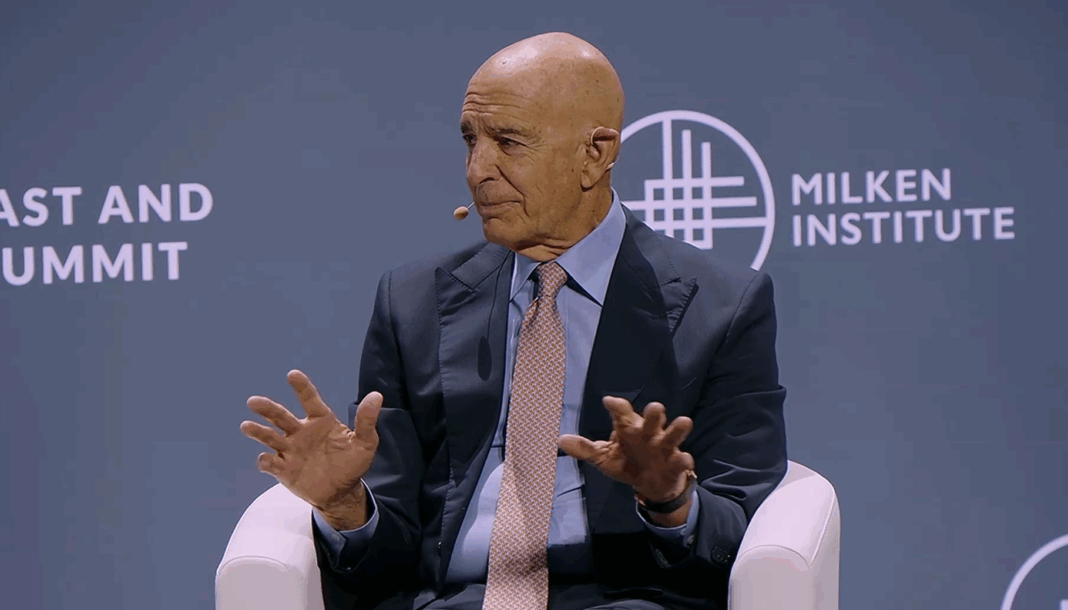

US Ambassador to Turkey Tom Barrack on Friday called the personal relationship between President Donald Trump and Turkish President Recep Tayyip Erdoğan a “bromance” and “a great thing” and predicted that strained ties between Turkey and Israel will improve once the Gaza crisis moves into a political phase.
Barrack was speaking at the Milken Institute Middle East and Africa Summit in Abu Dhabi in a public conversation with Bloomberg editor Paul Wallace.
He described Trump and Erdoğan as unusually close and treated that bond as a central fact of current US policy toward Ankara.
“Look, the great thing is we have a bromance between our two presidents,” Barrack said, drawing a contrast with past periods of tension between the allies.
He told the audience that Washington does not see Erdoğan as trying to rebuild the Ottoman Empire, a frequent claim in Western debate about Turkey’s foreign policy.
“Our belief, the US belief, is he’s not interested in extending the Ottoman Empire,” Barrack said. “Taking care of Istanbul and Ankara is enough.”
Barrack presented Turkey as a core security partner.
He called it “our largest NATO ally besides America” and stressed the country’s position between Europe, the Middle East and Central Asia, with the Bosporus Strait as a vital route for trade and energy flows.
At the same time, he said Turkey still feels shut out of Western political clubs.
“Europe still doesn’t want them in the European Union,” he noted, while describing Turkish citizens as “hard working, industrious and smart” and the domestic economy as “in a bit of a crisis.”
Turkey is a Muslim majority country of about 85 million people, a member of NATO since 1952 and the host of important US military facilities.
Under Erdoğan, who has ruled initially as prime minister and later as president for more than two decades, Turkey has bought Russian weapons, carried out cross-border operations in Syria and Iraq and clashed with EU states over a host of issues while also acting as a transit hub for refugees, gas and trade.
Barrack used the session to argue that Washington still needs Turkey inside what he called a regional “tapestry” that includes nearby countries such as Azerbaijan and Armenia and new transport routes from the Caspian Sea to the Mediterranean.
In a separate part of the conversation, he turned to Turkey’s relations with Israel, which have deteriorated with Israel’s Gaza offensive and Ankara’s strong criticism of Israeli actions.
“So the simple answer, it’s bad,” Barrack said when Wallace asked how bad the relationship is.
He stated that Turkey, a NATO member with a large non-Arab Muslim population, has reacted much like other governments in the region to the death and destruction in Gaza.
“I think any Islamic country looking at what’s happened in Gaza supports a position that ‘You need a two state solution’ or something similar to that,” he said.
Barrack underlined how sharply the economic relationship had changed.
“Go back to October 5th,” he said. “On October 5th, the [Turks and] Israelis had a trading relationship and a foreign trade agreement with a surplus of about $7 billion. It vanishes in an afternoon.”
He said many people in Turkey now see Israel through the lens of expansion and cross-border strikes rather than trade.
Inside Turkey, he explained, “they view Israel as Greater Israel, that Netanyahu’s game is not to protect the people inside, that he’s extending his territory everywhere,” including through repeated military operations in Syria and Lebanon.
Despite that bleak picture, Barrack forecast that the two countries will move back toward cooperation once the current phase in Gaza ends and a new regional framework takes shape.
“At the end of Gaza, which is a dramatic step forward, I think that you will see at some point in time Turkey and Israel finding a relationship,” he said. “Whether it’s the Abraham Accords or the Solomon Accords or a hybrid, it makes sense.”
He also described Turkey’s contacts with Hamas and its role in talks over hostage releases, placing Ankara beside Qatar in the final rounds of negotiation.
“Quite honestly, Turkey, at the end of these discussions, stepped in to have the final discussion with Hamas side by side with Qatar, which saved us,” Barrack said. “It really got the US to a decision point.”
Looking ahead, he voiced strong personal support for Turkish participation in an international stabilization force that Trump wants to see enter Gaza in stages after Israeli troops withdraw.
“So my personal opinion, which is beyond my job description, is absolutely,” he answered when asked if Turkey should take part. “If I were personally advising Netanyahu, I would say that’s one of the most brilliant things he could do because Turkey has a very good relationship, a criticized relationship with Hamas.”
He then added that he does not expect Israel to agree.
Gaza’s health ministry says more than 70,000 Palestinians have been killed and well over 150,000 wounded since October 2023, with most of the 2.1 million residents displaced and basic services shattered.
UN experts warned early on that Palestinians were at “grave risk of genocide,” and South Africa’s case at the International Court of Justice has led to provisional orders telling Israel to prevent genocidal acts and allow more aid, now backed by a growing list of supporting states including Turkey.
Major rights groups such as Amnesty International and Human Rights Watch have argued that Israel’s campaign amounts to genocide or involves genocidal acts and the crime against humanity of extermination.
The mounting legal and political scrutiny means any international stabilization force in Gaza, of the kind Barrack wants Turkey to join, would operate under the shadow of continuing genocide proceedings and investigations.