

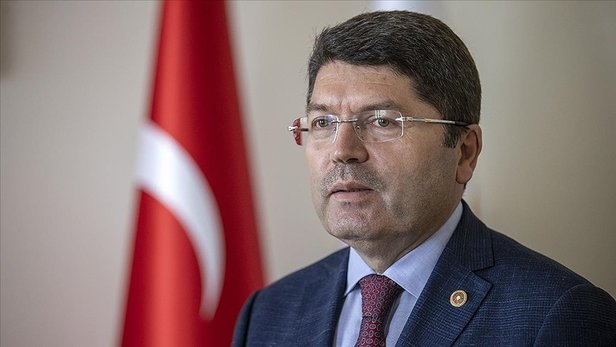
, marking the second official correction after prosecutors previously removed all references to the Gulf country from their announcement, the Anka news agency reported.)
Turkey’s justice minister has said suspects detained this week as part of an espionage investigation in İstanbul have no connection to the United Arab Emirates (UAE), marking the second official correction after prosecutors previously removed all references to the Gulf country from their announcement, the Anka news agency reported.
Three executives from defense contractors operating in Turkey were detained on Tuesday on accusations of spying for foreign powers as part of an investigation led by the İstanbul Chief Public Prosecutor’s Office. A controversy arose over whether the suspects were accused of spying for the UAE due to an initial statement made by the prosecutor’s office that included a reference to the country.
Minister Yılmaz Tunç on Thursday addressed the controversy surrounding the probe, saying in a social media post that there was “a need to inform the public” about media reports concerning the investigation.
Tunç said the suspects had obtained mobile phone lines from a Turkish operator, created fake profiles and conducted calls, later taking the lines abroad to be used “for information-gathering activities supported by spyware.”
Tunç added that the individuals acted in coordination but that “there is no UAE national among the suspects and no connection with this country has been identified.”
“The investigation is being meticulously carried out,” he said.
İstanbul Cumhuriyet Başsavcılığınca yürütülen ve geçtiğimiz günlerde kamuoyuyla paylaşılan bir soruşturma kapsamında bazı mecralarda yer alan haberler hakkında kamuoyunu bilgilendirme ihtiyacı hasıl olmuştur.
Soruşturmada;
Şüphelilerin Türkiye’de bir GSM operatörü üzerinden…
— Yılmaz TUNÇ (@yilmaztunc) November 27, 2025
His statement came after the prosecutor’s office itself corrected its statement earlier this week.
The initial version of the statement had alleged that intelligence operatives linked to the UAE attempted to collect biographical data on individuals in critical positions in Turkey, using fake profiles connected to a GSM line obtained from a Turkish mobile operator. It also said one suspect transported the line to the UAE.
The initial announcement was deleted shortly afterward and replaced with a revised text that removed all references to the UAE as well as details about the foreign ministry phone, the GSM line transfer and the use of fake profiles. The prosecutor’s office did not repeat its earlier claim of a UAE link in the updated statement, according to which four suspects were identified, three of whom were detained, while a fourth is abroad and is the subject of a detention warrant.
The abrupt correction raised further questions about the basis of the initial announcement, which explicitly accused the suspects of conducting political or military espionage on behalf of the UAE.
Former intelligence officer Associate Professor Ali Burak Darıcılı, who spoke to Turkish media, argued that the broader context of alleged espionage activity involving the UAE may be linked to Israel. Darıcılı said he believes the UAE has in recent years come increasingly under the “influence and control” of Israel.
He claimed that the question of why the UAE reference was withdrawn from the prosecutor’s statement may be related to Ankara’s dual aim of “sending a message” while avoiding a complete breakdown in relations with Abu Dhabi, given ongoing and potential areas of cooperation between the two countries.
The developments come amid a recent effort by Ankara and Abu Dhabi to repair long-strained ties.
Turkey and the UAE backed opposing sides in regional conflicts and have sparred over issues including gas exploration in the eastern Mediterranean.
But since 2021 Turkish President Recep Tayyip Erdoğan has sought to improve relations with regional rivals amid growing diplomatic isolation and declining Western investment.
In early 2022 Erdoğan made his first visit to the UAE in nearly a decade and urged business leaders there to invest in Turkey.
His trip followed a rare visit by then-crown prince Mohammed bin Zayed Al Nahyan to Ankara in November 2021, after which the UAE announced a $10 billion fund for investments in Turkey.
As UAE president, Al Nahyan also traveled to Turkey in July for a state visit and the inaugural meeting of the Turkey-UAE High-Level Strategic Council. The visit, which included talks with Erdoğan, focused on strengthening bilateral ties, economic cooperation and discussing regional issues, resulting in the signing of seven agreements.
In recent months the conflict in Sudan has revived some of the underlying tensions between the two regional rivals. The Sudanese army has repeatedly accused the UAE of supplying weapons and other support to the paramilitary Rapid Support Forces (RSF), an allegation Abu Dhabi denies.
Turkey has backed the Sudanese Armed Forces (SAF), providing Bayraktar TB2 drones along with Turkish operators.
Turkey has also in recent years detained dozens of suspects accused of working for foreign intelligence services, including those linked to Israel, Russia and Iran.