

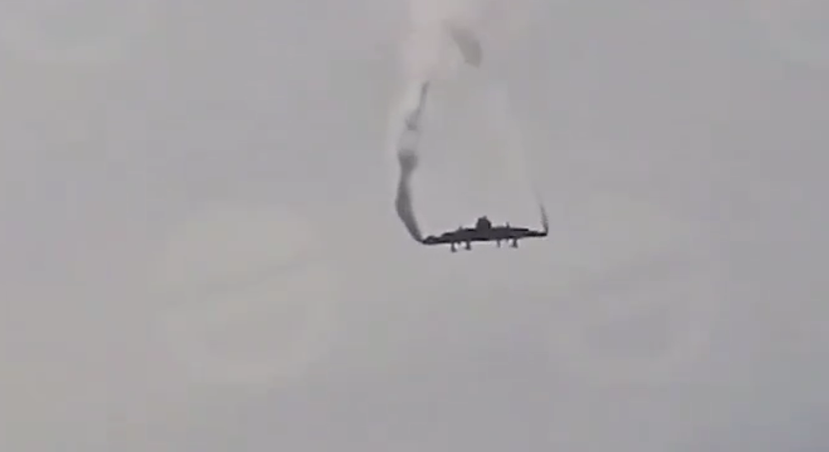

Turkish investigators have recovered the black box from a military cargo plane that crashed in Georgia on Tuesday, killing all 20 people on board, as online speculation grows over whether sabotage or a projectile could have caused the in-flight breakup.
The Lockheed C-130 Hercules, a four-engine transport aircraft built in the United States and widely used by air forces around the world, took off on Tuesday afternoon from Ganja Airport in western Azerbaijan and was returning to Turkey when it went down shortly after crossing into eastern Georgia.
Turkey’s defense ministry said the plane disappeared from the radar without sending a distress signal and crashed near the town of Sighnaghi, about five kilometers (three miles) from the Azerbaijani border. Nineteen bodies have been recovered, and search teams are still looking for the last one.
Defense Minister Yaşar Güler said the aircraft was carrying Turkish personnel returning from a military parade in Baku marking Azerbaijan’s Victory Day, which celebrates its 2020 triumph over Armenia in the Nagorno-Karabakh conflict. Among the dead were maintenance specialists who had serviced Turkish F-16 fighter jets used in the parade, he said. Güler shared 20 photographs of those killed on X, calling them “our heroic comrades-in-arms.”
President Recep Tayyip Erdoğan confirmed that a 46-member investigative team had arrived at the crash site and recovered the black box, which records flight data and cockpit conversations. He said the black box has been found but not yet analyzed.
“We are examining every possibility,” Erdoğan said, urging people not to “exploit this tragedy for political gain.”
Video filmed by eyewitnesses and circulated by Azerbaijani media showed the aircraft spinning as it fell, with large pieces of debris detaching mid-air. The footage has fueled intense online debate over what caused the sudden breakup.
Some aviation experts, including retired Royal Air Force pilot Scott Bateman, cautioned against rushing to conclusions, describing the C-130 as one of the world’s most reliable and battle-tested aircraft. He said the video more likely showed structural failure than an explosion.
Other observers, including analysts on social media, have pointed to the unusual sight of the plane’s forward and rear sections detaching, leaving a “see-through” fuselage. Some suggested this could indicate an explosion on board, while others speculated about the possibility of an external projectile.
No government or credible source has provided evidence to support those claims. Turkish officials have not reported finding missile fragments, explosive residue or any signs of hostile action. The Azerbaijani Report news agency said the aircraft was carrying mechanical spare parts for F-16s but “no explosives,” ruling out the possibility of an onboard blast.
Georgia’s interior ministry said its air traffic control systems lost contact with the plane without receiving any emergency signal and that emergency services first alerted authorities to the crash site. The aircraft reportedly broke apart before hitting the ground, scattering debris across a large area.
The C-130 Hercules, first flown in the 1950s, has been used by more than 70 countries and remains in production by US defense contractor Lockheed Martin. While accidents involving the type are rare, similar in-flight breakups have occurred when propeller blades or central wing structures failed due to fatigue.
A comparable incident occurred in 2017 when a US Marine Corps KC-130T transport plane crashed in Mississippi after a propeller blade broke off, slicing through the fuselage and causing the aircraft to disintegrate in mid-air.
Critics also say Turkey’s military has suffered a loss of technical expertise since massive purges that followed an attempted coup on July 15, 2016.
Former naval officer Mehmet Dağcı, who was expelled from the Turkish Armed Forces by a government decree following the failed coup, questioned the state of Turkey’s Air Force in a post on X. He argued that the post-coup purges had removed thousands of experienced airmen, engineers and maintenance staff, weakening institutional capacity.
The events of July 15, 2016, described by the government as a coup attempt but viewed by many opponents as a pretext for a purge, remain deeply contested. President Erdoğan accused followers of US-based cleric Fethullah Gülen of staging the takeover attempt, which involved tanks and fighter jets in Ankara and İstanbul. Gülen, who passed away in the US in October 2024, consistently denied the accusation up until his death, while the movement he inspired maintains the group did not have any involvement in the coup.
International assessments have challenged Ankara’s account. In 2017 Germany’s intelligence chief Bruno Kahl said Turkey had not convinced the BND that Fethullah Gülen had directed the events; a leaked EU Intelligence Analysis Centre report said the movement likely lacked the capacity; and in 2016 US Director of National Intelligence James Clapper said the allegation did not pass the “smell test” and that US intelligence had not seen evidence.
After July 2016 the government declared a state of emergency and issued decrees dismissing more than 100,000 public employees, including thousands of officers, pilots and technical personnel. Analysts say those purges gutted the armed forces and civil institutions, enabling Erdoğan to consolidate power.
Dağcı said the cost of those decisions had already exceeded $50 billion when lost expertise and canceled defense projects, such as Turkey’s removal from the US-led F-35 Joint Strike Fighter program, are factored in. He also criticized Ankara’s reported plan to buy retired C-130J aircraft from the United Kingdom, calling them outdated and overpriced.
While there is no evidence linking Tuesday’s crash to those purges, the remarks have resonated with critics who argue that the erosion of institutional knowledge and independent oversight within the Turkish Armed Forces has made such tragedies more likely to occur.