

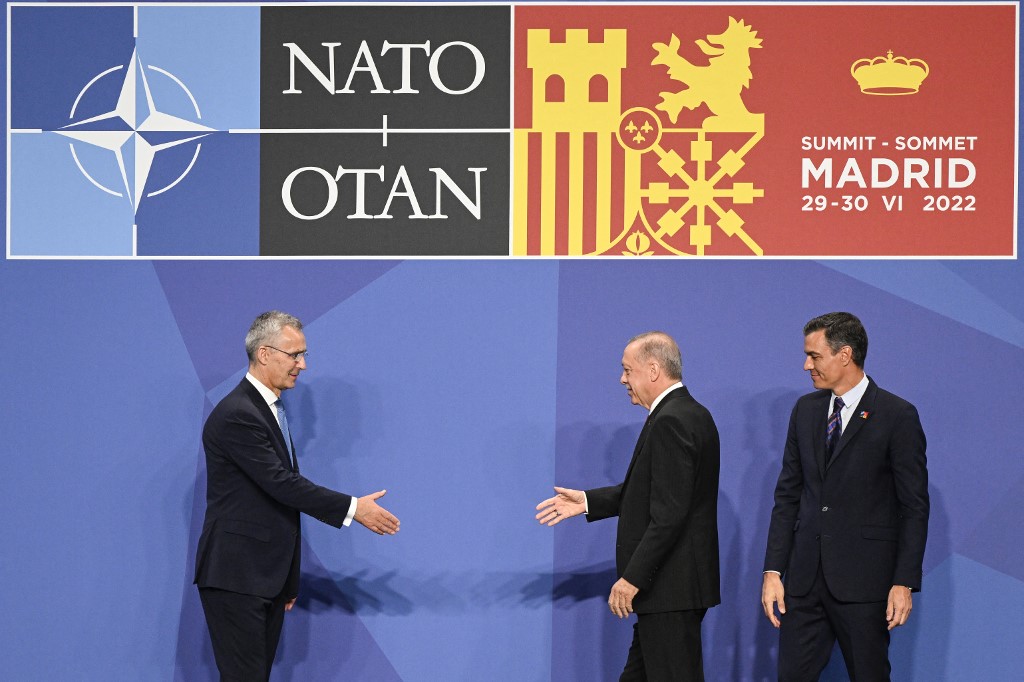

Former NATO secretary-general Jens Stoltenberg’s new memoir offers a detailed account of his decade leading the alliance, including tense exchanges and personal diplomacy with Turkish President Recep Tayyip Erdoğan over issues ranging from Syria to the NATO enlargement process, Middle East Eye reported on Tuesday.
In “On My Watch: Leading NATO in a Time of War,” Stoltenberg, who served as NATO chief from 2014 to 2024, recalls how he navigated disputes involving Turkey, including the 2015 downing of a Russian fighter jet, Ankara’s incursions into Syria and its objections to Sweden and Finland’s NATO membership bids, according to the report by Middle East Eye’s Ragıp Soylu.
The first major test with Ankara came in November 2015, when Turkish forces shot down a Russian Su-24 aircraft for violating Turkish airspace. Stoltenberg said that while he publicly backed Turkey’s right to defend its borders, several allies — notably France, Italy and Germany — questioned the proportionality of the response.
Stoltenberg also recounts disagreements among NATO members over support for Ukraine prior to Russia’s 2022 invasion. He cites a conversation with then-Ukrainian president Petro Poroshenko, who expressed frustration that most allies refused to provide weapons while praising Turkey for supplying drones.
Describing Erdoğan as an “old acquaintance,” Stoltenberg writes that the Turkish leader was “committed and knowledgeable,” often using an iPad in meetings to present charts and videos. During a discussion on Turkey’s 2019 military operation in northern Syria, Erdoğan argued that Western powers were “using one terrorist organization to fight another,” referring to the Kurdish People’s Protection Units (YPG), which Ankara considers an extension of the outlawed Kurdistan Workers’ Party (PKK).
That operation, launched by Turkey under Stoltenberg’s watch in October 2019, displaced tens of thousands of civilians in Kurdish-held parts of northern Syria and drew criticism from human rights groups. Ankara said the incursion was needed for security reasons, while rights monitors documented civilian casualties among possible war crimes that include forced demographic changes along the border.
The former NATO chief includes a series of anecdotes illustrating Erdoğan’s informal and unpredictable style. In one meeting Erdoğan served roasted corn and chestnuts to attendees, joking that “it is possible to negotiate with the Taliban” while criticizing his own protocol department, according to Middle East Eye.
Stoltenberg also describes the tensions between Erdoğan and French President Emmanuel Macron, whose criticism of Turkey’s Syria operation and secularism debates led to open friction within the alliance. He quotes himself as finding it “demanding to have two presidents of major NATO countries who had become each other’s ideal enemies.”
The memoir recounts the behind-the-scenes negotiations over Sweden and Finland’s NATO accession in 2022, when Turkey blocked the process, citing national security concerns. Erdoğan demanded that the final agreement explicitly name not only the Kurdistan Workers’ Party (PKK) and its Syrian offshoot, the People’s Protection Units (YPG), but also the faith-based Gülen movement, which Ankara accuses of orchestrating a coup attempt in 2016 and labels a terrorist organization, a classification rejected by the most of the international community, including US and other Western allies as well as Russia and China.
Those demands turned exiled Turkish dissidents and Kurdish activists in Europe into bargaining chips. In the months that followed, Sweden and Finland tightened terrorism laws, extradited several asylum seekers to Turkey and restricted Kurdish demonstrations, steps that rights organizations said compromised asylum standards and freedom of expression.
Stoltenberg describes a one-on-one session with Erdoğan that lasted over an hour, during which he offered coffee and snacks to keep the talks going. Erdoğan reportedly declined with a smile, saying, “I’m not that cheap.”
After several rounds of edits, an agreement was reached when Erdoğan approved the final text in the presence of Finnish President Sauli Niinistö and Swedish Prime Minister Magdalena Andersson. “The whole room erupted in applause,” Middle East Eye quoted Stoltenberg as writing.
The book presents these moments with light humor, yet the policies they reflect had far-reaching human costs. NATO’s accommodation of Ankara’s demands coincided with intensified Turkish airstrikes in Kurdish areas of Syria and Iraq and renewed pressure on political dissidents at home and abroad.
Stoltenberg portrays Erdoğan as a difficult but indispensable partner whose cooperation was often secured through personal engagement and pragmatism, an approach rights groups said left many of the president’s critics paying the price.