


Ömer Murat*
In the complex world of Middle Eastern diplomacy, appearances often take precedence over reality. Until last month’s meeting in New York on the sidelines of the United Nations General Assembly, there was no indication that Turkey was playing a direct role in the Gaza ceasefire negotiations. Presented as co-chaired by US President Donald Trump and Turkish President Recep Tayyip Erdoğan, the meeting was attended by representatives of leading Muslim countries.
Washington Post columnist David Ignatius’s article contains behind-the-scenes information on how Trump’s ambitious 20-point peace plan was prepared and provides new insights into this mystery. Based on interviews with American, Israeli and Qatari officials, Ignatius reports that when Israel launched an airstrike in Doha in September on a location where members of the Hamas delegation were staying in an attempt to assassinate them, Qatar responded with a kind of ultimatum. The Qatari government warned the Trump administration that it would withdraw from the ceasefire negotiations unless certain conditions were met for it to continue its mediation role. Washington ultimately accepted these conditions.
At the heart of this drama lies the 20-point plan, a blueprint forged through months of quiet backchannel diplomacy. According to Ignatius, the plan was largely shaped by four people: Steve Witkoff, the US special envoy to the Middle East; Jared Kushner, Trump’s senior adviser and son-in-law; former British Prime Minister Tony Blair; and Ali al-Thawadi, Qatar’s minister of strategic affairs. Initial reports suggested that Blair would chair a transitional committee that would govern the Gaza Strip like a “viceroy” during the post-conflict period. However, due to his negative public image in the Arab and Muslim world because of his role in the Iraq War, this idea quickly drew criticism and appears to have been shelved for the time being.
Qatar, long adept at quiet mediation in regional crises, urged Trump to host the New York summit to lend legitimacy to the plan. The goal was to cloak the plan in collective Arab and Muslim endorsement, thus shielding it from accusations of being a US-imposed diktat on the Palestinians. Indeed, several key Arab nations and Turkey discussed the plan at the meeting and publicly voiced their support. Although the United States organized the event at Qatar’s request, it remains unclear why Erdoğan sat at the meeting in a way that created the impression that Turkey was directly involved in the Gaza talks.
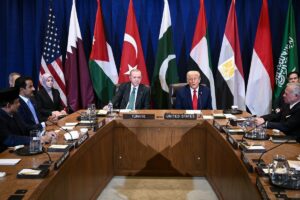
Interestingly, the arrangement of national flags in the meeting hall reinforced this ambiguity. The Qatari flag was placed immediately after the American flag and before the Turkish flag, suggesting that the seating plan was decided at the last minute. Erdoğan may have requested this arrangement to project an image of diplomatic centrality to the Turkish public. The emir of Qatar, Sheikh Tamim bin Hamad Al Thani, likely did not object, given the close relationship between the two leaders.
For Erdoğan the photo opportunity was ideal, providing Turkish voters with a visual cue that their leader was in control of the situation in Gaza. From Doha’s perspective, this was equally astute. By distributing the political heat to populous Muslim states such as Turkey and Egypt, Qatar could leverage their support to appease a skeptical Muslim public and share the political responsibility of such a sensitive process with these influential states.
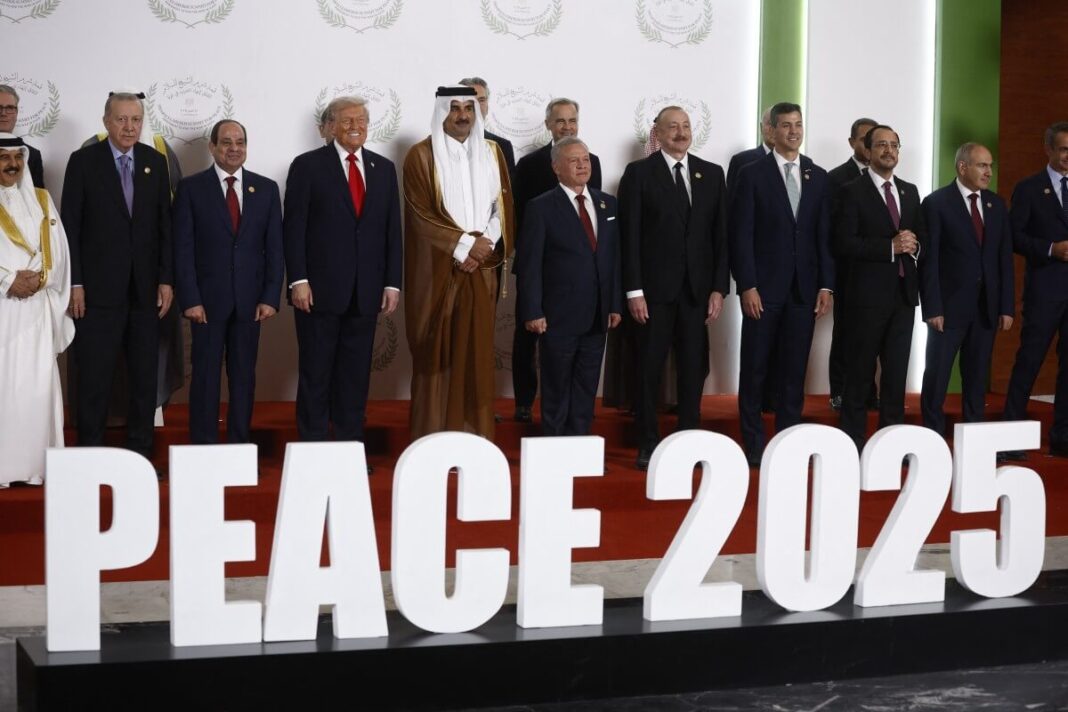
Meanwhile, the UK’s absence from the front row at the signing ceremony in Egypt requires explanation, despite the Trump administration’s explicit acknowledgment of the United Kingdom’s active involvement through Blair and Jonathan Powell, the national security adviser to British Prime Minister Keir Starmer. One plausible explanation is that Washington and its Arab partners wanted to minimize Britain’s role due to sensitivities surrounding its colonial legacy in the Middle East, which could provoke a negative public response. Consequently, while the UK played an active behind-the-scenes role in shaping the plan, it was absent from the public signing. In contrast, Turkey, whose actual involvement appears minimal, was featured prominently alongside the United States, Egypt and Qatar.
The joint communiqué signed by these four countries and later released by the White House offers no concrete details about Turkey’s contributions or commitments. Turkish media reports, many based on statements by Erdoğan, claim that Turkey will act as a guarantor, along with the United States, Qatar and Egypt, to ensure the ceasefire is implemented. However, the document titled “The Trump Declaration for Enduring Peace and Prosperity” contains no reference to such a guarantor role and the term “guarantor” does not appear anywhere in the text. No clause hints at enforcement mechanisms or Turkey’s oversight role. Therefore, it would be misleading to believe that any document unsigned by Israeli and Palestinian representatives could grant these external actors such extraordinary authority.
Trump’s 20-point plan envisions an international stabilization force to ensure security in Gaza until a new Palestinian security force can be established and trained. Erdoğa recently announced that Turkey would contribute to this force. However, authorization from the United Nations Security Council would be required for such a deployment, and no such mandate has yet been issued. It also remains unclear how contributing nations would be selected and what the deployment timeline would be. Without that mandate, such promises remain symbolic rather than operational.
So far, Turkey’s only discernible role in the Gaza negotiations appears to have been to apply joint pressure, alongside Qatar and Egypt, on Hamas to accept Trump’s plan in principle. Erdoğan is widely believed to have influence over Hamas due to their shared Islamist ideological roots. (Ignatius conspicuously described Turkey as “an Islamist state with leverage over Hamas.”) However, this relationship has also led Israel to view Turkey as an unreliable intermediary. Due to the close relationship between Israeli Prime Minister Benjamin Netanyahu and the Trump administration, Turkey’s proximity to Hamas may limit its ability to influence future developments in the Palestinian issue.
Essentially, Turkey’s perceived role as a pivotal participant in the Gaza peace process is arguably more attributable to strategic stage management and symbolic gestures than to substantive diplomatic initiatives. Nevertheless, both Trump and Erdoğan had their reasons for presenting such an image to their domestic audiences. One sought to showcase his prowess in global deal-making, while the other aimed to reaffirm Turkey’s relevance in a region where appearances often carry as much weight as reality.
* Ömer Murat is a political analyst and a former Turkish diplomat who currently lives in Germany.
Disclaimer: The views expressed in this opinion piece are those of the author and do not necessarily reflect the editorial stance of Turkish Minute.