

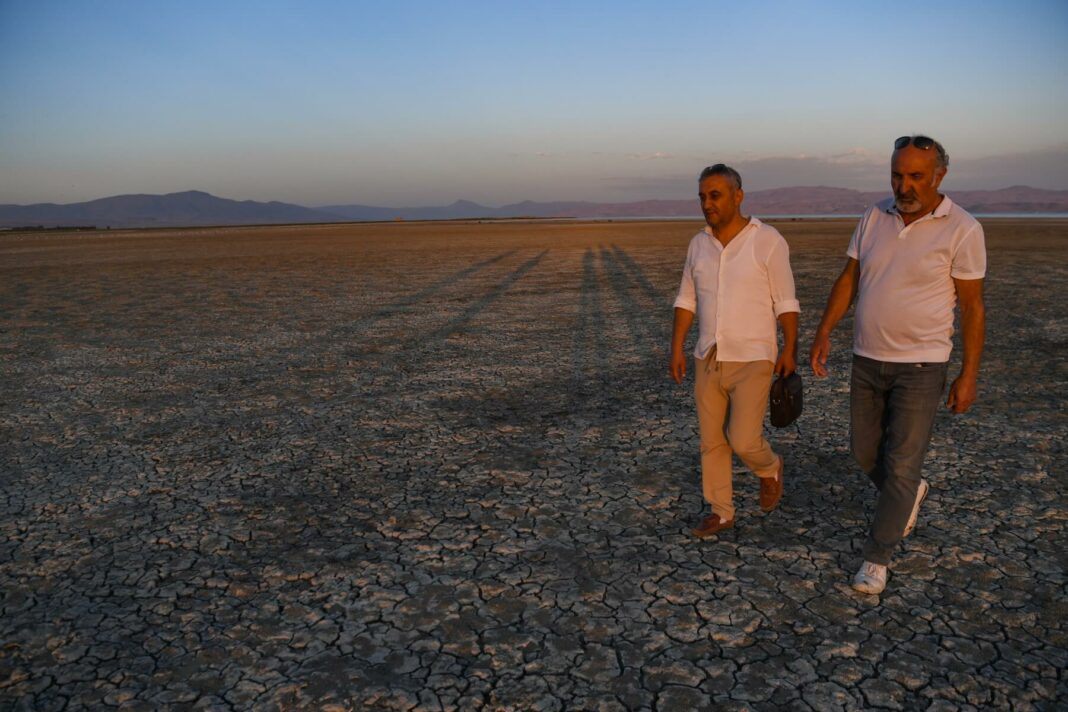

Turkey has recorded its lowest rainfall levels in more than five decades, according to a report released by the General Directorate of Meteorology, part of the Turkish Ministry of Environment, Urbanization and Climate Change, the state-run Anadolu news agency reported.
The 2025 Water Year Report, covering the 12-month period from October 1, 2024, to September 30, 2025, found that nationwide precipitation fell well below both the long-term average and last year’s figures.
The term “water year” refers to the total precipitation measured during the 12-month cycle most critical for farmers, as it directly overlaps with irrigation periods.
The report said Turkey received an average of 422.5 kilograms of rainfall per square meter during the period, 26 percent below the long-term average and 29 percent lower than the same period a year earlier. The agency noted that the data mark the lowest rainfall level in 52 years.
The ministry warned that the decline in rainfall could worsen drought conditions and put additional pressure on water resources across the country.
Experts say the findings expose the growing impact of climate change on Turkey’s weather, with prolonged dry periods, heat waves and heavy rainfall becoming increasingly common.
Scientists warn that reduced precipitation, coupled with rising temperatures, is straining the country’s agriculture and freshwater reserves, particularly in central and southeastern provinces where water scarcity is already severe.
Water shortages paired with abnormally high temperatures made for a hellish summer in Turkey this year.
The month of July was the hottest in 55 years: Average temperatures exceeded those between 1991-2020 by 1.9 C, and even broke records with 50.5 C in Silopi in the southeast at the end of the month.
Adana, the southern region known for its citrus production, also saw its hottest day in 95 years when it hit 47.5 C in early August.
The situation triggered multiple forest fires in the west and southern Turkey, prompting mosques across the country to pray for rain at the beginning of August.
An NGO study published in early July estimated that 88 percent of Turkey risks desertification.
Rainfall is set to decrease by a third between now and the end of the century, while temperatures could rise by 5 to 6 C compared to averages recorded between 1961-1990, experts predict.
According to the Falkenmark Water Stress Index, Turkey could be classified as water-poor within five years if urgent action is not taken.
The index shows Turkey now ranks among countries experiencing water stress.
To become water-poor, a country must have less than 500–1,000 cubic meters of water per person per year. Turkey is approaching that critical threshold.
Meanwhile, last month was recorded as the 11th hottest September in the past 55 years, with an average temperature of 21.7 degrees Celsius, which was 0.8 degrees above the 1991–2020 average. The lowest temperature, minus 2.4 degrees, was observed in the eastern province of Erzurum, while the highest, 44.6 degrees, was recorded in the southeastern district of Cizre in Şırnak province.
Atypical weather has affected Turkey’s most important exports such as apricots, apples, figs and hazelnuts, which make up 70 percent of global production.
In late August, President Recep Tayyip Erdoğan estimated agricultural losses of 23 billion Turkish lira ($557 million) for the country’s 50,000 insured farmers and promised state aid for the 420,000 without any coverage, whose incomes have collapsed.