


Fatih Yurtsever*
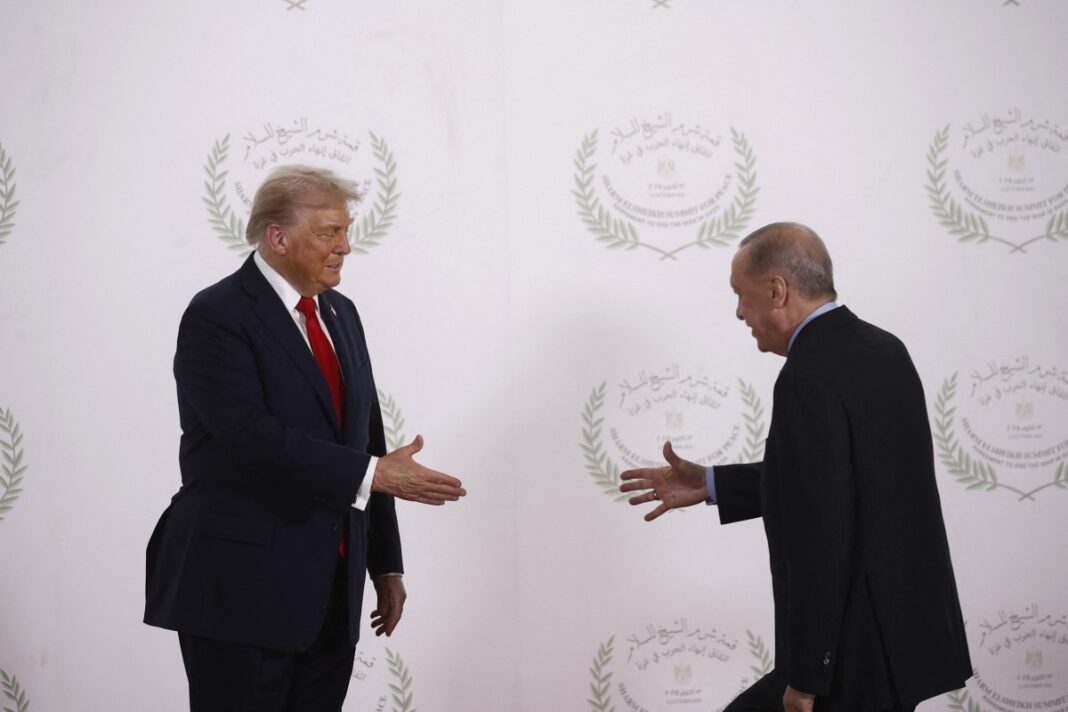
The ceremony in Egypt that named the United States, Turkey, Qatar and Egypt as formal guarantors of a 20-point Gaza cease-fire agreement placed Turkish President Recep Tayyip Erdoğan at the center of a new diplomatic experiment. Regional powers would be responsible for enforcing the truce, while Washington would keep political control of the process.
In practice, this means that the work of monitoring and pressure would fall to others, but the diplomatic credit would stay in Washington.
The summit, co-chaired by President Donald Trump and Egyptian President Abdel Fattah el-Sisi, coincided with the first exchanges of hostages and detainees and an early pledge to reduce fighting in stages. The hardest issues — disarmament, future governance and the possible role of the United Nations — were postponed.
Trump’s warm praise for Erdoğan was more than showmanship. It reflected a calculated decision. The US president believed that Turkey’s rare access to Hamas’s political leadership could help turn promises into action. Washington’s reasoning was simple: Erdoğan would use his influence with Hamas’s political wing to secure its cooperation in exchange for political recognition at home and economic opportunities in Gaza’s reconstruction.
A more balanced view of Ankara’s motives
Erdoğan’s main political goal is to turn visibility into credibility. At home the March 2024 local elections revealed how vulnerable his ruling party has become and how strongly the Palestinian issue still resonates with Turkey’s conservative base. If he can deliver concrete results in Gaza, he can turn years of polarizing rhetoric into proof of effective policy and recover political ground lost in the cities.
Internationally, the guarantor role offers Erdoğan a chance to re-enter the good graces of Western capitals after years of friction. If Ankara’s influence helps keep cease-fire violations contained and exchange schedules on track, it can project itself as an indispensable partner rather than a disruptive actor. This performance-based legitimacy could soften Western criticism of democratic backsliding without requiring immediate internal reform.
A second objective is to translate guarantor status into economic and technological leverage. Turkish officials have already proposed roles for state agencies and private contractors in reconstruction projects such as clinics, schools, power infrastructure and water systems, which serve as symbolic, nonpartisan deliverables showcasing the Turkish flag before regional and domestic audiences. This reconstruction portfolio was part of the implicit bargain in which Ankara would pressure Hamas in exchange for access to donor-funded rebuilding contracts.
In Washington effective use of Turkish influence could open the door to selective defense cooperation and limited sanctions relief — areas long burdened by mistrust. Erdoğan’s government believes that visible performance in Gaza could make pragmatic deals easier to justify to skeptical lawmakers and bureaucrats in both capitals. The White House’s embrace of a results-first partnership with Erdoğan, which was on display during his September visit, reinforces that reading even as rights concerns remain unresolved. European diplomats, however, caution that any deeper partnership will depend on verifiable improvements in Turkey’s human-rights record and its coordination with EU humanitarian agencies.
A third motive lies in rebalancing regional influence. By appearing beside Egypt and Qatar in a US-anchored framework, Ankara repositions itself as a co-manager of the Arab-Israeli file rather than a marginal spoiler. This complicates Iran’s networked influence in Gaza and Syria without forcing Turkey into an overtly anti-Iran coalition. The arrangement effectively allows Erdoğan to bypass Tehran’s influence over Hamas’s armed wing by working directly through the political leadership, though this creates a structural vulnerability: if Iran chooses to sabotage the cease-fire through its ties to Hamas’s military commanders, Ankara’s leverage may prove insufficient. It also dilutes Egypt’s traditional monopoly over Gaza-border diplomacy, suggesting a Turkey that seeks to be seen as a stabilizer capable of reshaping its strained ties with Tel Aviv.
Finally, there is the ideological and reputational dimension. For years, Turkey kept political channels to Hamas open and declined to list it as a terrorist organization — a policy that alienated Israel and much of the West but preserved access no other NATO member had. Now, being elevated to formal guarantor status allows Ankara to reframe that controversial access as an asset for order rather than indulgence. If Turkey’s influence can help maintain discipline in Gaza, Erdoğan can argue that engagement rather than isolation has produced results. That narrative underpins his broader vision of Turkey as a civilizational intermediary capable of engaging actors that Washington and Brussels cannot.
How the leverage was earned
Erdoğan has said that Trump personally asked Turkey to help secure Hamas’s agreement, which aligned with Ankara’s unique advantage as the only NATO member maintaining political dialogue with the group. Over years of cautious engagement, Turkey cultivated access to Hamas’s political leadership while other Western capitals kept their distance. This gave Ankara a critical channel at a decisive moment, as US officials appeared to calculate that Erdoğan could obtain commitments from Hamas that direct American pressure could not.
Turkish intelligence chief İbrahim Kalın joined the Egypt-based talks that established a compliance-monitoring task force and a set of guardrails against unilateral actions — mechanisms designed to turn leader-level promises into enforceable procedures. For Trump, public praise for Erdoğan helped sustain momentum and provided political cover to press Israel while mobilizing Muslim-majority partners. For Erdoğan, it offered the validation he sought by showing that his controversial ties to Hamas could now be judged by results rather than rhetoric.
Analysts note that Turkey’s leverage over Hamas’s political wing may not extend to its more autonomous, Tehran-linked military groups, which retain significant operational independence. This creates a critical gap: Erdoğan’s strategy depends on bypassing Iranian influence by working through Hamas’s political leadership, but Iran maintains the capacity to undermine the cease-fire through its ties to the armed wing. Whether Tehran will tolerate being sidelined or actively work to sabotage the arrangement remains an open question that could determine the cease-fire’s durability.
What success would look like from Erdoğan’s perspective
Success, in Erdoğan’s view, means proof of deliverables: measurable reductions in cease-fire violations, predictable exchange timetables, sustained humanitarian access and early reconstruction projects attributed to the guarantors collectively rather than any single actor. Each of these outcomes serves both domestic and international goals by demonstrating that Ankara can “deliver for Gaza” while enhancing policy credibility abroad.
Over the medium term Erdoğan aims to turn that external performance into structured dialogue with the United States on defense trade, export controls and reconstruction financing. He also seeks a more straightforward pathway for Turkish companies in donor-funded projects and a role in shaping any technocratic governance model that preserves the possibility of Palestinian statehood. Ultimately, Erdoğan’s role is less about neutral mediation and more about pragmatic influence that uses his access to Hamas’s political wing to maintain discipline while positioning Turkey for material and political rewards. For Washington this arrangement offers short-term utility, while for Ankara it presents a longer-term opportunity.
The constraints that could upend the bargain
The guarantor model rests on a fragile balance that may not last. Turkey has influence over Hamas’s political leadership, but the group’s armed wing, which is more independent and closely linked to Iran, may act on its own. If Tehran sees the deal as a threat to its influence in Gaza, it could encourage Hamas’s fighters to break the truce, revealing the limits of Ankara’s control. Whether Erdoğan can turn political persuasion into real discipline on the ground — especially if Iran decides to spoil the process — will determine whether the model survives.
Turkey also faces a credibility risk. If it looks like a partisan advocate rather than a neutral mediator, Israeli and Western trust in the arrangement could collapse. At home Erdoğa may still be tempted to use harsh or triumphalist language to satisfy his base, especially after the 2024 election losses that narrowed his room to maneuver. These weaknesses make many analysts view the plan as a temporary structure, not a lasting solution. Steven A. Cook of the Council on Foreign Relations notes that the toughest issues — disarmament, stability and new governance — remain undefined. Aaron David Miller has praised the initiative as “extraordinary” but warned that the difficult parts, such as demobilization and long-term planning, are still unresolved. Other regional experts point to the absence of a clear monitoring system and the lack of a plan to prevent Iranian interference.
Bottom line
Erdoğan’s goals in this cease-fire are straightforward and, for once, aligned with the process itself: regain international credibility through results, open paths for economic and defense cooperation and reposition Turkey as a partner rather than an obstacle. The bargain is purely practical. Washington needed Erdoğan’s access to Hamas’s leadership to get a deal, while Erdoğan needed US validation and a role in reconstruction to boost his standing at home. Trump’s praise showed that the United States is ready to offer legitimacy and opportunity — but only if Ankara delivers.
The risk is just as clear. Without concrete benchmarks, outside verification and steady US involvement, the guarantor plan could quickly collapse into blame and mistrust. The key question is whether Erdoğan’s influence over Hamas’s political leaders can restrain its fighters when Iran still has both the means and the motive to disrupt the peace — and whether a deal based on mutual needs can produce lasting stability. If the truce holds and progress continues, Erdoğan will have turned Turkey’s controversial ties to Hamas into political capital both at home and abroad. If not, the Sharm el-Sheikh ceremony will be remembered as a brief pause that stopped the fighting without changing the future.
* Fatih Yurtsever is a former naval officer in the Turkish Armed Forces. He uses a pseudonym due to security concerns.