

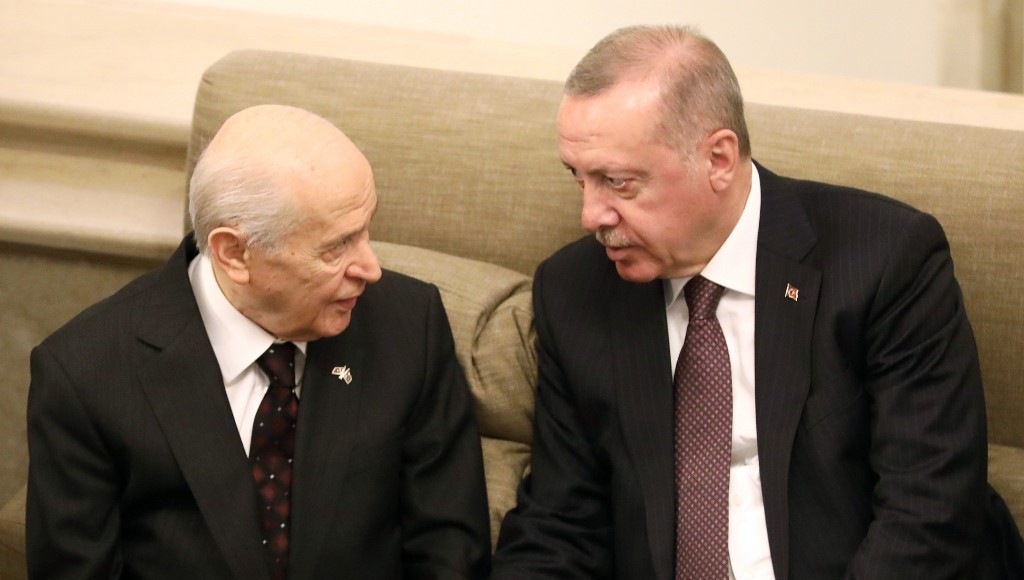
 and a political ally of President Recep Tayyip Erdoğan, has stirred Turkey’s political arena with his bold and unexpected proposal for a “Turkey-Russia-China [TRC] alliance” to counter what he described as the “United States–Israel evil coalition.” At first glance, the call might suggest a dramatic foreign policy shift. Yet I believe it reflects simmering domestic tensions rather than a genuine geopolitical realignment. In Turkish politics, foreign policy declarations often serve as coded messages in internal power struggles.)
Ömer Murat*
Devlet Bahçeli, leader of the far-right Nationalist Movement Party (MHP) and a political ally of President Recep Tayyip Erdoğan, has stirred Turkey’s political arena with his bold and unexpected proposal for a “Turkey-Russia-China [TRC] alliance” to counter what he described as the “United States–Israel evil coalition.” At first glance, the call might suggest a dramatic foreign policy shift. Yet I believe it reflects simmering domestic tensions rather than a genuine geopolitical realignment. In Turkish politics, foreign policy declarations often serve as coded messages in internal power struggles.
Turkey, a longstanding member of NATO, continues to maintain close ties with the West. President Erdoğan, in particular, has been meticulous in nurturing relations with US President Donald Trump, even securing a Washington meeting this week. Against this backdrop, Bahçeli’s sudden enthusiasm for Moscow and Beijing looks less like strategy and more like a veiled warning aimed at Erdoğan himself.
Despite their alliance, the rift between the two men is hardly new. It became visible with the arrest of a mafia figure close to Bahçeli named Selahattin Yılmaz and deepened when Erdoğan reassigned MHP-linked police chiefs to less influential posts. Bahçeli retaliated with complaints about “parallel structures” in the bureaucracy, a thinly veiled jab at Erdoğan’s alliances with some religious groups.
Further underscoring the discord, Bahçeli offered public support to a business figure under investigation, in contrast to pro-government journalists who criticized the probe as too limited.
In my previous articles I argued that at the heart of this feud lies the issue of opposition leadership and, in particular, the presidential candidacy of İstanbul Mayor Ekrem İmamoğlu, who was jailed in March in a corruption probe, seen widely as politically motivated. Erdoğan views both the main opposition Republican People’s Party (CHP) and the MHP as branches of an “old establishment” that must be kept on a short leash. By targeting CHP municipalities for about a year, which has resulted in the arrest of 12 mayors in İstanbul so far including İmamoğlu and pressuring MHP affiliates in the bureaucracy, he has sought to remind his uneasy allies who holds the reins.
Erdoğan also wants to shape the opposition’s presidential ticket. A recent court case challenging the CHP’s party congress that elected current leader Özgür Özel, which could have led to the reinstatement of former leader Kemal Kılıçdaroğlu, was unexpectedly adjourned last week, defying initial expectations. While reinstating Kılıçdaroğlu would weaken the opposition too severely to be useful, pro-government columnist Abdülkadir Selvi has hinted at Erdoğan’s preferred outcome of positioning Özel as the presidential candidate. The subtext is obvious: abandon İmamoğlu’s candidacy, avoid promoting Ankara Mayor Mansur Yavaş as an alternative popular candidate and use his growing popularity within the opposition to secure his own candidacy. That way, Erdoğan can fragment the opposition while presenting Özel as a compromise candidate palatable even to İmamoğlu supporters.
This maneuvering unfolds against the backdrop of Gaza, where a UN commission recently accused Israel of committing genocide. Bahçeli’s TRC alliance proposal may be intended to put pressure on Erdoğan ahead of his visit to Washington and his meeting with Trump. Erdoğan’s fiery rhetoric on Gaza has not translated into action, particularly when it comes to Trump. He has conspicuously avoided confronting Trump, a staunch supporter of Israel, on the issue. Revelations that Erdoğan promised to purchase hundreds of Boeing aircraft in order to secure an invitation to the White House, a promise that was later indirectly confirmed by Trump on social media, highlight his eagerness for the meeting. Erdoğan’s reluctance to prioritize Gaza is evident in his efforts to downplay a recent encounter with Trump’s son in İstanbul, where the topic was reportedly sidestepped.
Bahçeli has seized on this contradiction. Well aware of Erdoğan’s eagerness to court Trump, he has sought to box him in. By branding the United States and Israel as members of an “evil coalition” and urging Erdoğan to deliver a speech at the UN that would “shake the oppressors,” he has cornered the president. The irony, of course, is that Erdoğan is now preparing to smile alongside Trump, the very figure Bahçeli has declared an enemy.
This has left Erdoğan in a precarious position. When asked in New York about Bahçeli’s TRC alliance call, Erdoğan claimed he “couldn’t quite follow the issue.” That answer was not only unconvincing but also revealing.
Bahçeli lacks the leverage to confront Erdoğan directly, yet his provocative statements expose the growing fissures in their partnership. As Erdoğan steps into the global spotlight in Washington, he must juggle not only his delicate relationship with Trump but also the domestic discord Bahçeli has dragged into plain view.
In the end, Bahçeli’s TRC gambit is not about Russia or China. It is about Erdoğan and the fragility of an alliance that can no longer conceal its cracks.
* Ömer Murat is a political analyst and a former Turkish diplomat who currently lives in Germany.
Disclaimer: The views expressed in this opinion piece are those of the author and do not necessarily reflect the editorial stance of Turkish Minute.