

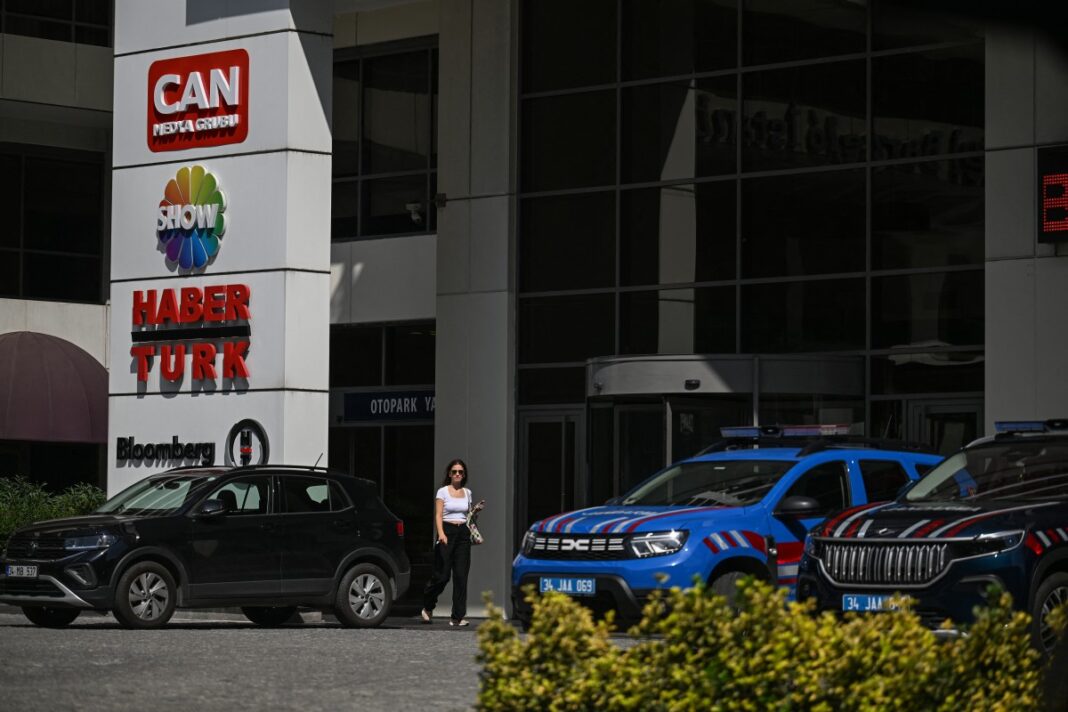

A Turkish court has ordered the house arrest of Kenan Tekdağ, chairman of Can Holding, while detaining five other company executives as part of a sweeping criminal investigation that led to the seizure of 121 companies of the conglomerate.
The probe targeting Can Holding, one of Turkey’s largest private conglomerates, is led by the Küçükçekmece Chief Public Prosecutor’s Office in İstanbul and centers on allegations of forming a criminal organization, tax evasion, fraud and money laundering.
On Sunday six suspects, including Tekdağ, were brought before a court after several days in detention.
A judge ruled to impose house arrest and a travel ban on Tekdağ.
The five other suspects were formally arrested and sent to prison pending trial.
The case led to the government’s September 11 seizure of 121 companies belonging to Can Holding, including broadcasters Habertürk TV, Show TV, Bloomberg HT and HT Spor, once part of Ciner Holding but acquired by Can Holding in 2024.
The government also seized İstanbul Bilgi University and the nationwide Doğa College network, which were part of the conglomerate’s extensive education portfolio.
The seized companies have been placed under the management of Turkey’s Savings Deposit Insurance Fund (TMSF), a state body that oversees confiscated assets.
Turkish gendarmerie vehicles were seen outside the Habertürk TV headquarters in İstanbul during the raids.
Prosecutors say their case against Can Holding dates back to 2022 and involves alleged financial crimes.
The state-run TMSF has pledged that media and education operations would continue without disruption under trusteeship.
The takeover of Can Holding is the latest in a series of high-profile corporate seizures in Turkey. Since a failed coup in 2016, authorities have put hundreds of businesses under state control, often citing links to alleged criminal networks or terrorism financing.
Critics, including human rights groups and opposition parties, have accused the government of using such measures to punish political opponents and silence dissenting media. In particular, companies linked to the faith-based Gülen movement have been targeted, with the TMSF taking control of schools, banks, media outlets and industrial groups once affiliated with the movement. The TMSF currently manages hundreds of companies seized in connection with criminal or terrorism investigations.
Turkish President Recep Tayyip Erdoğan has been targeting followers of the Gülen movement, inspired by the late Muslim cleric Fethullah Gülen, since corruption probes in 2013 implicated then-prime minister Erdoğan as well as some of his family members and inner circle.
Dismissing the investigations as a Gülenist coup and a conspiracy against his government, Erdoğan began to target the movement’s members. He designated the movement as a terrorist organization in May 2016 and intensified the crackdown on it following a failed coup on July 15 of the same year that he accused Gülen of masterminding. The movement strongly denies involvement in the coup attempt or any terrorist activity.
A 2023 report by the Institute for Diplomacy and Economy estimated that Turkey has seized around $50 billion in assets from more than 1.5 million people since 2016, warning that the scale of the confiscations may constitute “persecution” amounting to crimes against humanity under international law.
More recently, the government has also targeted opposition figures. In March a construction company tied to İstanbul Mayor Ekrem İmamoğlu, a leading figure in the main opposition Republican People’s Party (CHP) and the strongest rival to President Erdoğan, was seized following his detention.
Legal scholars and watchdog groups have warned that Turkey’s use of trusteeships and asset confiscations has eroded property rights and created a climate of uncertainty for investors. They argue that the measures have also been used to curb political dissent and bring influential media outlets and schools under tighter state control.
Founded by entrepreneur Zamanhan Can, Can Holding traces its roots to a trading company established in 1972. Can consolidated his businesses under Can Holding in 1986, later relocating its headquarters to İstanbul in 1990.
The conglomerate has since expanded into multiple industries including education, energy, consumer electronics, technology, logistics, health care and media.
The seizure places one of Turkey’s most diversified business groups under state management, as prosecutors advance a case that could reshape parts of the country’s media, education and energy sectors.