

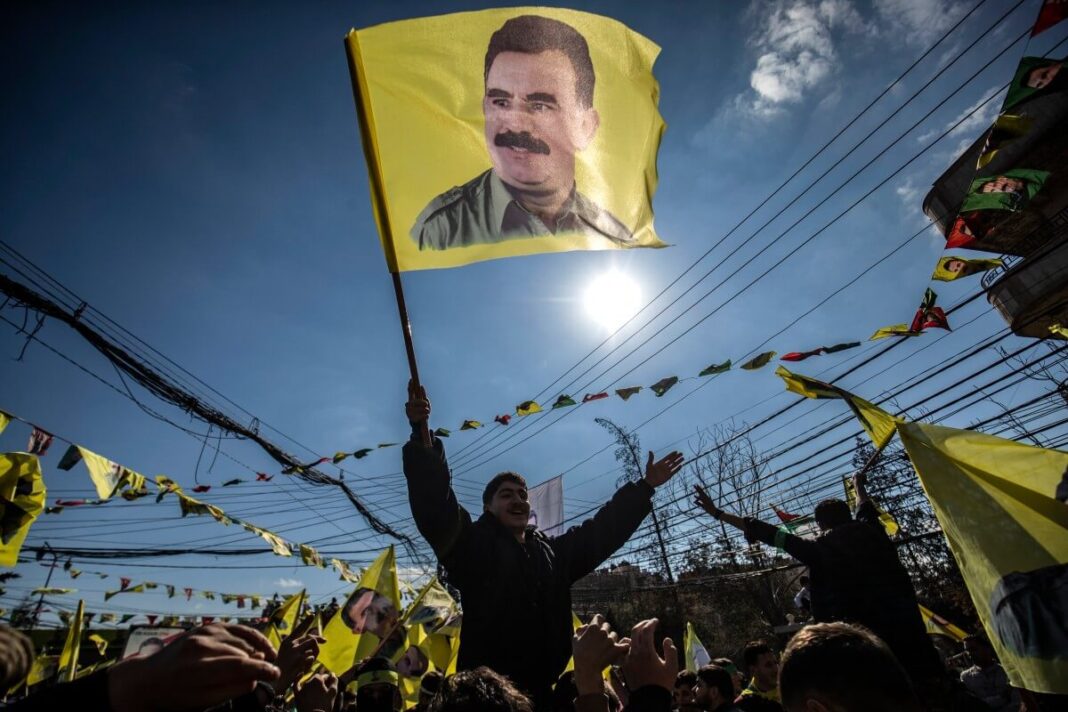

Abdullah Öcalan, the jailed leader of the Kurdistan Workers’ Party (PKK), told visitors that “Syria is my red line,” referring to the Kurdish-led administration in the country’s north-east, in the context of ongoing peace efforts with Ankara, a lawmaker from Turkey’s main pro-Kurdish party said.
Pro-Kurdish Peoples’ Equality and Democracy Party (DEM Party) lawmaker Pervin Buldan spoke on JIN TV on Wednesday and described recent prison conversations with the PKK leader on İmralı Island in the Sea of Marmara, conducted as part of Turkey’s peace efforts with the PKK.
Northeast Syria is run by Kurdish-led authorities who partnered with the United States against the Islamic State group. Turkey says the main militia there is linked to the PKK and opposes recognition or support for it.
Positions on that front affect trust and sequencing in any steps inside Turkey.
Buldan said Öcalan wants channels to open with Kurdish-led authorities in northeast Syria if the process advances and that most Syria-related exchanges occur with state officials rather than party delegates.
“The leader said more than once that Syria is his red line,” Buldan said, adding that contact with actors there would help shape steps if ground rules are agreed.
The debate over Syria has intensified in Turkey after Nationalist Movement Party (MHP) leader Devlet Bahçeli, an ally of President Recep Tayyip Erdoğan, warned on Tuesday that a cross-border operation would be “inevitable” if Kurdish-led forces in Syria fail to honor an agreement with Damascus. Bahçeli framed the issue as one of national security, saying Ankara could not tolerate armed groups holding territory across the border.
The remarks followed an article by Abdulkadir Selvi, a columnist in the pro-government Hürriyet daily, who said Erdoğan had effectively given a green light for a joint move by Damascus, Turkey and allied militias against the Kurdish-led Syrian Democratic Forces (SDF) if they did not disarm. Selvi claimed Ankara would back Syria’s new authorities and Arab tribal partners in such an operation.
The SDF is a coalition dominated by the Kurdish People’s Protection Units (YPG) but also includes Arab fighters. The United States partnered with the SDF in the war against the Islamic State group and still conducts raids in Syria with its help. Turkey, however, says the YPG is the Syrian branch of the PKK and rejects its continued autonomy in northern Syria.
Erdoğan’s comments and Selvi’s column came as Syria’s transition government seeks to fold rival armed groups into state structures. US officials have also pushed for SDF integration into national forces as Washington recalibrates its military presence. Skirmishes this summer between Damascus-linked fighters and SDF units highlighted the risk of escalation if talks collapse, adding weight to Öcalan’s remarks about Syria as a “red line.”
‘Parliament should speed up its work on peace’
The lawmaker also urged Turkey’s new parliamentary commission to speed up its work on a peace framework.
Buldan called for a small group from each party on parliament’s National Solidarity, Brotherhood and Democracy Commission to meet with Öcalan and report back, saying five or six members from each party would be sufficient.
Parliament formed the cross party commission on August 5 to propose legal and political steps toward ending the conflict.
Speaker of Parliament Numan Kurtulmuş has said the body aims to finish its work by December 31, with possible extensions in periods of two months.
The PKK began armed conflict against the Turkish state in 1984 and is listed as a terrorist organization by Turkey and its Western allies.
The group said in May 2025 it would end its insurgency and pursue politics and held a symbolic event to mark giving up arms in northern Iraq in July.
The DEM Party is the third largest group in parliament and backs a negotiated end to the conflict within a legal and constitutional framework.