

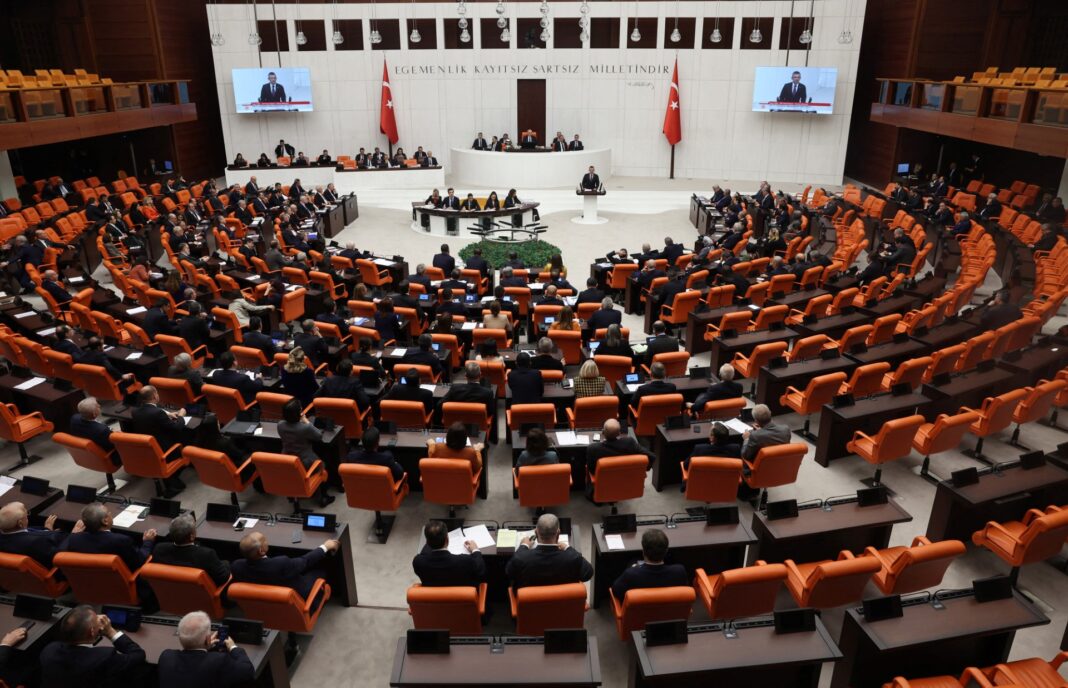
 held its second meeting on Friday, declaring all discussions “state secrets” to be withheld from the public for at least a decade.)
A parliamentary commission tasked with shaping Turkey’s approach to the potential disbanding of the outlawed Kurdistan Workers’ Party (PKK) held its second meeting behind closed doors on Friday, declaring all discussions “state secrets” to be withheld from the public for at least a decade.
The National Solidarity, Brotherhood and Democracy Commission, established by parliament to oversee political and legal steps toward a peaceful resolution of the decades-long Kurdish conflict, voted unanimously to make the session fully confidential. According to Turkish Parliament Speaker Numan Kurtulmuş, a complete transcript of the meeting will be kept but will not be released to commission members or the public until at least 2035, and only by a decision of the General Assembly.
“No part of what is said here will be disclosed outside,” Kurtulmuş announced before asking reporters to leave the room. Signal jammers were reportedly used inside parliament to prevent any unauthorized transmission from the meeting.
The commission’s work is linked to a broader process launched after jailed PKK leader Abdullah Öcalan’s February 27 call for the group to disband and lay down its arms. That call has triggered complex negotiations over how to demobilize fighters, reintegrate them into society and dismantle affiliated structures, including the Syrian Kurdish-led forces in northeast Syria, which Turkey views as an extension of the PKK.
Friday’s session included presentations from Interior Minister Ali Yerlikaya, Defense Minister Yaşar Güler and National Intelligence Organization (MİT) chief İbrahim Kalın. The three officials reportedly briefed the 51-member panel on security and intelligence matters tied to the PKK’s activities in Turkey and across the region.
While the first meeting on August 5 had allowed partial press coverage, the commission had already laid the legal groundwork to hold subsequent sessions behind closed doors. It remains unclear if or when the transcript from the initial session will be released.
The commission will play a key role in drafting possible legislation for demobilization, amnesty and repatriation, depending on fighters’ records. Such proposals would require the approval of at least three-fifths of the commission — 31 votes — which appears achievable under the current composition, with support from the ruling Justice and Development Party (AKP), the far-right Nationalist Movement Party (MHP) and potentially others.
A proposal by the pro-Kurdish Peoples’ Equality and Democracy Party (DEM Party) to fill three vacant seats left by the İYİ (Good) Party with one additional member each from the AKP, the CHP and the DEM Party was accepted. The commission now includes 22 AKP members, five from the DEM Party, four from the MHP and others from the CHP and smaller parties. The CHP’s Umut Akdoğan and DEM’s Celal Fırat were announced as the new members.
The confidentiality decision is expected to shield the highly sensitive discussions from political backlash and public scrutiny, as government officials seek to negotiate both the end of the PKK insurgency and the dismantling of Kurdish self-rule in Syria without inflaming nationalist sentiment at home.
The commission is expected to continue meeting in the coming weeks to evaluate legal frameworks and determine the scope of potential legislative changes.