

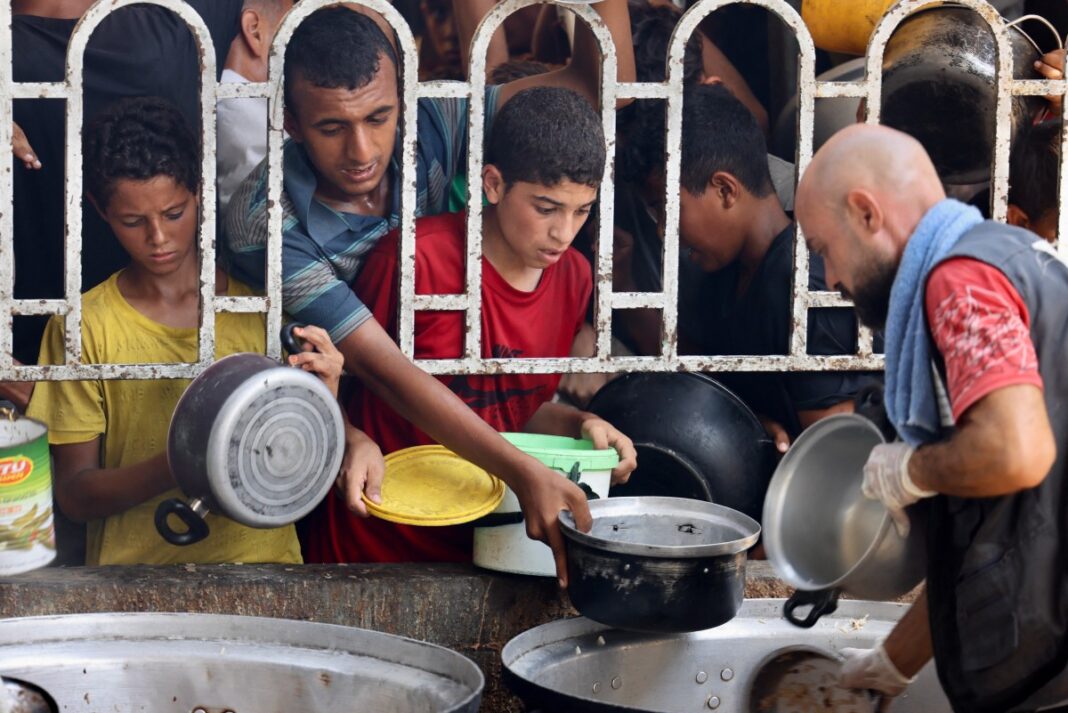

Israel is facing mounting backlash from press freedom advocates, academics and international observers after targeting a Palestinian photojournalist working for Turkey’s Anadolu news agency while continuing to bar international reporters from independently entering the Gaza Strip.
Beware of fake news.
A joint investigation by @SZ and @BILD reveals how Hamas uses “Pallywood”, staged or selectively framed media, to manipulate global opinion.At the center is Anas Zayed Fteiha, a Palestinian photographer for Anadolu and an open Israel- and Jew-hater, whose… pic.twitter.com/MrBfvylwCi
— Israel Foreign Ministry (@IsraelMFA) August 5, 2025
The Israeli Foreign Ministry on Monday amplified claims published by German media outlets Süddeutsche Zeitung and Bild, accusing Gaza-based photographer Anas Zayed Fteiha of producing “staged” or “selectively framed” images designed to manipulate international opinion. The ministry labeled Fteiha a propagandist for Hamas and described his widely circulated photos — many of which depict women, children and the humanitarian toll of Israel’s ongoing assault on Gaza — as part of a broader disinformation campaign.
Fteiha has not responded publicly, but colleagues, media analysts and academics have denounced the accusations as baseless and dangerous. Critics say the campaign is an attempt by Israeli authorities to discredit photojournalists documenting the humanitarian catastrophe in Gaza, where over 61,000 Palestinians have been killed and nearly 200 have died of starvation, according to the Gaza Health Ministry.
The controversy is especially charged due to Fteiha’s work for the Anadolu news agency, Turkey’s state-run media outlet. The Israeli Foreign Ministry and German media outlets have attempted to frame his affiliation as part of a larger geopolitical narrative, pointing to Turkish President Recep Tayyip Erdoğan’s vocal criticism of Israel’s Gaza campaign and long-standing support for the Palestinian cause.
A Bild article went further, highlighting old social media posts in which Fteiha allegedly expressed pro-Palestinian and anti-Israel views, including one image showing him in a vest marked “PRESS” beneath a “Free Palestine” mural, and another with an expletive directed at Israel. The tabloid used these posts to question the neutrality of his journalism and the credibility of the images published under his name.
However, observers note that no verifiable evidence has been presented to prove that the photos attributed to Fteiha were falsified, staged or misrepresented.
I read the Bild story and there is no proof whatsoever that Anadolu journalist misrepresents the situation in Gaza.
Another shameful unsubstantiated charade by Bild, which is totally an Israeli propaganda tool, they themselves say so https://t.co/xtrBaRjz70
— Ragıp Soylu (@ragipsoylu) August 6, 2025
Ragıp Soylu, the Ankara bureau chief of Middle East Eye, called the Bild story a “shameful unsubstantiated charade,” noting that neither Bild nor the Israeli Foreign Ministry demonstrated any actual manipulation of content.
‘Pallywood’ narrative resurfaces
The episode is part of a broader strategy by Israel to revive the “Pallywood” narrative — an old trope that suggests Palestinians routinely stage suffering for the camera. Media scholars and analysts have long criticized this term as an effort to delegitimize evidence of civilian suffering under Israeli occupation, particularly during large-scale military operations like the current one in Gaza.
The "Pallywood" narrative has been a macabre means by Israel's hasbara to deny Palestinian suffering and victimhood
Instead of owning Israel's responsibility for the famine in Gaza, MoFA relies on an oxymoronic "BILD investigation" (Bibi's) favoured info ops outlet to attack… https://t.co/SyBAkwUrpq
— Dr Andreas Krieg (@andreas_krieg) August 6, 2025
Dr. Andreas Krieg, a security analyst and professor at King’s College London, said Israel is using the “Pallywood” accusation to deflect responsibility for famine conditions and mass displacement. “The narrative has been a macabre means by Israel’s hasbara to deny Palestinian suffering and victimhood,” Krieg wrote on X. “Instead of owning responsibility for famine in Gaza, the Israeli Foreign Ministry attacks one single journalist.”
Announcement from the facts department: Israel is blocking the international press from entering Gaza which makes it much harder to independently cover what is going on there https://t.co/sGQO5LzN0b
— Barak Ravid (@BarakRavid) August 6, 2025
Meanwhile, Israel has refused to grant independent access to Gaza for international reporters, including during two ceasefire periods. CNN analyst Barak Ravid noted that the restrictions make it “much harder to independently cover what is going on,” while other critics have pointed out that Israel’s ban undermines its own narrative by relying on unverifiable official statements while discrediting local documentation.
Press freedom advocates warn that Israel’s attacks on Fteiha risk further endangering journalists in Gaza, where over 180 media workers have been killed since October 2023, according to the Committee to Protect Journalists. By portraying Palestinian photojournalists as propagandists or enemy actors, Israel may be fueling justification for military targeting.
The Süddeutsche Zeitung article that initiated the controversy noted that some images used by aid groups and media were lacking context — for example, showing children with visible signs of chronic illness unrelated to malnutrition. In one case, a child photographed in Italy for medical treatment was incorrectly claimed to be in Gaza.
However, the paper acknowledged that such instances do not invalidate the overall situation and included expert voices urging more nuanced reading, not outright dismissal, of Gaza images.
Despite those caveats, Israel’s official narrative has fixated on the “manipulation” claim — without addressing the fact that international agencies continue to report severe famine conditions and mass starvation deaths, which both the imagery and the data confirm.
Israel lied about: flour and ambulance massacres, beheaded babies, World Central Kitchen workers, starving civilians, and arming ISIS to loot aid.
ALLOW international journalists into Gaza without IDF censorship!
Israel’s gov wouldn’t allow us in during the 2 ceasefire periods! https://t.co/SARehK6LtR— Rula Jebreal (@rulajebreal) August 6, 2025
The backlash to Israel’s stance has been swift and global, with critics pointing out the contradiction: If Israel believes the reporting is unfair, why not allow international journalists in under open terms, without IDF escorts or pre-approved messaging?
The situation in Gaza continues to deteriorate rapidly, with at least 135 Palestinians killed in the past 24 hours, including 87 aid seekers shot near distribution points. Five more people have died of starvation, raising the hunger-related death toll to 193. Hospitals report severe shortages of blood, anesthesia and medical supplies, while only 84 aid trucks entered the enclave on Tuesday — far below the 600-truck daily minimum needed to prevent famine. Human rights experts warn of systematic targeting of humanitarian infrastructure, and calls are mounting for an immediate end to Israel’s engineered starvation campaign.