

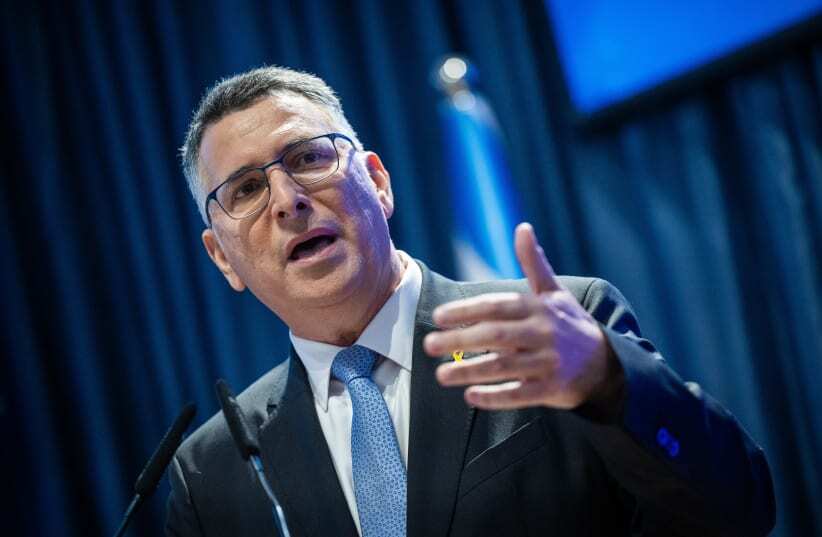

Israeli Foreign Minister Gideon Sa’ar said Thursday he would ask the government to recognize the 1915 killings of Armenians under Ottoman rule as genocide, a move likely to anger Turkey as Israeli rhetoric increasingly portrays Ankara as a strategic threat.
Sa’ar announced on X that he would bring a draft resolution to the next Israeli government meeting.
If approved by the government, the resolution would be sent to the Knesset, Israel’s parliament, for a vote.
Sa’ar called recognition a “moral and historical obligation” and said denial, minimization or distortion of historical truth should be condemned.
The proposal would mark a shift in Israeli state policy.
Israel has debated recognition for years but avoided formal action, partly to protect relations with Turkey and Azerbaijan, two countries that reject the genocide label.
The 1915 killings remain one of the most sensitive issues in Turkish foreign policy.
Armenians, many historians and more than 30 countries say the deaths of Armenians during World War I amounted to genocide.
Turkey, the successor state to the Ottoman Empire, accepts that Armenians died during the war but rejects the genocide designation, arguing that the deaths occurred during wartime collapse, disease, famine, forced displacement and intercommunal violence rather than a state policy of extermination.
The issue carries legal and political weight for Ankara, which often condemns foreign governments and parliaments that use the term genocide.
Sa’ar’s move comes at a moment when relations between Turkey and Israel are under strain over a host of issues.
Israel’s military campaign in Gaza remains part of the public confrontation. President Recep Tayyip Erdoğan has accused Israel of genocide and compared Prime Minister Benjamin Netanyahu’s government to Nazi Germany.
But Turkey’s declared break with Israel has been met with skepticism due to trade data and investigations showing continued Turkish-linked commercial and energy flows to Israel despite Ankara’s May 2024 announcement that it had halted trade.
That contradiction has strengthened the view that the current rupture is not driven by Gaza.
The larger picture includes Iran war, the regional order after the fall of Syrian president Bashar al-Assad, Lebanon, Jerusalem, Cyprus and the eastern Mediterranean.
US President Donald Trump said this week that Erdoğan had stayed out of the Iran war after he asked him to do so.
“He was a prime candidate to go into the war with Iran, maybe on the Iran side, because he’s not a big fan of Israel,” Trump told reporters at the White House.
Trump’s remark reflected a wider Israeli and US discussion about Turkey’s place in the region after Israel and the United States weakened Iran’s position.
That debate has grown sharper in Israeli media and security circles.
In April The Jerusalem Post published an analysis under the headline “Turkey is the new Iran,” citing Israeli security analyst Yoni Ben Menachem, who argued that Erdoğan was trying to build a Sunni bloc that could replace Iran’s weakened regional role.
In June Israel Hayom warned that Israel’s security establishment was watching Turkey with growing concern and described Turkey as a “turning-point state,” meaning a country that is not formally an enemy but could move in that direction.
The same analysis argued that a Sunni axis led by Turkey and Qatar could become a major challenge for Israel even if Iran remained weakened.
The rhetoric has also moved from analysis into direct political attacks.
Israeli Prime Minister Benjamin Netanyahu called Erdoğan an “antisemitic dictator” this month after the Turkish president said Israeli strikes in Syria and Lebanon had reached a point where they threatened Turkey.
Netanyahu accused Erdoğan of supporting Hamas, jailing political opponents and carrying out genocide against Kurds.
Defense Minister Israel Katz has also used increasingly personal language, calling Erdoğan a “paper tiger” in April and later rejecting Turkish Interior Minister Mustafa Çiftçi’s remarks about envisioning himself as the future governor of Jerusalem by saying, “Jerusalem is not Constantinople.”
Syria also remains one arena of the rivalry.
Turkey has become one of the main outside powers in post-Assad Syria, while Israel has expanded military operations there and opposes any military infrastructure that could limit its freedom of action.
Israel is recalibrating its threat map after the Iran war and as Turkey seeks a larger role in a region where Iran’s influence has been damaged but not erased.
In that context, recognition of the 1915 killings as genocide gives Israel a way to strike at one of Turkey’s most sensitive historical disputes while presenting the step as a moral act.
The move also opens Israel to charges of selective morality.
Israel is seeking to recognize the killings of Armenians more than a century ago as genocide while it rejects genocide accusations over its own conduct in Gaza, including the case brought by South Africa at the International Court of Justice.
Sa’ar’s proposal follows a personal statement by Netanyahu in August 2025 in which he said he recognized the Armenian genocide.
That statement did not amount to official recognition by Israel.
A government resolution and Knesset vote would go further, turning recognition into formal state policy.