

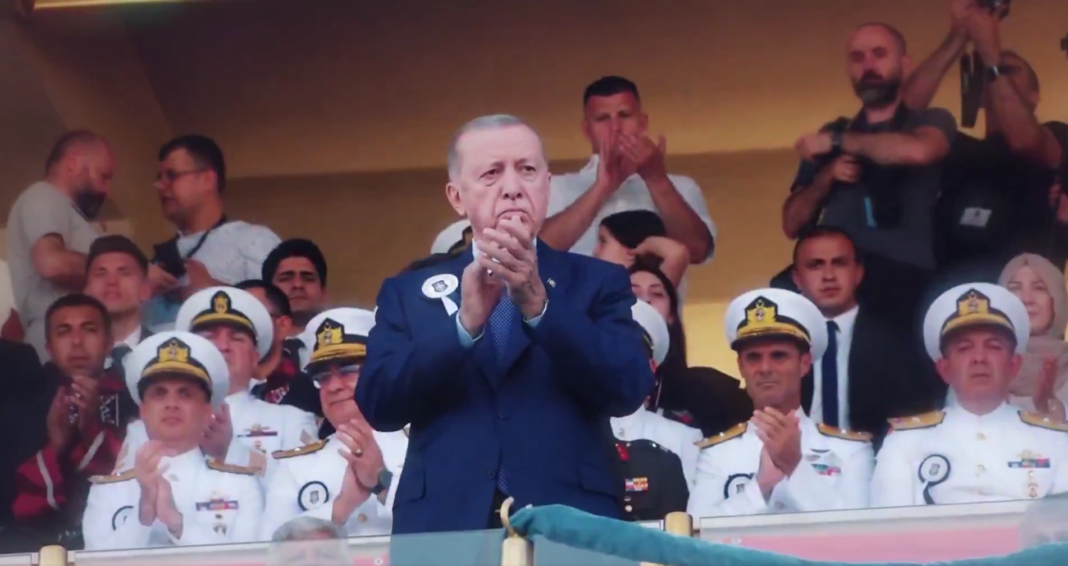
 video that mixed football highlights with images of President Recep Tayyip Erdoğan, military ceremonies and Turkish weapons systems.)
Turkey’s return to the World Cup after 24 years, a rare national sporting moment in a polarized country, has already become a political battleground after the national team’s official account shared a ruling Justice and Development Party (AKP) video that mixed football highlights with images of President Recep Tayyip Erdoğan, military ceremonies and Turkish weapons systems.
The video was produced by the AKP’s publicity and media department on Erdoğan’s instructions ahead of Turkey’s first match at the 2026 World Cup.
It cuts between national team players and supporters, repeated images of Erdoğan and footage of drones, fighter jets, missiles, warships, the domestically produced Togg electric car and military displays.
A Millî Takımımız için, Cumhurbaşkanımız Sayın Recep Tayyip Erdoğan’ın talimatları doğrultusunda, AK Parti Tanıtım ve Medya Başkanlığı tarafından hazırlanan “Siz Hepiniz Biz Türkiye” marşı sizlerle.
Millî Takımımızın Dünya Kupası yolculuğunda birliğimizi, beraberliğimizi ve… pic.twitter.com/NX9AFmOyP1
— Türkiye #BizimÇocuklar 🇹🇷 (@MilliTakimlar) June 11, 2026
Turkey’s national teams account shared the video Thursday and thanked Erdoğan and the AKP for what it called a message of unity built around the national team.
The decision prompted criticism from opposition politicians, journalists and social media users who said a team representing the entire country had allowed its official platform to be used for party propaganda.
“Is this the World Cup, or are we going to war?” Burhanettin Bulut, a lawmaker and deputy chairman of the main opposition Republican People’s Party (CHP), said on X.
“Our national team is not a vehicle for political propaganda but the shared joy and common value of 86 million people,” he said.
CHP lawmaker Seyit Torun said the national team’s official account was not an AKP publicity bulletin.
“The crescent and star jersey belongs to the nation, not to politics,” Torun said.
Turhan Çömez, parliamentary group deputy chair of the nationalist opposition İYİ (Good) Party, mocked the video’s use of armed drones, fighter jets and defense products.
Çömez said the video appeared designed to frighten Turkey’s opponents and accused the government of exploiting the national team for political purposes.
The controversy unfolded as Turkey prepared to make only its third appearance at the World Cup.
Turkey qualified for the 1950 World Cup but withdrew before making its tournament debut in 1954. Its second appearance came in 2002, when the team reached the semifinals and finished third after defeating co-host South Korea.
The 2026 tournament is therefore the first World Cup appearance for a generation of Turkish supporters who were children or had not been born when the team last competed.
It also carries political symbolism.
Turkey’s 2002 World Cup run took place months before the AKP first came to power in the November 2002 general election. Erdoğan’s party has governed the country ever since, turning the current tournament into Turkey’s first World Cup appearance under more than two decades of AKP rule.
The party’s video presents qualification not only as a sporting success but also as part of an Erdoğan-era account of a stronger Turkey built around military power, infrastructure and domestic technology.
The title and lyrics draw a division between “you” and “us,” while the images link the national team to the government’s defense industry message and its claim that Turkey has become more independent and powerful under Erdoğan.
Turkey’s defense industry has become one of the government’s main sources of political branding.
Erdoğan regularly appears at ceremonies featuring drones, warships, missiles and fighter aircraft, presenting them as evidence of national independence and a challenge to Western restrictions on Turkey.
Researchers have described this message as techno-nationalism, political language that combines technology, military strength and national pride. The approach allows the government to appeal beyond its religious conservative base, including to younger and more secular voters attracted to defense technology and an assertive image of Turkey.
The World Cup video applies the same formula to football.
Instead of presenting the national team as a shared institution separate from party competition, it places Erdoğan and AKP-promoted projects within the story of Turkey’s qualification.
The Turkish Football Federation reinforced that connection by publishing the party’s production on the official national team account and its website.
The federation’s post said the video had been prepared on Erdoğan’s instructions and thanked the president and the AKP’s publicity department for their contribution.
The federation is formally responsible for governing Turkish football, but its independence from political power has faced questions for years.
Its president, İbrahim Hacıosmanoğlu, said after his election in 2024 that being Erdoğan’s friend was an honor and thanked the president. He has also praised state investment in football stadiums.
Football clubs in Turkey depend on the state in areas including stadium construction, sponsorships, tax arrangements and revenue connected to state-regulated betting. Researchers say those relationships have helped political authorities gain influence over club officials and football institutions.
AKP publicity and media chief Faruk Acar said the party’s video and the accompanying song had not been declared the official World Cup anthem and that the federation had shared it as a courtesy.
Acar accused critics of being disturbed by images of a “great and powerful Turkey.”
The Turkish national team is led by Italian coach Vincenzo Montella and includes players such as Real Madrid midfielder Arda Güler, Juventus forward Kenan Yıldız and captain Hakan Çalhanoğlu.
Turkey will compete in Group D with Australia, Paraguay and co-host the United States.
Montella has urged his players not to carry the burden of Turkey’s 24-year absence and has sought to lower the expectations of a young squad.
The political campaign surrounding the team has moved in the opposite direction, putting its World Cup appearance within a wider story about Erdoğan, military power and the government’s vision of the country.