

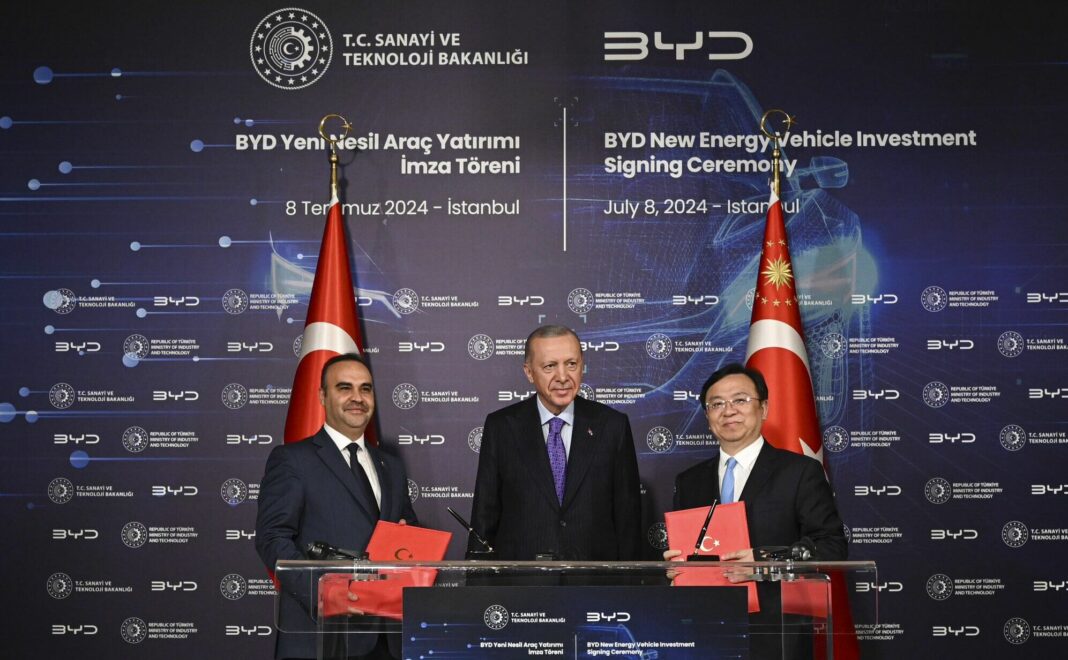

Turkey has suspended import tax exemptions for Chinese electric vehicle maker BYD over delays in a planned $1 billion factory investment and warned the company it may have to repay incentives if it fails to carry out the project, Nikkei Asia reported on Thursday, citing an official from Turkey’s Industry and Technology Ministry.
“As there has been no progress for some time, we suspended since the beginning of 2026 the incentives the company had been using,” the unnamed official told Nikkei Asia.
“The investment agreement with the company, its conditions, obligations and guarantees are still valid,” the official said. “If the investment is not completed, companies are obliged to pay back the incentives, based on the legal arrangements and commitments they have made.”
BYD declined to comment to Nikkei Asia on its operations in Turkey.
The report comes nearly two years after BYD and the ministry signed an agreement in July 2024 for the company to build a research and development center and a factory in Manisa, a province in western Turkey.
The planned plant was expected to produce 150,000 electric and plug-in hybrid vehicles a year, become operational by the end of 2026 and employ 5,000 people.
The investment would have made BYD the first new foreign automotive brand to commit to production in Turkey since 1997, according to the report.
Turkey had granted BYD import tax exemptions and exempted its distributor from a requirement imposed on other automakers to operate 20 maintenance and repair service points across the country.
The incentives were offered as Turkey sought to attract Chinese electric vehicle investment and position itself as a production base for sales to Europe.
Turkey is not a member of the European Union but has a customs union with the bloc, allowing many industrial goods made in Turkey to enter the EU market without customs duties.
Construction has not yet begun on the Manisa factory, raising concern in Ankara and prompting questions from opposition lawmakers.
BYD Executive Vice President Stella Li told Reuters on Tuesday that the company’s first priority was its plant in Hungary, where production is expected to begin in the final quarter of this year.
She said BYD’s second priority would be finding another production facility in Europe and added that the Turkey project was on hold, without giving a timeline.
Nikkei Asia said BYD’s sales in Turkey appear to have fallen after the suspension of tax exemptions.
The company sold 152 cars in Turkey in May, down from 3,866 in January, the report said.
BYD sold 45,537 vehicles in Turkey last year, more than five times its 2024 sales volume.
Erol Şahin, general manager of automotive consultancy EBS, told Nikkei Asia that Turkey’s appeal had weakened due to uncertainty over whether it would be included in the EU’s “Made in Europe” initiative, formally known as the Industrial Accelerator Act.
Şahin said Chinese automakers were putting more focus on production inside the EU, including by taking over idle factory capacity.
He said incentives should be tied to progress rather than granted before investment begins.
Şahin estimated that tariff-free imports would have cost Turkey close to $1 billion in lost tax revenue if the investment fails and BYD does not repay the incentives.
Turkey has also had talks with Chinese automaker Chery over a potential production facility, but two officials with direct knowledge of the discussions told Nikkei Asia there had been no progress there, either.