


A leaked Turkish government document obtained by Nordic Monitor shows that Turkish intelligence operatives conducted surveillance in France to collect information on critics of President Recep Tayyip Erdoğan’s government, the investigative outlet reported Thursday.
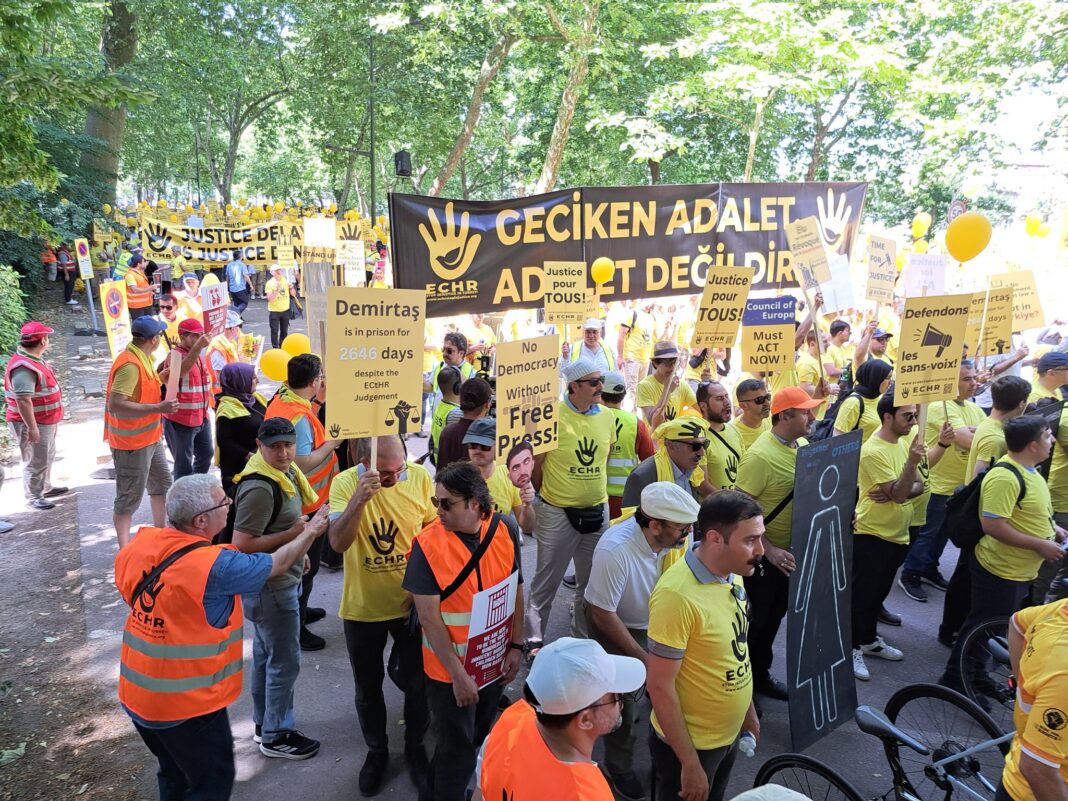
The document, prepared by two officials identified only by their badge numbers, says Turkish operatives monitored a peaceful demonstration in Strasbourg, near the German border, where Turkish dissidents gathered to protest human rights violations in Turkey.
The event reportedly drew some 5,000 participants, including European politicians, members of the Parliamentary Assembly of the Council of Europe (PACE), academics, activists and public figures.
Although the document does not explicitly identify the intelligence agency involved, it says the information was transmitted to police authorities by an “affiliated institution,” a term Turkish authorities often use to conceal the origin of intelligence reports.
Nordic Monitor said the phrase typically refers to the Turkish National Intelligence Organization (MİT) or other intelligence units operating under the Foreign Ministry or the Security Directorate General.
Such wording is often used to obscure the source of intelligence and reduce the risk of diplomatic fallout if covert operations abroad become public.
The document reviewed by Nordic Monitor shows the same pattern. Although it portrays the information as having been compiled from publicly available sources, the details in the report indicate that Turkish operatives conducted surveillance on the ground during the Strasbourg demonstration.
The inclusion of open-source references appears designed to conceal the extent of the intelligence-gathering operation and mask the involvement of Turkish agents who monitored participants and collected personal information at the event, according to Nordic Monitor.
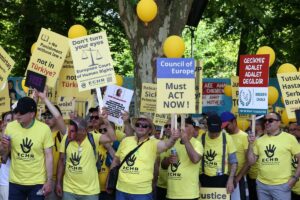
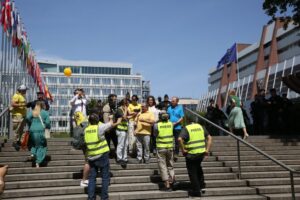
According to the document, the intelligence report was transmitted to the Ankara Police Department on July 22, 2025. Turkish operatives reportedly monitored the demonstration held near Council of Europe (CoE) headquarters and compiled notes on the event and its participants.
Individuals identified at the gathering were flagged and their names circulated among Turkish government institutions, including prosecutors’ offices. In similar cases, such information has been used to initiate criminal investigations into critics of the government on terrorism-related accusations, despite their participation in lawful and peaceful activities abroad.
The document specifically references one individual who was singled out for further scrutiny. Additional background research was reportedly conducted on the person and later submitted to a court in Ankara by police chief Engin Aydın on May 18, 2026, as supplementary evidence in an ongoing case.
The individual, who currently resides in Germany and has been granted political asylum, had previously been tried in absentia by the same court.
The Strasbourg demonstration was organized by the Peaceful Actions Platform, a coalition of nongovernmental organizations operating across Europe. Participants called on the Turkish government to comply with binding rulings of the European Court of Human Rights (ECtHR), which has repeatedly found Turkey in violation of the European Convention on Human Rights.
The coalition has organized annual demonstrations in Strasbourg since 2022 to draw attention to what it describes as systematic human rights violations in Turkey and Ankara’s refusal to execute ECtHR rulings.
The June 25, 2025 protest, held under the slogan “Justice for Everyone,” drew participants from Germany, Belgium, the Netherlands, France, the United Kingdom and other European countries.
Demonstrators marched toward the Council of Europe headquarters carrying banners and portraits of jailed politicians, academics and civil servants while chanting, “Justice delayed is justice denied.”
Participants urged the Council of Europe to hold Turkey accountable for its failure to implement landmark ECtHR judgments, including those concerning philanthropist Osman Kavala, Kurdish politician Selahattin Demirtaş and former teacher Yüksel Yalçınkaya.

The group also delivered letters to Council of Europe Secretary General Alain Berset, Commissioner for Human Rights Michael O’Flaherty and ECtHR President Mattias Guyomar, urging stronger action regarding Turkey’s human rights record.
The rally received support from several PACE members, some of whom addressed the crowd. Speakers included Laura Castel of Spain, Vinzenz Glaser of Germany, Benjamin Dalle and Christophe Lacroix of Belgium and Emmanuel Fernandes and Sandra Regol of France.
At the center of the Yalçınkaya case is Turkey’s crackdown on the Gülen movement, a faith-based civic initiative inspired by the late Muslim cleric Fethullah Gülen. For decades the movement operated schools, charities and educational institutions in Turkey and abroad.
The Turkish government began targeting followers of the movement after corruption investigations in 2013 implicated senior government officials and members of Erdoğan’s inner circle. Erdoğan accused the movement of orchestrating the probes, a claim denied by the movement, and subsequently launched a campaign against its members and perceived supporters.
The crackdown intensified after a failed coup in Turkey in July 2016. Erdoğan accuses Gülen and the movement of masterminding the coup attempt, allegations the movement denies.
In the aftermath, hundreds of thousands of people were investigated on terrorism-related or coup-linked accusations over alleged ties to the Gülen movement. Tens of thousands have been imprisoned, while many others have been dismissed from public-sector jobs, had their assets seized or were forced into exile.
Despite the ECtHR’s landmark 2023 judgment in the Yalçınkaya case, which found serious violations of fundamental rights, Turkish courts have continued to issue rulings based on similar legal reasoning. In 2024 a Turkish court reimposed Yalçınkaya’s sentence despite the Strasbourg judgment.
In May the Grand Chamber of the ECtHR issued another ruling in Yasak v. Turkey, finding that Turkey violated the principle of “no punishment without law” as well as the prohibition of inhuman or degrading treatment.
The case concerned Şaban Yasak, who was convicted of membership in a terrorist organization over alleged links to the Gülen movement and was held for years in overcrowded prison conditions.
The ruling is expected to affect hundreds of similar applications pending before the Strasbourg court.
The Strasbourg surveillance operation fits a broader pattern of intelligence-gathering activities conducted by Turkish authorities across Europe in recent years. Court documents, parliamentary inquiries and criminal investigations in several European countries have revealed how Turkish diplomatic missions, intelligence officers and government-linked informants have collected information on journalists, political dissidents, Kurdish activists, members of the Gülen movement and other critics of Erdoğan.
German authorities have repeatedly warned about Turkish espionage activities targeting dissidents living in Germany, which hosts the largest Turkish diaspora community in Europe. Similar concerns have been raised in Austria, Belgium, the Netherlands, Sweden and Switzerland.
French authorities have also monitored the activities of Turkish nationalist and Islamist groups operating on French soil, particularly after diplomatic disputes between Paris and Ankara in recent years.
The latest document suggests that Turkish intelligence services continue to view political exiles and human rights activists in Europe as targets, even when their activities consist solely of peaceful demonstrations protected under European law.
The intelligence collected abroad often finds its way into criminal case files in Turkey, where prosecutors use information gathered by intelligence agencies to open investigations or support ongoing prosecutions.
Human rights advocates say such practices amount to transnational repression and represent an attempt by Erdoğan’s government to extend its crackdown beyond Turkey’s borders.