

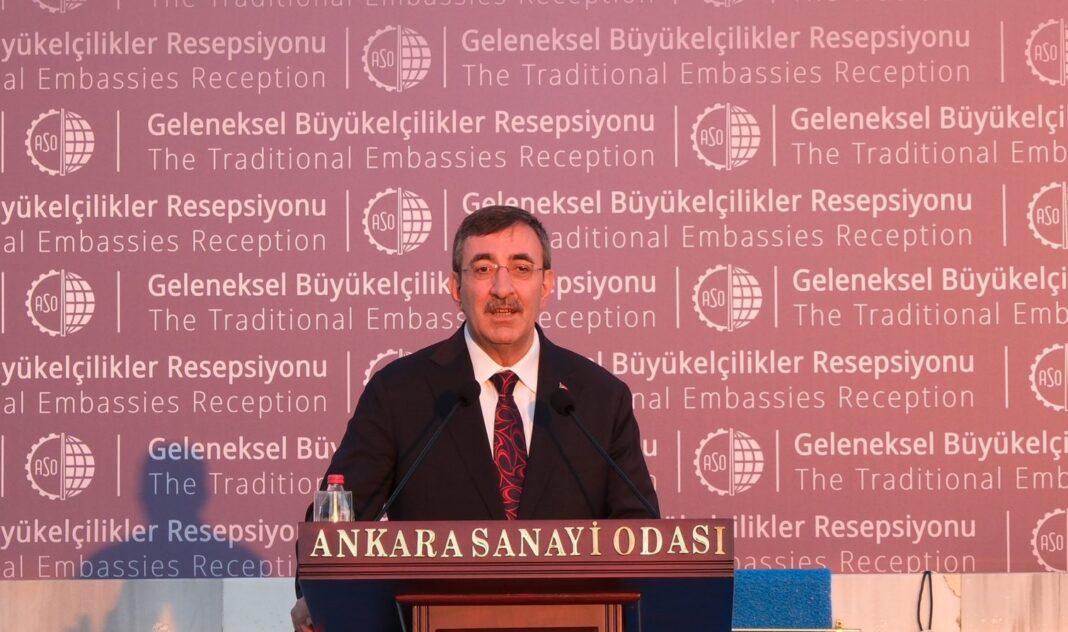

Ankara’s industrialists voiced frustration over persistent visa barriers with the European Union at an annual reception bringing together diplomats and business leaders, saying the restrictions are stifling exports, investment and international cooperation.
At the Ankara Chamber of Industry’s (ASO) 14th Ambassadors’ Reception, held on Wednesday with the participation of Turkish Vice President Cevdet Yılmaz, ASO President Seyit Ardıç singled out the problem in stark terms.
“Even to pick up a machine we purchased from your countries, we are not granted visas,” Ardıç told the EU ambassadors, asking for their support on the matter.
Ardıç said businesspeople routinely face “long and exhausting visa procedures” when seeking to attend international fairs, sign new partnerships or finalize investments. “While goods move freely, the fact that the industrialists who produce them are blocked is a serious contradiction,” he added.
The complaints come despite new EU rules introduced in July that ease Schengen visa procedures for Turkish nationals with a record of lawful travel. Under the framework, applicants can gradually obtain longer-term multiple-entry visas — starting with six months and extending to one, three and eventually five years — depending on their history of legal use.
The regulation stems from the European Commission’s June 26, 2024, annex to the Visa Code Handbook, which introduces the so-called “Cascade Rule.” EU officials say the move aims to reward bona fide travelers while reducing the workload of consulates facing a surge in applications. Still, the system does not apply to all categories, excluding groups such as truck drivers, and remains dependent on case-by-case evaluation.
EU Ambassador to Turkey Thomas Hans Ossowski said in July that while the reform would “facilitate travel for Turkish citizens,” it does not resolve long-standing challenges. “Every other candidate country has visa-free travel except Turkey. It is urgent to re-engage in this process of visa-free travel in the Schengen space and the EU,” he said.
Turkey and the EU have been engaged in a Visa Liberalisation Dialogue since December 2013, which outlines 72 benchmarks that Turkey must fulfill in order to qualify for visa-free travel within the Schengen area. According to official EU progress reports, the six remaining benchmarks primarily focus on politically sensitive areas, including ensuring effective cooperation with Europol, revising Turkey’s broad counterterrorism legislation in line with European standards, strengthening personal data protection, adopting measures against corruption, establishing judicial cooperation with all EU member states and aligning certain judicial practices with EU human rights norms.
Visa demand still high despite frustrations
Despite the new reforms, frustration over the Schengen process remains widespread in Turkey, fueled by long delays and rising rejection rates in recent years.
In 2024 Turkey ranked second among all Schengen visa applicant countries, with more than 1.17 million applications, according to EU statistics. More than 1 million were approved, while the refusal rate dropped to 14.5 percent, down from 16.1 percent in 2023.
Foreign Minister Hakan Fidan has criticized the current system for restricting mobility and harming EU–Turkey relations. Ankara continues to push for the full revival of the visa liberalization process as part of broader efforts to improve ties with Brussels.